
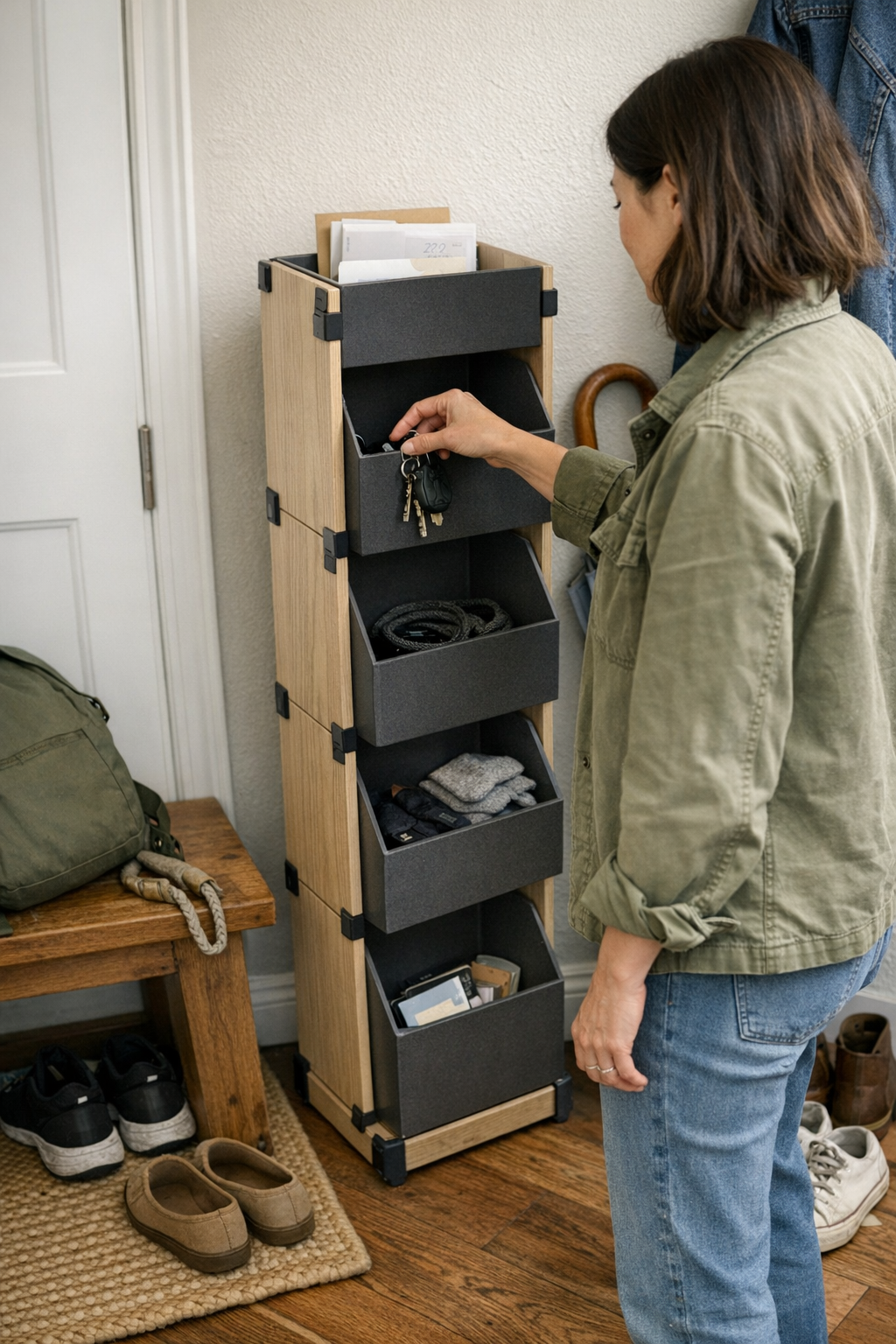
The moment you finish clearing the entryway, real life ambushes the system you worked so hard to set up. It takes just one rushed Monday morning for shoes to migrate out of their neat line, for tote bags and backpacks to reclaim the bench, and for the “catch-all” bin by the door to swallow stray keys, gloves, and mail. What starts as a hopeful setup unravels in real use: the rows widen, the piles build, and a misplaced leash or solo glove triggers the same last-minute search—again. With each unplanned drop or hasty return, the entry loses its order and returns to its default setting: high-traffic clutter, blocked passage, and slow, distracted exits.
When Day-to-Day Use Overwhelms the Setup
Open bins and trays seem practical in theory—just drop and go. But in repeated, rushed routines, those wide-open containers turn into collection points for clutter and temporary “just for now” placements. Monday’s backpack lands on top of Sunday’s shoes; Tuesday adds lunchboxes; by midweek, the bin hasn’t just filled—it’s collapsed as a usable system. Now, every trip through the threshold means digging through mixed layers: gloves hidden under yesterday’s mail, keys stranded beneath a soccer cleat, and a leash that’s migrated out of sight just when it’s needed most.
The Real Cost of a Collapsing Drop-Zone
No one schedules time to retrieve lost things in the entryway, but daily friction adds up. The penalty isn’t just visual mess—it’s a routine slowdown, especially in moments under pressure. You’re sent scrambling for a glove at the last second, shuffling bags off the bench to make space, or squeezing around stray shoes that have drifted into the traffic lane. What was meant to simplify departures instead creates resistance points that waste time and attention exactly when you’re heading out the door.
Why Open Storage Breaks Down in Real Entryways
In nearly every home, the entry is a squeeze point—part path, part drop zone, always at risk of overflow. Benches that promise a place to sit become landing strips for gear that never fully leaves. Floor bins seem smart on move-in day, but once daily use begins, they’re quickly buried by the very things they’re supposed to organize. The travel path tightens as shoe rows spill out and bags settle wherever there’s space. Returning one extra item can block a small hallway, and a “temporary” dump next to the bin sticks around all week. Even wall racks that look great during a reset can’t stop bags or coats from drifting back to benches or the floor once actual routines reassert themselves.
Temporary Fixes, Permanent Interruptions
The cycle is familiar: an overflow bag perches “just for now” on the edge of the bench, a couple of shoes wait by the door for tomorrow’s use, and suddenly, these stand-ins become permanent obstacles. Each pass-through adds one more item left slightly out of place, until navigating the space means bumping, stepping sideways, or moving things just to walk through. Resetting the zone gets postponed—until the buildup forces a messy, inconvenient reshuffle right before guests arrive or someone needs to rush out the door. Would-be “easy access” devolves into semi-permanent blockages and extra work every single day.
Structure: The Quiet Fix for Repeated Friction
Open options collapse under the pressure of daily routines, but structured solutions reintroduce control. Adding real structure—through modular cubbies, vertical racks, or labeled slots—turns a dumping ground into a working system. Every key category gets a physical boundary: keys go in a slot, not a heap; gloves fit the top compartment; shoes are corralled in defined rows instead of pooling by the door. The magic isn’t the formality—it’s the way each belonging gains a reliable address, cutting out the constant hunt, the pile reshuffles, and the stalled movements these all trigger in a cluttered entryway.
Turning Dump Zones into Designated Zones
- On re-entry, you drop your keys straight into a labeled slot, not a slushy communal bin.
- Gloves slip into their top cubby, bypassing the cycle of being crushed beneath backpacks or groceries.
- Shoes aren’t scattered in a loose row along the wall or blocking the walk path—they live upright, side-by-side, always visible and reachable.
The result is plain: less tripping, no more bench buried in yesterday’s bags, and the access lane staying, for once, actually accessible. Resets are faster because less has drifted out of place—nothing is hiding, and nothing has to be rescued or re-sorted just to leave or return.
Real Entryway Moments: Where Structure Pays Off
Picture the weak points: weekday mornings, arms full of work bags, lunchboxes, or groceries, kids scattering in different directions, the dog ready to bolt out the door. The wrong setup means someone’s stopped, shuffling through a pile for the missing leash or tripping over a wedge of shoes in the path. But when structure sorts the entry—leash in its own slot, kids’ shoes in their vertical rack, mail stacked where it won’t vanish—chaos doesn’t stick and access doesn’t stall. Movement through the zone stays clear, even at peak times. Instead of the entry acting as a bottleneck, it works as a checkpoint: everything needed, nothing in the way.
The payoff: Fewer missed items, less last-second scrambling, and movement that isn’t constantly blocked by spillover gear. When the bench is empty enough to sit on, when walkways hold the line against clutter, and the dog leash is never buried, the system is truly working for your routine—not adding hidden work to it.
Small Adjustments, Noticeable Uptick in Ease
Even one or two changes—like a wall-mounted rack for leashes, or vertical shoe slots near the door—can break the old pattern. Labeling storage by category tightens the return flow: everything gets put back right, and nothing disappears into the heap. For small or high-traffic entryways, this category clarity and vertical separation stop the midweek slide into confusion and save time on every pass-through.
The Real Difference: Looks Nifty vs. Works Every Day
Entryways that just look organized offer a false finish. What matters is whether the setup survives actual routines—bags dropping, shoes multiplying, hands full, resets delayed. Systems that merely “hold” items buckle under pressure, but a single layer of added structure—modular cubbies, wall hooks at the real-use height, or a vertical shoe rack—changes how the space performs after the first wave of daily use. The right storage doesn’t just tidy the view; it keeps the pulse of the threshold clear before the next scramble, so routines stay fast and friction stays low—even if perfection is always a few steps away.
See more practical entryway storage solutions at Betweenry.