
The first day your backyard looks organized is usually the last day it actually feels that way—especially once more than one person takes over the routine. A week after the “big tidy,” that tidy corner becomes a clutter trap: the rain boots that don’t dry fast enough, the trowel you propped up for a second and forgot, the deck chair someone left blocking the gate because there was nowhere else to put it. What breaks isn’t the system; it’s the workflow. That “has a place for everything” setup quickly turns into a maze, where today’s quick drop-off is tomorrow’s obstacle course—and the real friction is figuring out who’s actually going to untangle the latest mound of misplaced, mid-use gear.
Why Floor Bins and Boxes Break Down in Shared Backyards
Imagine the practical chaos of a tight side yard: everyone needs something, everyone drops something off, nobody actually wants to sort out the pile. That oversized outdoor bin feels like the answer at first—it swallows everything, and the ground stays clear. Fast forward three rainy weekends or a few nights when “I’ll put it away later” wins over order. The bin’s lid is a drying rack for gloves, the inside is a half-buried heap of gardening forks and barbecue spatulas, and the weatherproof promise comes crashing down the second you try to extract a hose from the bottom.
Buildup isn’t gradual—it sneaks in, then takes over. Each person uses the bin differently, and before long the most-used tools migrate to the top, while less-used gear sinks out of reach. It doesn’t matter how careful you are in the beginning; once overflow hits, everything that doesn’t fit lands wherever there’s room—wedged next to the gate or blocking the path. Floor space shrinks, movement slows, and the “just toss it in” convenience results in daily reshuffles just to reach what you actually need.
Anyone who’s tried to reclaim order from a neglected bin knows the pattern: the surface looks under control, but the real mess is buried. Eventually you’re pulling out half the contents just to find a spade or untangle the extension cord—resetting the lot takes more effort every time. The setup hasn’t failed because it’s not big enough, but because the system can’t keep up with different habits and the constant drift of daily use.
Wall Systems That Guide Flow Instead of Feeding the Pile
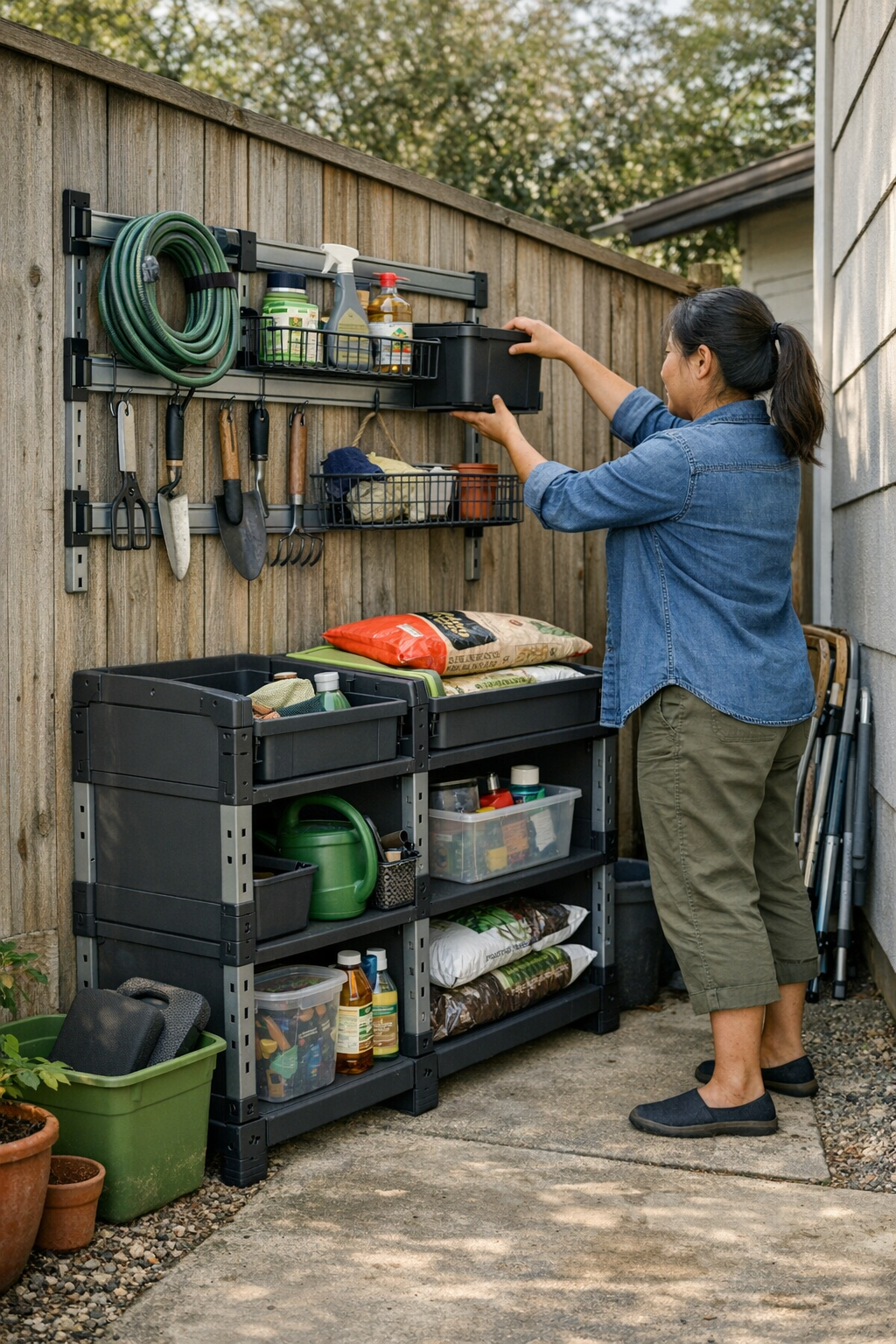
Wall hooks, modular rails, and open shelving don’t just store things—they change how stuff moves through the yard. Instead of new gear sinking into a box or eating up floor space, each return has a visible spot that doesn’t smother the path. Hanging a rake, tossing gloves in a basket, propping folding chairs onto strong hooks: now, nothing is out of sight or underfoot.
Step into a yard where the wall system actually gets used: the difference jumps out. There’s no hunt for last week’s clippers under a pile or accidental kick of a tripping hazard by the gate. Movement stays clean because even sloppy returns go up and out—not down and across your walking space. When something’s misplaced, it’s instantly obvious—a single tool out of place, not a hidden layer of chaos.
Scene: Three People, One Side Yard, and Reset Fatigue
Picture a classic setup gone sideways: a slim utility strip between house and fence, one hefty bin pushed under a window. The gardener tries to keep planters and pruners neat, the grillmaster stacks barbecue tools just inside the lid, and the third person needs quick chair access for reading after work. At first, everything looks promising. But soon, grill tongs won’t fit and rest against the wall, gloves are forgotten on the bin’s lid, and stacking chairs hog the ground in front. You go to water the pots but now you’re awkwardly stepping over chairs—plus the bin’s jammed with gear that’s not even yours. Nobody’s sure who’s supposed to fix it, and the smallest routine—grab shovel, get the gate open—forces a shuffle of three or four things every time.
Now run the same routine with a wall system: lower hooks and rails for handled tools, baskets for gloves and hand gear, broad hooks for folded chairs. There’s less to hide. At worst, the trowel lands in the wrong basket or chair hangs unevenly; but paths stay open, gear is visible, and resetting is a minor correction—not a weekly overhaul. The routines coexist—the grill tools aren’t blocking the planters, and chairs can be grabbed without guessing what’s in the way.
The Real Payoff: Reset Speed and Return Flow
This is where structure stops being theoretical. Every time someone returns something, there’s a choice: hide it in a “catch-all” or give it a place that’s visible, immediate, and easy to correct. When the bin is overflowing, even a careful return results in a new mess, and you’re back to shuffling just to reclaim a clear path. Missed hooks or baskets with open slots turn small mistakes into small corrections—you see what’s wrong and fix it in seconds.
Quick layout tip: Set your lowest rail or hook just high enough to clear the tallest tool that lives in that area—mower, shovel, broom. That one adjustment keeps floor traffic open, so even on a rushed afternoon, nothing is blocking walkways. Over weeks, the payoff shows: paths don’t shrink, resets take moments not hours, and the “Why does this space never stay clear?” routine fades from daily complaint to rare annoyance.
When Your Setup Has Quietly Failed (and the Signs to Spot)
A backyard fails its owners not when it fills up, but when it stops matching real use. You can feel this shift: items migrate out of bins onto the floor, every corner collects overflow, and nobody’s zone quite works for anyone. Wall space gets “used” with a single hook, but the ground below it clogs up anyway. You recognize the failure when you have to move three things just to get to the one piece you need—or when you hear, “Where did the watering can go? I swear I just left it here.”
Look for the red flags:
- Having to clear a route before you can even start your actual outdoor job.
- Floor space disappearing even though you aren’t adding new gear.
- Reshuffling the same pile, over and over, to “reset” the path or doorway.
- Regular confusion: “Did you move the tongs?” “Why is the bin full again?”
The outdoor setups that work keep resetting themselves, not because people are more organized—but because the structure makes it easy for anyone to fix a problem as it happens.
Why Wall Systems and Modular Storage Win the Daily Routine
No wall or modular system magically enforces perfection—but with the right setup, “mess” never becomes a mystery or a constant burden. The target isn’t a perfect surface; it’s a repeatable routine that doesn’t collapse under daily life: resets are quick, nobody is forced to play janitor, and problems reveal themselves early instead of festering. Even when returns are hurried, the fallout is minor, and floor storage never manages to keep pace—because the pile always outgrows the bin, and the pathway always shrinks to half its intended width.
The secret is visible flow, not hidden stashes. Modular layouts with staggered rails or shelf zones let routines exist side-by-side, so the gardener’s pruners don’t get lost behind a stack of chairs, and the barbecue tools are never buried under hoses and pots. When the structure fits the way the space actually gets used, the whole area works—even when users are in a rush or someone forgets to return an item. The difference isn’t in how it looks after a big clean-up, but how reliably it stays workable after a normal, shared week.
If you want an outdoor setup that cuts down on traffic jams and keeps your space usable—without endless resets—choose modular wall systems and open storage that flex the way your daily routines actually demand. See what fits your side yard, fence line, or utility corner at http://tidyyard.myshopify.com