
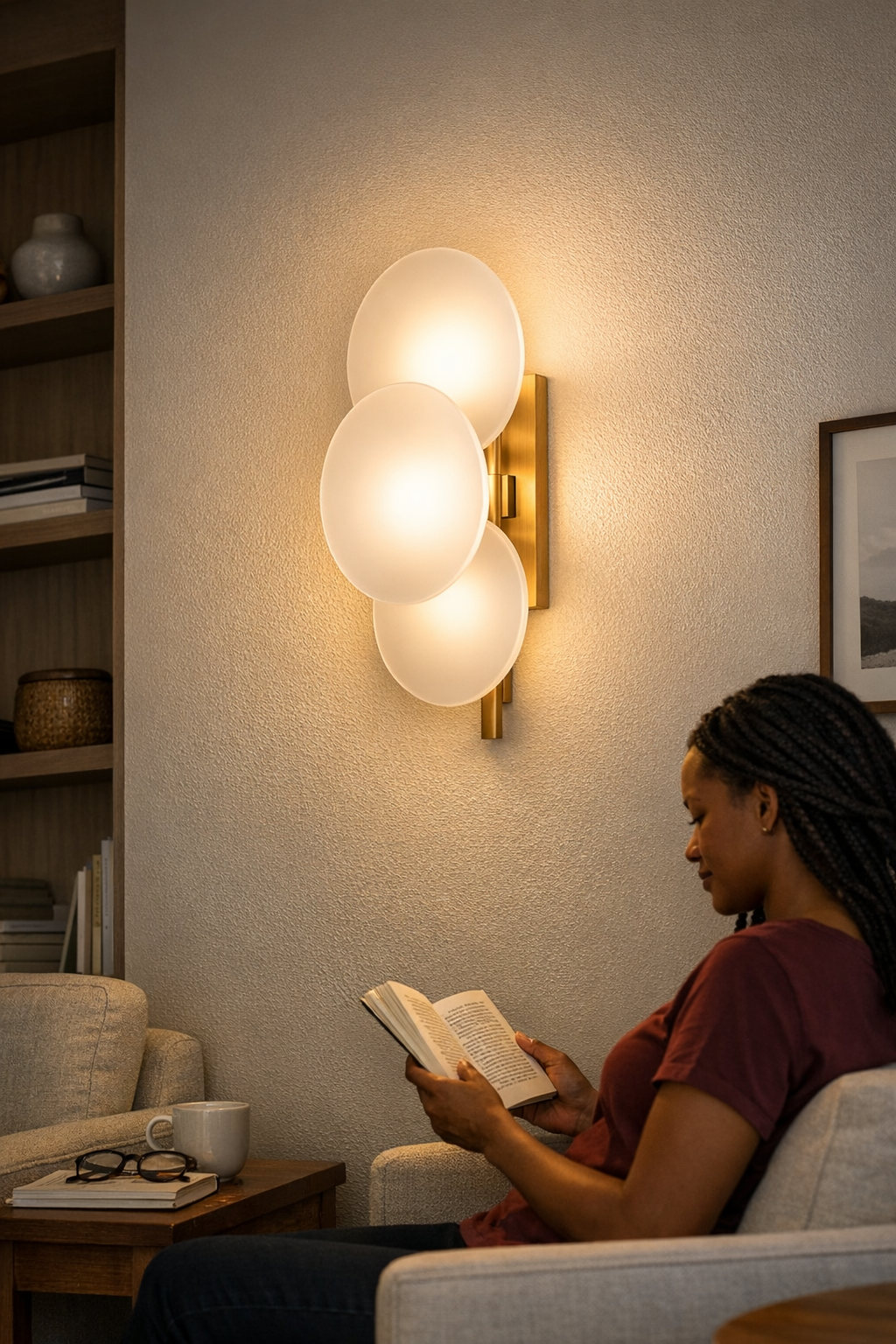
Walk into any lived-in room at night and you’ll spot the weak lighting fast: the empty corner nobody uses, the chair angled away from the wall, the surface that looks clean but sits ignored after sunset. The cause repeats: a good-looking fixture, often a wall sconce with a bare bulb or clear glass, pulls off a minimal profile—but leaves the space stuck in squinting, adjusting, and avoidance. Style wins on the wall, but daily use breaks down. It’s the sconce that seemed like a smart, simple upgrade—until it sends glare sideways every evening, or carves dramatic shadows across detailed surfaces that demand calm consistency instead of hotspots.
When Minimal Design Crosses Into Ongoing Discomfort
Clear-glass wall sconces and exposed-bulb fixtures get picked for their “uncluttered” look—streamlined, crisp, and photogenic. They do their job until actual habits set in: every light switch throws barbed beams at eye level, scattering outlines across walls and turning regular seating zones into irritation traps. The visual drama turns practical: harsh glare, uncomfortable sightlines, and cast shadows that make you adjust or abandon the space. What started as a clean silhouette becomes a magnet for avoidance behaviors—shoulders tense, seats shift, and suddenly one patch of the room is written off after dark.
This isn’t designer nitpicking. The pattern shows up fast in high-traffic spots: a hallway with an overexposed sconce that people subconsciously skirt, a bedside with too much kick for winding down, a reading alcove where comfort dissolves at night. Even when the friction is subtle, it sticks. The furniture drifts away from the problem zone. A work surface sits idle. Guests settle elsewhere. The “solution” morphs into a silent limiter—stylish on the wall, but actively subtracting from the room’s real use.
Daily Routines Show Where Lighting Falls Short
Repeated use exposes what the setup hides at first glance. A reading nook that makes you shuffle books or twist in your seat to find a clear spot—just to dodge stray glare. A hallway where dramatic rings look good in daylight but scatter distraction across walls after dusk. At the kitchen counter, a proudly bright sconce promises coverage, but the undiffused bulb bounces glare off cookbook pages and throws hard shadows that disrupt routine meal prep. Each small workaround—the habitual shifting, the instinct to avoid part of a surface—proves something’s off. The fixture still “works,” but the zone it lights up is quietly written out of regular routines.
Install an exposed-bulb sconce and you may not notice the cost until daily repetition exposes the drag. Routines—reading, prepping, quick notes—brush against hotspots and shift elsewhere. Eventually, you just skip the area that once seemed improved by design.
“Looks Clean” vs. “Feels Usable”
The change becomes real when you finally swap the setup—a clear bulb cover for a snug frosted diffuser, for example. The squinting stops, and the work surface stops acting like an obstacle course. Suddenly, recipes stay readable, counters receive a steady wash instead of streaks and harsh edges, and the fixture fades into genuine support mode. The aesthetic stays minimal, but the daily grind gets meaningfully easier—no more constant nudging or glare-dodging just to get basic things done.
Why Diffusers Matter: The Case for Subtle Support
The fastest upgrade for a harsh sconce is often just a real diffuser—frosted glass, a well-fitted shade, or an integrated cover that shields direct sightlines to the bulb. It’s a modest intervention with outsized results: glare shrinks, shadows even out, and the sconce stops acting like a trap. Instead of slicing beams at eye level, the light disperses soft and steady, making the zone actually usable again. Reading nooks regain comfort. Transitional spots along hallways or at doorways stay active instead of fading into the background. The dance of shifting chairs, angling books, and narrowing routines simply disappears.
Look closely in any space where people pause or linger after sunset: a proper diffuser is what turns a fixture from background bother to real support. These are the shifts that define whether a spot stays in rotation or quietly drops out of use.
Watch Out for Weak Diffusers
But not every diffuser solves the problem. The wrong cover—thin, badly fitted, or too transparent—can still let out “pin spots” and glare, keeping the discomfort alive. A well-matched frosted glass or quality shade is what separates a merely tidy appearance from true day-to-day comfort. Minimalist fixtures don’t need to sacrifice support: a simple, neutral diffuser keeps the clean look while blocking the distraction, making everyday routines feel right instead of rehearsed around the problem zone.
The Tradeoff: Slightly Lower Brightness, Much Greater Comfort
Add real diffusion and you might lose a notch of maximum brightness, especially moving from clear to frosted. But what fades is surplus output—what you gain is all practical: even, comfortable light that makes the space genuinely usable. The reading chair becomes inviting again. The kitchen prep zone gets steady coverage. The harsh visual reminder disappears, replaced by a setup that lets routines run without reaction. This is the step that moves a room from “styled for photos” to “built for real use.”
Recognizing and Solving Subtle Lighting Friction
You can spot problem areas by how you use your space: if furniture is always nudged off-axis, eyes shielded, or surfaces left empty as night falls, lighting friction is the likely culprit. Watch for the telltale signals—glare streaks on book pages, unwelcome reflections on the desk, clumped shadows on the wall, or that one zone that nobody uses once daylight disappears. These are not quirks; they’re early warning signs. In most cases, adding a proper diffuser or choosing a better support bracket resolves the issue fast—removing the need for constant workarounds.
Dialing in lighting at the support level—whether through real diffusion, choosing a bracket that positions the light correctly, or adding cable management to reduce distraction—pays off week after week. The “angle and avoid” routine drops away. The room regains its intended use, and comfort becomes the norm rather than a lucky break. This is the reward for thinking not just about fixture style, but about how lighting structure supports real-world living, working, and relaxing—without added friction.
Effective indoor lighting isn’t about maximizing raw output or chasing a minimalist silhouette at all costs. It’s about making repeated tasks, small transitions, and regular routines easier and more comfortable for everyone who shares the space. Solve the small friction points, and the fixture’s support will stand out in daily life—long after the first impression fades.