
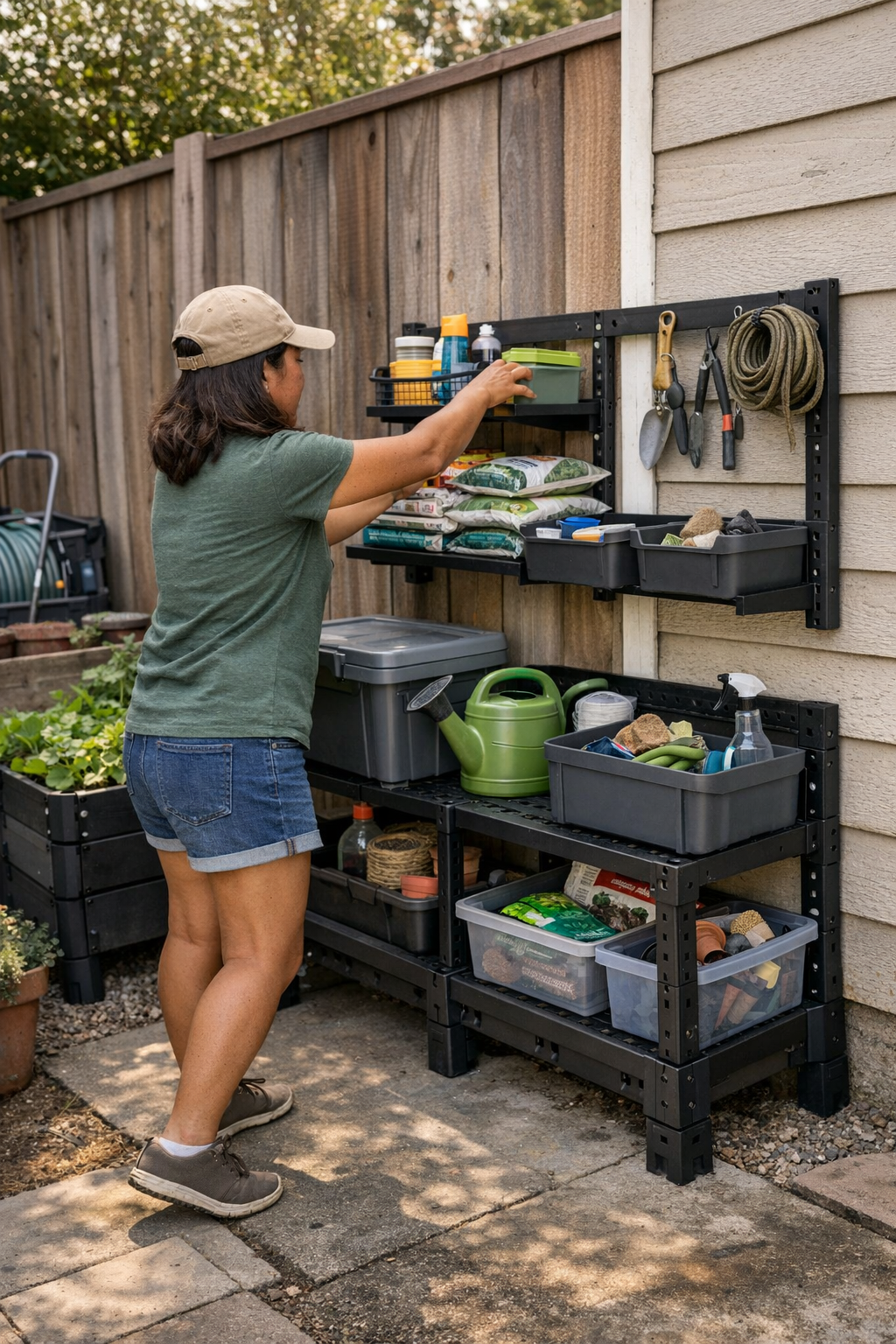
The quickest way to ruin a good outdoor setup? Let bins and storage creep into your only walkway. A clear side-yard path or patio quickly becomes a maze: edge bins inch forward, shelf corners jut out, and every trip to the trash feels slower. What was once a simple walk turns into a clumsy dodge, the route tightening each week until even dragging out the wheelbarrow means stopping to nudge something just to squeeze through.
Why Walkways Become the Pressure Point in Outdoor Organization
There’s no such thing as extra space in the real zones—narrow backyards, side-yard strips, or fence-line utility runs. You walk these routes daily: hauling out yard bags, returning a shovel, or guiding a bike out before work. When bins and racks start eating into these passageways, every trip stacks friction. Move a bin “just for now” and it stays lodged in the path for days. Squeeze past a half-shut lid and you’re setting up the next slowdown. Organization that looks tidy but strangles movement does not survive repeat use.
The frustration builds in increments, not explosions. It’s not about how much you’re storing—it’s about whether you can get past it without having to shift things every time. A walkway lost to overflow is a daily interruption. And once you’re pausing in the rain to reshuffle overflow or sliding containers back into line just to get through, the setup is the problem.
The Creep: How Floor Bins Quietly Steal Your Space
The classic fix—neat rows of floor bins—works for a day. Lined up against the siding or fence, they promise order. But almost immediately, reality reasserts itself: lids tip, a heavy bin edges out a little closer, someone pulls one out and doesn’t quite shove it back. By the next cleanup, the line has kinks, and your “straight shot” through the yard is a sideways shuffle.
The real pain? It’s incremental. Maybe you tilt your shoulder to get by. Maybe the garden cart snags on a protruding bin and you have to back up for a better angle. Next week, you’re stacking a bag on top of the recycling because the ground zone is chokepoint. What seemed organized goes rogue—just slowly enough to feel like background noise until you can’t ignore it.
Scene Report: The Overlapping Side Yard
This hits hardest in tight quarters. Imagine a seven-foot-wide gap between house and fence. There’s space for storage against one wall and a narrow walking route—until a deadline day. The recycling’s lid hangs open, a shovel left sideways, a paper bag from last weekend sits where you “meant to move it.” Taking out the trash means a three-part shuffle: pivot, scoot, lift, swearing a little when the bag snags on a bin’s handle. None of the bins moved far, but every inch costs time and patience. By the time you’ve made two or three trips, it’s obvious—the layout fought back.
How Wall Systems Change the Equation
The entire flow shifts once you get storage up off the floor and onto the wall. Even six inches makes a tactical difference: garden tools go from a toe-stub risk to lined up, tight against the fence. Wall-mounted rails, vertical racks, utility hooks—they buy you the critical foot of open path. Suddenly you’re not slowing the cart to dodge corners, and a bag set down in a rush doesn’t spill into tomorrow’s walk.
This isn’t about stuffing every square inch with storage. It’s defending the path—the only reliable way to keep routines running without constant resets. Ownership of your walkway is clearest after a rain, or on recycling night, or mid-project chaos. When the wall holds the bulk of the gear, you notice: nothing spills where feet and wheels need to go. Even if the scene isn’t pretty, it’s functional in all the right directions. Organization that only looks good for a photo collapses the first time you actually need to move fast.
The Real Payoff: Less Reset, More Return Flow
Elevating storage makes cleanup honest. Junk won’t quietly accumulate at ankle level. If something lands on the ground, you spot it—and clear it—before it becomes a pile-up zone. Pushcarts glide through, not zigzag. Lugging yard bags no longer requires a detour or preemptive tidying. The path isn’t just clear; it stays clear because the layout enforces it. Resetting stops being a draining chore and becomes a two-minute visual sweep: if it’s not on a rail or shelf, it needs to move.
Keeping the Path Open: When Good Storage Works (and When It Doesn’t)
The best setups hold up when you aren’t thinking about them—after a week of rain, three days of home projects, or one rushed garbage run. Smart organization supports the real routine: grab, move, return, repeat. The weak points show up fast:
- You’re constantly nudging bins out of your way to reach the shed or open a gate.
- Returning a rake blocks the space you need for the trimmer next time.
- The back corner fills with overflow until you dread moving anything near it.
- Every “quick reset” turns into a half-hour of dragging, stacking, re-lining.
It’s not abstract—it’s an everyday stutter in how your space works. Storage solutions that only look clean turn into the biggest hassles as soon as routines pick up speed or weather gets in the way.
Modular Systems: Flexible, but Not Magic
Modular wall racks, rails, and adjustable shelves are designed to flex real-time—especially outdoors, where today’s bike zone is tomorrow’s tool wall. You can expand or pull back storage as seasons change, but there’s a catch: too many pieces, or modules not locked in, breed their own chaos. If one section’s tight and another’s loose, overflow finds the weakest link. The walkway shrinks, the footprint sprawls, and the “modular advantage” is lost to haphazard growth.
The fix isn’t adding storage, but tuning how storage meets movement. When hooks, rails, and bins hug the edges instead of spilling out, the path remains usable even as needs shift. But even wall setups need policing—if a rail starts filling past its length, if a low hook interferes with a mower, you know it. Real flexibility means being able to pull back at the first sign of spread, not just stacking more in every direction.
The Only Test That Matters: Does the Path Stay Clear After Real Use?
This isn’t about showroom order. A system passes the test if—after rain, mess, and five returns—your walkway isn’t blocked. Maintenance time drops. There’s no last-minute shuffle. Doors swing wide, pushcarts don’t glance off bins, and returning something after dark isn’t a calamity.
The biggest difference between a setup that works and one that merely stores is simple: invisible friction disappears. There are no lingering detours, no guilt-pile in the corner, no inescapable clogs as the week wears on. When you stop thinking about the layout—and start flowing through your routine without slowdowns—that’s when the outdoor setup finally fits the space it claims to serve. If you’re still tripping, nudging, or stopping to rearrange, it’s time to rethink not just what’s being stored, but how often it’s in your way.
See what real, repeated-use outdoor setups look like at TidyYard.