
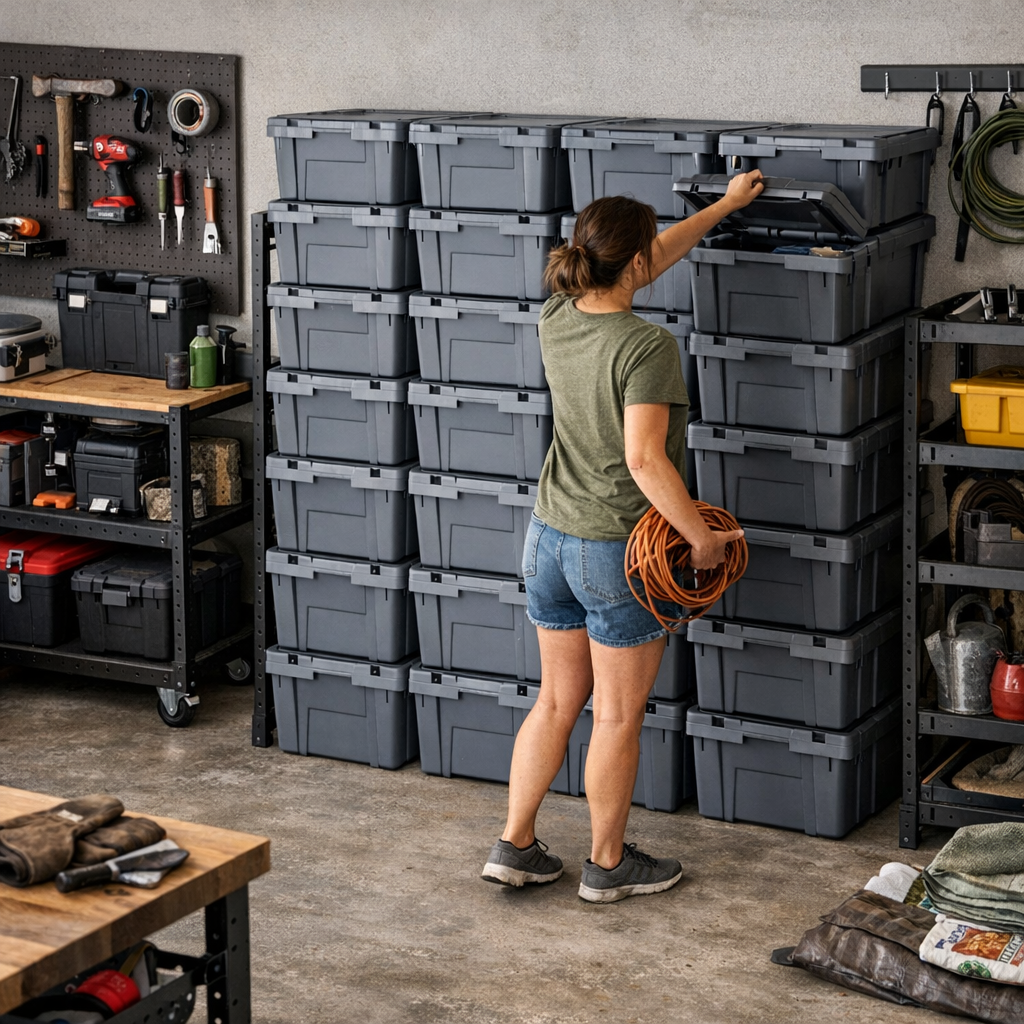
The truth about “organized” garages is that most never quite work as planned. You haul out every dusty bin, stack them with care, wedge a rolling cart into a corner, and line up shelves like dominoes—sure, it looks tidy on Sunday afternoon. But by Thursday? The cracks show. The ladder is blocked again. Retrieving garden shears means shifting two containers and balancing one lid against your knee so it doesn’t slam shut. Every “grab and go” turns into a cautious shuffle, detouring around a cart that never stays put. The feeling isn’t disaster, but it’s not seamless either. The order you created takes daily hits—adding slow friction that multiplies the more you use the space.
When tidy falls apart: Where routine meets real-life
You stand back, see everything “put away,” and call it a win. But a garage that looks organized isn’t the same as one that lets you move freely. The first frustration usually comes fast—a shelf blocks half of the only real walkway, forcing you to squeeze sideways, shoulder to the wall. Bins of different heights don’t nest, so you wind up building awkward stacks in random spots. Every time you need the extension cord from the bottom of the pile, there’s that old routine: stoop, unstack, pull, restack, curse. Feel familiar?
The daily setup becomes a game of avoidance. That rolling rack you originally parked inside the door now migrates, wedge-like, near the workbench, scraping over uneven concrete. One move always triggers three more: slide the cart, nudge the shelf, shift the scattered bin—just to clear a path. The supposed system starts to feel like a slow-moving obstacle course.
The slow breakdown of mixed storage
The rookie move: set up bins, a couple different shelves, a cart for heavy tools, and call it organized. At first, each type of storage promises a purpose—the hardware bin here, painting gear there. But the seams don’t hold. Bins won’t tuck flush against shelves, casters hit cracks and refuse to budge, deep containers hide behind others. Soon, every edge—the dead zone by the back wall, the strip under the window—catches oddball overflow that won’t quite fit anywhere else.
Every time you return something, you size up the mess. Does this bin fit in the gap beside the rolling rack, or do you wedge it by the freezer, half-blocking the path? Each decision means a little shuffle, a nudge, a small compromise. The “one-time setup” turns into a hundred micro-adjustments that bog you down and blur your original zones into chaos.
Weekend reality: The garage after real use
Picture Saturday after a rushed repair or dig in the garden. You’ve pulled out the bin of hand tools, spilled a box of screws on the counter, hauled the rolling cart out to reach your favorite shovel. Now—time to tidy up:
- The extra-large bin slides just far enough to block an outlet and jams small containers into the margin. Plugging anything in requires a foot-long reach-around.
- The cart only fits back in its spot if you turn it diagonally, eating up a third of your walkway.
- You’re sidestepping around tight corners, hip-checking a shelf, steadying your armful of tools, all to make it through without a spill.
Each “reset” takes longer than last time. Storage creeps into every usable strip of floor, but with each cleanup, things settle just a little further from where they belong. By week’s end, it’s hard to tell where one zone stops and the next begins.
Uniform bins rewrite the routine
The shift isn’t about owning less—it’s about bins that fit together, every time. Move to a single size of modular, stackable container and the space starts to cooperate. Bins line up neatly, lids don’t hang up or require unstacking, and there’s finally a straight edge along the wall, not a series of jutting corners inhaling all the floor space. That six-inch strip by the door? It becomes usable: slide a bin in—done.
Uniformity creates a kind of muscle memory. Need the drill? You know exactly which bin, exactly how to lift the lid—no guessing, no creative rearranging just to get under one box. The wall stays clear, walkways go back to actual walking, and the dreaded “reshuffling” disappears. You see instantly when something’s out of place, instead of wondering if you left it somewhere in the back corner last week.
Giving up variety? Or gaining usable space?
This isn’t about stuffing the awkwardly sized garden rake into a bin that’s too small—it’s about choosing a set of containers whose footprint matches your gear and your patterns. Oversized bins eat corners and block walkways, so get real about your most-used pathways. The reward for matching your system to your routines? Clear floor paths that stay clear. Resetting after a project actually feels as quick as it should, and zones don’t spill out of bounds with every use.
The price of ignoring the mismatch
Stick with a piecemeal setup, and the penalties add up. Walkways narrow as bins slide crooked; corners collect random overflow; wall edges fill, but never usefully. A quick reset grows into a mini-move—track down the right lid, realign the cart, squeeze the toolbox in wherever it fits. It’s never catastrophic, but it’s always slow. Each little hurdle chips away at the space’s promise of effortless use, turning routines that should take seconds into small projects of their own.
Keeping the flow: Habits that stop the slide
Even uniform bins aren’t magic unless you work with them. Take a few minutes every couple weeks to scan for spots where loose gear is gathering (high shelves, back corners, wherever the system feels “fuzzy”). Tweak the layout before a dead zone grows. If your routines change—a new tool, a new hobby—adapt where needed. When the system follows the way you actually use the space, resets go back to simple. Tidying up after a project doesn’t feel like a negotiation, just another part of the rhythm.
And you notice the difference fast. Gear goes back without detours. You spend less time hunting or shifting and more time actually working. The garage finally moves at your pace—not the other way around.
The real test of organization isn’t the first impression after a deep clean—it’s how smoothly the space handles your fourth, tenth, or fiftieth project. A unified storage system isn’t about perfection; it’s about supporting your routines without interruptions. The right containers become less about storage, more about removing the friction between you and the work you want to do.
Visit StackNest for systems that stay in line with real use.