
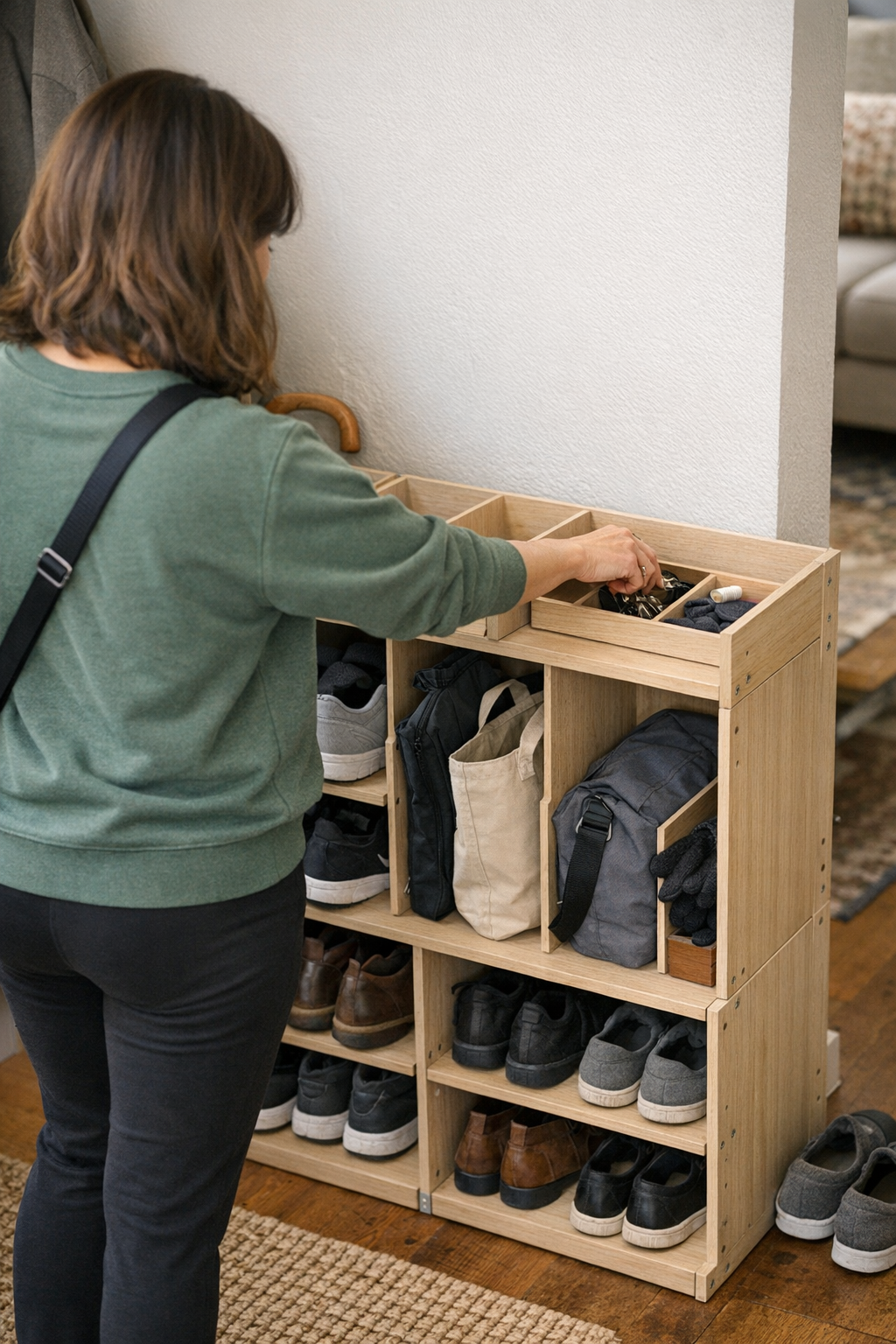
Most entryway clutter doesn’t announce itself as chaos—it arrives as small, daily friction. Set up your bench and cabinet on Saturday, and by Tuesday the system’s falling apart: shoes angle out of line, bags block the walkway, keys vanish under the growing pile. It’s not about having too little space. It’s how fast shared routines and rushed drop-offs break down boundaries, letting items blend, pile, and interrupt the flow through your threshold. The deeper problem? Any structure built only for storage, not for flow, fails under real, repeated use. Entryway storage from Betweenry isn’t about capacity—it’s about handling pressure, overlap, and fast resets in transition spaces where ‘organized’ collapses by midweek.
When Plenty of Space Isn’t the Solution
The lure of a bigger cabinet or bench is strong: for a few days, every shoe and backpack has a place, and the entry looks under control. Yet by Wednesday, boots have drifted under bags, gloves are buried, and someone’s keys are jammed unseen behind the last grocery return. The problem isn’t storage size. It’s how quickly mixed items invade each other’s zones. With catch-all storage, every end-of-day reset becomes a project—tugging at pileups, sorting jumbled categories, and re-hiding the clutter until it reappears the next morning. The pain point: each new mess slows you down right when you’re least able to tolerate it.
When bags, shoes, and essentials mix freely, you don’t just lose order. You lose time and patience, right at your home’s bottleneck. A big cabinet with no boundaries lets the same small pileups become routine obstacles. Searching for keys under a backpack isn’t just an inconvenience—it’s tension at the threshold, delaying everyone behind you, and making a two-minute departure slip toward ten.
Dividers: Small Barriers, Big Impact
Insert dividers or trays in your main storage, and the effect is immediate. Shoes slide into lanes—so the row you start with on Monday still stands by Friday. Bags stack upright instead of drifting sideways. A shallow tray collects keys and gloves before they vanish into the churn. Now, when two people come home at once, each can open the cabinet, drop their gear, and move on—without shoving someone else’s pile aside or blocking the path.
The change isn’t just neater rows; it’s less collision, less searching, and a real drop in return friction. In the rush of morning exits and after school re-entries, dividers keep one pair of shoes from smothering another, shields essentials from bag spillover, and makes anything out of place instantly obvious. “Category creep” slows. Resetting takes seconds, not minutes—or worse, silent frustration as you step around the pile waiting for ‘later’ that never comes.
Reset Speed and Routine Pressure
Here’s how you know when open storage is failing: Sunday setup looks great, but by Thursday, you’re fishing for gloves under coats, and the last clean shoe slot has filled with odds and ends. Rushed mornings expose every weakness. A bench without clear lanes becomes a catch-basin. The overflow migrates to the walkway, crowding whoever arrives next. If one reset turns into heavy shuffling and awkward pass-throughs, the cost is bigger than clutter—it’s one more source of daily stress at the threshold where your routine is most fragile.
Dividers quietly block that breakdown. As volume rises, separation holds: shoes stay paired, bags don’t topple, and a low tray means keys are actually visible before you bolt. Instead of repeating the same ten-minute hunt, you see exactly what’s missing, move what you need, and get out. In transition zones, speed and clarity aren’t luxuries—they’re the line between flowing through and tripping up.
What Setup Drift Feels Like in Real Life
Most real entryways are narrow—sometimes just a small bench or low wall cabinet forced to absorb gear for the whole household. That’s where “drift” happens: drop a bag, and shoes scatter sideways; sit to tie laces, and the bench picks up a bottle or errant mail; any new arrival tips the nearest item into the main route through. Overflow isn’t a surprise—it’s inevitable when the only structure is a big, blank container.
- The bag placed too close to the edge now blocks half the pass-through the next day.
- Shoes that started lined up against the cabinet end up twisted or shoved into a tangle by midweek.
- An umbrella wedged in once becomes a permanent obstacle, chewing up foot space and cramping the threshold every morning.
Visual “order” is a false comfort. More space gives room to hide drift, but the routine keeps breaking: too many things stacked, too few boundaries, too much silent buildup until the zone clogs and movement stalls. That’s the real-world cost—flow interrupted, not just clutter visible.
Structural Boundaries Over Storage Size
Equating more storage with smoother routines is a classic mistake. In practice, the bigger the cabinet without structure, the more effort it takes to reach what you need. By Thursday, what looked like generous capacity is now a hard-to-manage obstacle course. When every use demands pulling items out to find what’s buried, the “extra space” just adds steps to your reset burden.
Divided storage flips this logic. A three-lane divider or segmented tray uses less total volume, but delivers more order: shoes stay paired and visible, bags stand up rather than drift, essentials stay corralled. Instead of guessing what’s behind the pile, you get a predictable routine: put away, retrieve, move through. For shared entryways, the clarity matters—no silent resentment, no repeated moves to reach your own stuff, no more morning pileups because someone else “reset” the space to fit their bags, not yours.
Keeping Order with Tight Entryways and Mixed Routines
Entryway setups aren’t static: guests show up, new sports or school gear arrives, and the lineup of must-haves keeps shifting by season. If you keep stepping into a bottleneck—standing on one foot in a tight entry, elbow-deep in a pile that’s drifted across the zone—it’s not just clutter. You’re missing friction-fighting boundaries that reset themselves, even when real life pushes the layout off-script.
Dividers and tray inserts adapt to almost any structure—wall-mounted cabinets, low benches, narrow shelves. In these tight spots, they block pileup drift: shoes can’t sprawl, bags find a set lane, and small essentials are less likely to feel “lost in the big zone.” Even on a slim shelf, a divided tray keeps keys and passes from sliding under the day’s outerwear or landing at the back where nobody looks until next week.
One Small Real-World Tip
Designate a divider slot or tray as a “re-entry” zone—a pocket that always catches quick returns, mail, or essential keys as soon as you walk in. This one small habit keeps return flow smoother, making resets less of a chore and reducing that silent spread where temporary placement becomes tomorrow’s new pile.
The Real Win: A Transition Zone That Works, Not Just Stores
Choosing dividers over wide-open storage isn’t about capacity—it’s about building invisible boundaries that match actual routines, so daily mess doesn’t quietly rebuild right after every reset. A slim bench or structured cabinet keeps categories in-check and mistakes visible, not buried. In homes where paths are tight and overlap is constant, structure makes the difference: less blocked movement, faster resets, a launchpad entryway rather than an obstacle zone. The real transformation is visible not in how things look once, but in how quickly the zone comes back to order with every return and departure.
Betweenry: http://www.betweenry.myshopify.com