
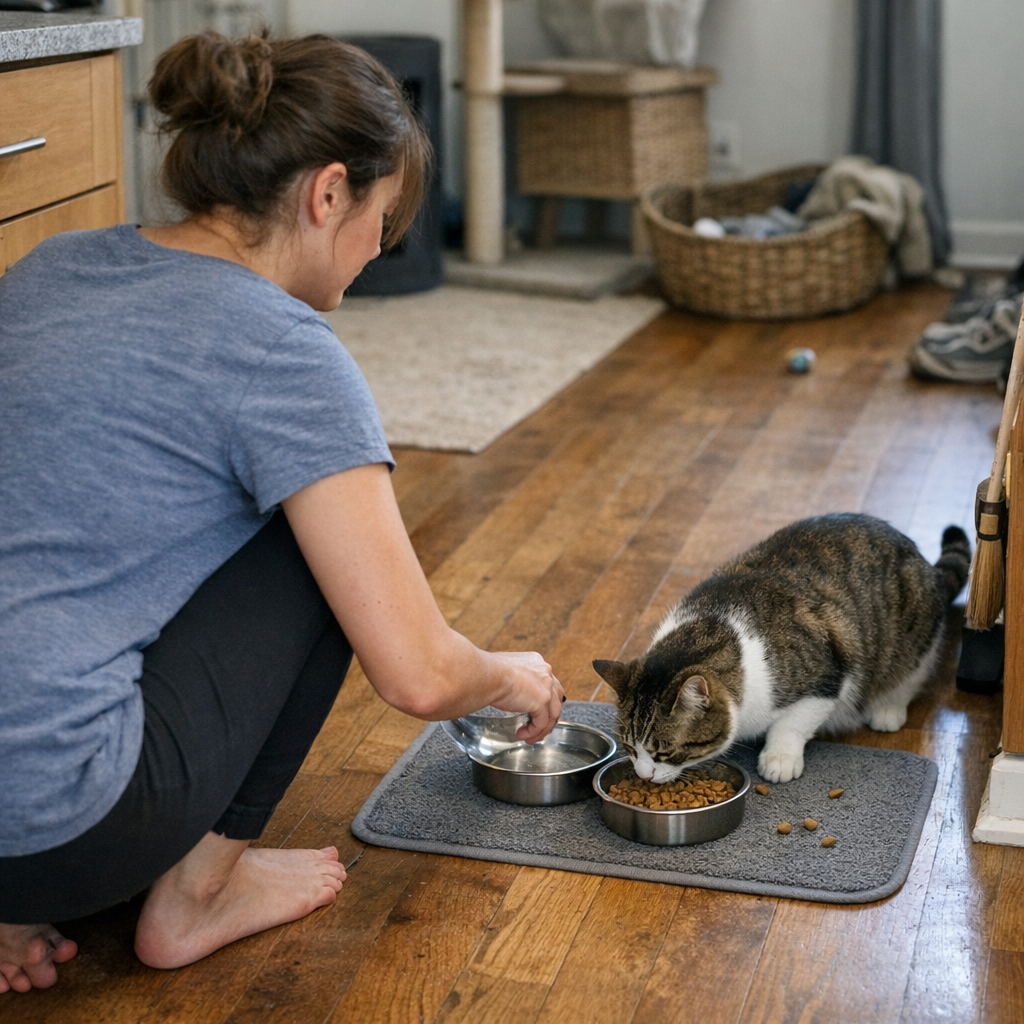
It always starts as something you can ignore—a bowl just out of reach, a mat “safely” out of the path, a corner for litter that looks invisible—until the friction piles up. Then one morning, you’re dodging a chunk of kibble with your foot again, brushing aside crumbs that reappear by lunch, and realizing what’s really off: the setup isn’t failing because it’s messy, but because it quietly fights your real daily routine. In most indoor-cat homes, the hidden cost isn’t chaos. It’s those seconds you lose, the unexpected pauses, and the energy spent resetting the same area over and over, all because the space isn’t made for how you actually live beside your cat. Welcome to the practical reality that StillWhisker was built for—where ordinary routines, not just containers or color schemes, determine what actually works.
The Real Roots of Cat-Related Clutter: Not a Storage Problem
The cycle is almost universal: bowls are brought back, litter trails appear again, and yesterday’s pile of toys works loose from the “tidy” bin before breakfast. If you feel like you’re constantly organizing, but the mess just slides back, here’s why: the hardest-to-fix chaos isn’t about storage or neatness—it’s about setups that break down as soon as real routines begin.
When cleanup becomes a repeat loop—retrieving bowls stuck behind stools, squeezing past a too-close mat, wrestling wipes out from behind where you actually need them—you’re not seeing failure so much as the signs of a setup that’s physically in your way. It doesn’t look like a mess until the tenth time you stoop down for the same toy wedged under the couch. What looked organized on day one now needs constant micro-fixes just to keep pace with your day.
When the Setup Looks Settled but Still Slows You Down
Tidy, yes—but functional? That “hidden” litter box in the corner, the curated toy basket, the feeding dish aligned with the backsplash… these all promise visible calm. But open the door during a normal week and the illusion cracks. You spot the unspoken swap: the area photographs well, but you’re now fighting slippage—wiping a mat that drifts every time someone walks past, crouching for toys that sneak behind radiator fins, breaking stride to dig behind stacked supplies that once “decluttered” the room.
The Daily Reset That’s Never Quite Done
Picture this: Every night, you drop all toys in a deep bin. By noon, your cat’s chosen two are back in the middle of the floor. One has already found its way into the shadow gap beside the fridge. Now you’re down on your knees again, and that clean floor you admired last night is a memory—while the “storage” isn’t helping any ordinary routine. It’s a loop. Soon, you’re straightening the mat or nudging the bowl back into place and hearing yourself think, “Didn’t I fix this already?” The room looks fine in snapshots. The burden only shows up on repeat.
This is why photo-ready order doesn’t always equal liveable ease. Sooner or later, constant resets start to feel like chores you shouldn’t have to do—but can’t quite skip without the system breaking down again.
Invisible Interruptions: How Misaligned Setups Cause Everyday Delays
It’s not always the sprawling mess; sometimes, it’s the tiny detour hiding in plain sight. Maybe the water bowl sits in a decorative alcove, but you have to break your morning flow to reach it—a few extra seconds each time, easy to dismiss, until a rushed morning means the refill gets skipped. Soon, there’s buildup or stray fur inside and that’s when the small inconvenience shows its teeth. Let enough minor frictions line up, and missed maintenance stops being rare—it becomes part of the week.
Comfort vs. Convenience: When One Fix Creates Another Issue
“Upgrades” sell the promise of improvement, but every change has a tradeoff. That stylized mat—now located “out of view”—keeps shifting, leaving a trail of crumbs extending past the spot you’re supposed to stand. Maybe you pick a soft cat bed that matches the room, but the cover refuses easy cleaning, so the comfy spot turns into another routine you grudgingly maintain. Design for cat comfort adds unseen labor for you, multiplying each time an easy solution means more crouching, more shaking out, even more hair to sweep up.
Shared Spaces: Cat Gear That Keeps Sneaking Into Your Life
Cats don’t respect defined zones; the nuisance is slow enough to ignore, until it builds up. Feeding mats edge closer to pathways, toys roll into hallways and under seats, even containers you picked to “hide the mess” begin to pile clutter just behind your reach. Need the broom? Now you’re moving a scatter of supplies stacked in your traffic lane. Carrying a cup of coffee? The kicker toy appears underfoot again. These are the micro-interruptions that erode convenience—unplanned, but felt just the same.
The real sign a setup is off? Annoyance you can’t quite get rid of, no matter how much you tidy.
Frequent Reset Points: Where the Routine Keeps Breaking Down
The classic offender: the feeding zone that looks unobtrusive, but gets crumbs nudged with your foot every visit. Or a litter mat that never sits square, drifting until cleanup is an extra step just to access the essentials. Then there are caddies or wipes tucked “logically” out of sight, only to be out of reach in the one moment you’re managing a spill. Setup friction isn’t always a big mess. Sometimes, it’s surfaces needing wiping later than you meant, accidents that happen just out of your prep zone, and trays that remind you the system’s built for looks, not for repeat use.
Spotting and Fixing Routine Friction in Real Cat Homes
When small resets start to feel like real work, it’s not about getting lazier—it’s the setup missing your life’s tempo. Let a few minor misalignments persist and items fall behind: wipes never where you need them, food areas that slide out of “easy,” hair clustered in spots you never check until errands are underway. The promise of an organized space weakens; your routines slow under the extra handling the tidy look demands.
Read the Repeats: When One Weak Point Keeps Returning
Watch where your own frustration pools. If you’re always bending for the same toy, nudging the same bowl, or missing wipes by two steps, it’s not a discipline problem—it’s a warning about the structure. The solution isn’t prettier storage or another basket; it’s a reset that reflects actual use: what you reach for, where you pause, and whether you can grab essentials with a minimum of bending or searching. Real fixes mean aligning the setup’s rhythm with yours, not just your cat’s.
Small Shifts, Big Results: A Feeding Zone That Actually Works
Change doesn’t have to be major to be felt. After months of crumbs working loose under the kitchen rug and half-resets that didn’t stick, moving the main feeding bowl from its “out of the way” niche directly onto our morning walk-path reshaped the routine. Suddenly, the cleanup wasn’t a side task—it was natural, done while passing, no added step. Refilling the bowl stopped being a minor detour. The mat didn’t shift; the bowl didn’t wander. What changed wasn’t the look, but the fit: the setup began to live where daily life actually happens, making invisible effort visible—and then, lessened.
No big re-design. Just one strategic move that cut down the repeat mess and stole back lost seconds. The setup didn’t only look more at home. It interrupted less, because it worked on the same loop as everything else.
Testing Your Own Routine: Signs It’s Time to Rethink the Setup
- Cleanup routines force you to detour, squat, or pause outside your normal path.
- Wipes, scoops, or bags exist—but you always reach for them a few steps too late.
- Surfaces stay dirty longer simply because essentials are slightly out of reach.
- The same trouble spots demand your attention over and over, stealing your focus from anything else.
- Resets start to feel heavier or leave you with minor regrets—even if everything looks organized.
All point to one core problem: a setup chosen for how it looks or what’s familiar, not for the way you and your cat move, play, and reset inside your actual space. The solution rarely involves buying bigger storage. More often, it’s relocating or reflowing what’s already there to get ahead of what keeps breaking down.
Practical Moves That Make Daily Resets Simpler
Want a setup that works in real life, not just in photos? Start here:
- Place feeding stations where your normal path brings you, not in a decorative or hidden spot. If you pass it