
Recognize the Pattern: When “Organized” Stops Working
Everyone knows the cycle. You tear through a Saturday morning, hauling bins out of the side yard, lining them in a parade against the fence, hooks loaded with tools, deck boxes shut tight. By Sunday, the path from the gate to the garage looks almost surgical—clear, controlled, even a little smug. But by midweek, it slips. A muddy soccer ball blocks the gate. A handled shovel slides underfoot just as you’re carrying groceries in. Someone’s bike—half in, half out—turns your side yard into a maze. Suddenly, you’re tiptoeing over clutter to reach anything, burning minutes resetting before any real yardwork can even start.
The wall you hit isn’t a lack of storage. It’s friction—the everyday gap between how you think the setup should work and how your family, your routines, and the weather actually use it, over and over.
Where the Setup Starts Breaking Down
It’s easy to blame “not enough storage” when the walkways get blocked or gear piles up, but real-life bottlenecks almost always come from setups that miss the way things move. The first few days after re-organizing are deceptively hopeful. By Thursday, the narrow path from garage to patio is rubbing elbows with a parked wheelbarrow, a rake slipping out of a loose rack, bins waiting for trash day, and a mess of shoes kicked off at the back door. Setup that looked clean on Saturday now pushes you to detour, step over, or just drop things anywhere they fit. Small frictions—an extra minute here, a clumsy shuffle there—are the early warning flags that your system is quietly falling apart.
“Tidy” Storage That Still Blocks Your Routine
Corner sheds, deck boxes, wall racks—these look sharp right after installation. Their surfaces are smooth, the floor is clear, and every tool has a slot. But in reality, that order rarely survives a real week. Here’s how it unravels:
- The deck box is jammed shut with a bike collection crowding its lid—so skipping gloves becomes normal.
- Wall racks mounted far from your natural path leave you or the kids dropping tools at the nearest patch of floor—they’ll get put back “later.”
- Modular panels divide the wall, but the empty space beneath always attracts plastic bats, yard shoes, or whatever needs a temporary home. That “temporary” bubble never bursts.
What looks like neat storage on paper or in photos quickly becomes a magnet for drop-offs and dead ends. The tools aren’t “out of place”—they’re simply escaping setups that interrupt the real routes you take.
The Draining Cost of Repeated Reset
Every touch builds up: sliding a mop just to reach the recycling bin, moving the compost bucket to get the extension cord, unstacking muddy boots that landed in the path. The friction adds hidden effort to every outside task. When your storage interrupts your access—even by half a meter—the reset job never ends. Friday’s “quick tidy” becomes a full afternoon scramble. And the more these micro-blockages layer up, the easier it is to say, “I’ll deal with it later,” while clutter gains permanent status in the zone meant to contain it.
Narrow Zone, Real Trouble: Side Yard Bottleneck
Picture that skinny gap from the back door to the trash bins—a classic side yard where every inch counts. You begin with a wall of hooks and a deck box. Four days later, here’s what creeps in:
- A long-handled broom totters, nudging the kid’s scooter almost into the path.
- Leftover hose, forgotten boots, and project scraps tighten the already-narrow route.
- Wet weather? Shoes, bags, and tools land wherever there’s dry concrete. Nobody wants to play storage Tetris—so nothing really moves back.
No single block is dramatic. But repeat the scramble, and suddenly the “organized” area becomes an obstacle course where every return or retrieval is a nuisance. Overflow starts to build its own gravity: the same corner collects soccer balls and gloves, week after week. Zones that looked efficient turn into daily bottlenecks.
Return Flow: The Real Test of Organization
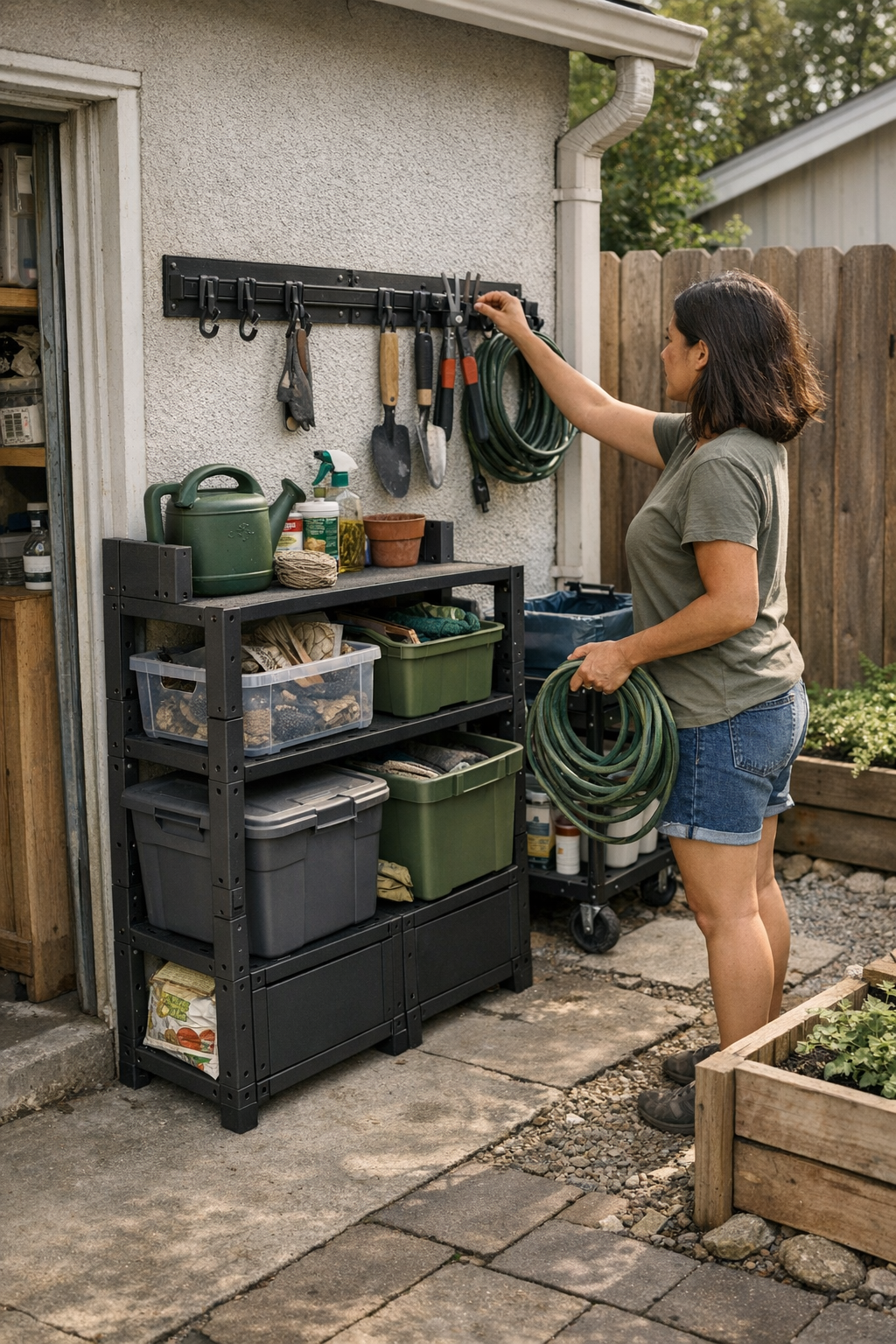
The difference between setups that last and setups that fail is simple: how easily things return to their spots in real time. Instead of forcing everything by type, try shaping zones along the paths you actually walk and reach. Hang shears or a hose by the gate—not on a panel behind a locked bin. Overflow bins? Place them further from essential footpaths, so they absorb seasonal gear without swallowing daily tools.
Leave the runway clear: Keep at least a stride’s width—about 90 cm—free of stuff in front of all key storage. This space isn’t extra; it’s vital. It means you’re never shifting bikes just to open a box or tripping over boots on the way to the compost. When the main routes stay open, clutter has nowhere to sneak in and resets shrink to seconds.
Zones That Survive the Real Test: Repeated Use
The sharpest setups carve out visible, functional boundaries. Wall racks shouldn’t just fill space—they should live directly on your everyday path, right where your hand naturally reaches mid-task. Movable bins or lidded baskets catch overflow but don’t live in the line of fire. If a routine task means stepping around or shifting anything, that’s a setup signal—a pause to rethink rather than accept another week of friction.
When “clear path” and “storage” are unmistakable, even after a stormy weekend or a burst of backyard games, it’s obvious: resets are quicker, no one defaults to “just drop this here,” and storage performs instead of getting in the way.
How to Spot Weak Points Before They Swallow Your Space
Warning signs are easy to miss until they multiply:
- Midweek, you’re always reshuffling—to make something fit, to reach a hidden rake—though you “should have enough room.”
- That strip under the wall rack? It’s a magnet for buckets, shoes, or garden toys that never move back.
- The same dead corner attracts clutter no matter how often you clear it.
- Your main route gets pinched, forcing odd detours, especially in rain—now items are not only in the way, but sometimes outright dangerous.
If you’re working to stay ahead of the mess instead of casually maintaining, it’s a sign: your setup doesn’t match your movement. Real organization isn’t static; it lowers maintenance, not just on day one, but every time you pass through.
Real Tweaks, Lasting Impact
What works aren’t wholesale overhauls, but small, targeted changes:
- Mount racks only where you actually reach for items—not to fill an empty panel.
- Guard floor space: footpaths aren’t storage. Zone them, protect them, clear them after each use cycle.
- Give overflow purpose-built homes—flexible bins, movable baskets—so quick dumps don’t become permanent piles.
The test? Return to your setup after three or four normal weeks. Where does the friction collect? What stalls a quick reset? Better to adjust zone layouts and access points while the pattern is still fresh—waiting turns an inconvenience into a fixture. The setups you want to keep are the ones that are hardest to derail, not just the ones that look best on a clean day.
The setups that survive aren’t the bulkiest—they’re the ones that keep up with the real, repeated moves of people, tools, and everyday outdoor life. When storage works around your actual rhythm, yardwork stops being a series of resets and finally becomes routine.
Find practical outdoor organization setups and real-use solutions at TidyYard.