
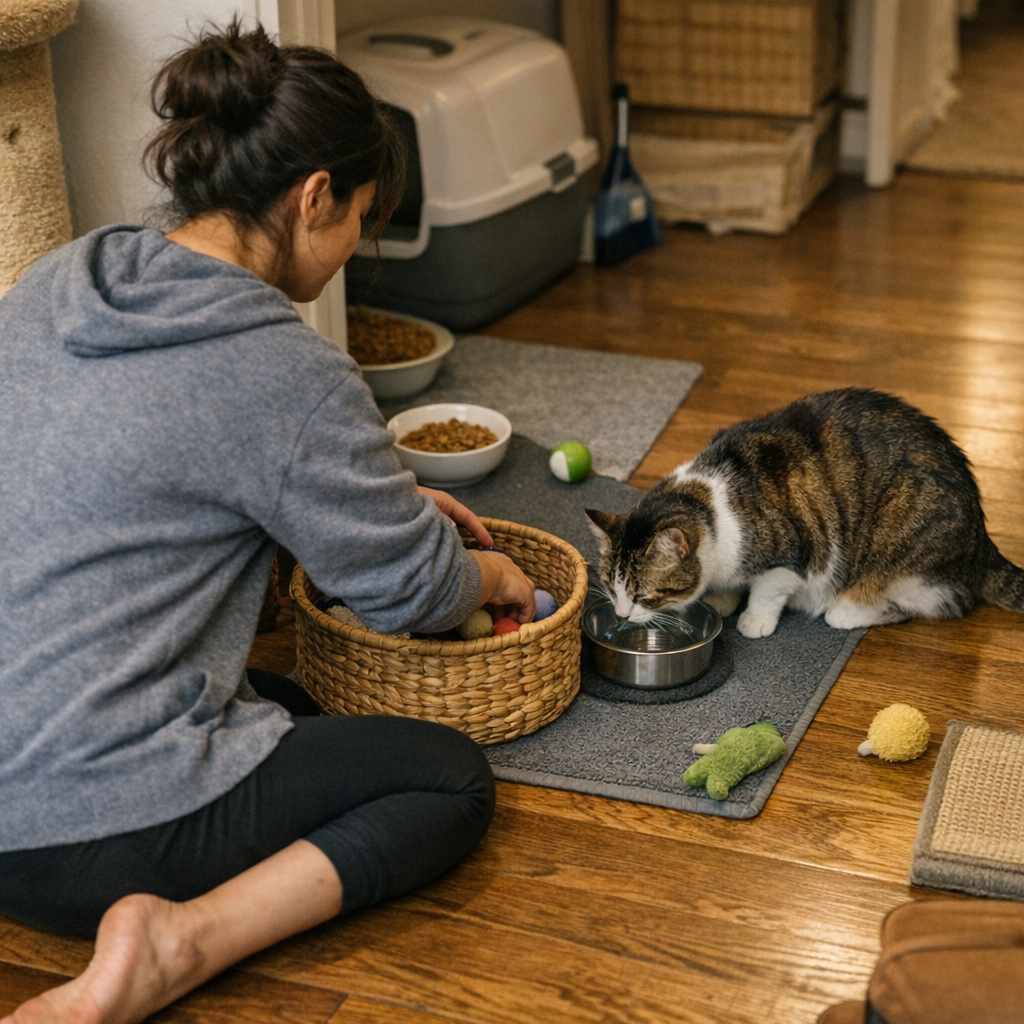
Finishing play with your indoor cat shouldn’t mean starting another cleanup sprint—but it does, unless your setup actually fits the rhythm of daily life. As cat toys roll straight into water mat edges, bowls block the path to the litter scoop, and shared corners turn into an obstacle course of crunched toys and tracked litter, one thing starts to show: routines that “look fine” break down fast under repeat use. That gap between a tidy layout and a functional one often appears after the second—or seventh—reset of the day.
When Play, Essentials, and Everyday Life Collide
Few homes separate cat play, feeding, and cleanup. Instead, a single stretch of floor becomes a shifting stage: breakfast at the edge of a walkway, lunchtime refills beside half-buried toys, late-afternoon play scattering foam balls over both resting mats and human traffic lanes. Cat gear drifts from zone to zone—one moment, the handled toy basket is close, the next it’s just out of reach when a runaway mouse wedges behind the water bowl. Cleanup bins look neat on the shelf, but always feel one step too far when wet prints or crumbs redraw the floor plan mid-routine.
Overlapping space isn’t just a quirk—it’s your daily grind. A setup can make sense after a deep clean, but by day two, you’re nudging aside a kickoff ball just to pick up the food bowl, breaking your stride to mop a sticky paw route past yesterday’s “clean” mat, or reaching your full stretch for wipes because toys keep migrating into the corner where you meant to sit down. It’s not an accident—when play, feeding, and cleaning collide, convenience quietly evaporates unless your layout adapts under pressure.
How Play Timing Affects the Hidden Workload
Letting play surge until your cat goes full-pounce means the aftermath waits for you—scattered toys under appliances, water arcs just past every mat edge, and a rinse of litter across tiles you already cleaned. The reality: peak-excitement play never stops at “just fun.” Instead, it leaves the next play start slow (as you hunt for lost toys), blocks access (“can’t reach that bowl without moving three things”), and makes you retrace steps for a wipe-up that’s always a bit too late.
The post-play mess isn’t background noise. Water that escapes the mat slows every crossing with a hidden slick. Toys jammed under furniture make each play session a crawl-fest. If you miss a corner during a sweep—because a ball darted out of sight—the problem circles back the next time you refill the bowl, always interrupting a different piece of your day.
Spotting the Pinch Points in Your Own Routine
The real challenge isn’t the grand “reset,” but the quiet fray between. Mats get realigned, toys are briefly binned, bowls rinsed—yet, in less than a full day cycle, the same trouble returns: balls returning to the kitchen, splash marks migrating across hallway tiles, and toys sneaking up against the rim of the litter mat just as you plan to relax.
Here’s where the grind becomes visible, especially when:
- Feeding, play, and scratch pads crowd the same square foot of space.
- Play runs until the “zoomie” surge makes retrieval nearly pointless.
- Cleanup supplies look organized but force a detour for every small fix.
The impact isn’t only visual clutter—it’s routine drag: every refill slowed by toy rescue missions, every intended quick wipe becoming a scrub, every “clean” rest area now hiding the day’s third wet paw print. Not enough to warrant a full reset, but always enough to add friction.
Ending Play Early: The Hidden Key to Less Cleanup
One of the simplest—but least obvious—ways to cut repeat work is ending play a few minutes before chaos peaks. Stop when your cat’s interest shifts from darting to watching, not when the room looks like a toy tornado landed. This isn’t about curbing energy; it’s about making the aftermath manageable.
If play runs to max speed in a shared zone, expect:
- Toys hiding where you’ll forget until the next lost-item search
- Splash marks tracking just beyond where the mat can shield
- Litter drifting further with every energetic dash
- Rest mats in need of a second, unplanned reset
Pushing “stop” while your cat is still shifting gears gives you a window: toys are easy to scoop up, mats haven’t moved off course, and cleanup takes two minutes—not fifteen. Miss that window, and the next simple reset becomes a scavenger hunt. It’s not about controlling play, but choosing a stopping point that prevents the room from tipping over into disorder you’ll feel for hours.
Toy, Water, and Feeding Mat Logistics: The Small Details That Shape the Day
It’s the detail work that either saves or sinks your routine. If you gather toys as play slows and actually store supplies within reach—not just visible, but grabbable—retracing steps vanishes from your list. A handled basket parked near—but never in—the splash zone keeps balls from escaping under the fridge each afternoon. Water bowls, when kept clear of high-traffic play lanes, mean fewer slip hazards and fewer surprise wipes. And mats that don’t double as a highway keep their dry “reset” status hours longer than a layout where every chase ends with a bowl skidding out of place.
Even a setup that looks photo-ready won’t last if every round of play means moving supplies back to where you should have left them—or if each feeding ends up tangled with leftover play gear. Without a real wind-down step, you’ll be repeating the same retrieval run, not because of chaos, but because the structure itself has no buffer.
Real-World Snapshots
You see it in scenes that don’t make the highlight reel:
- The ball rediscovered under the fridge, again, three days running
- The water bowl that never seems to stay dry past the first post-lunch chase
- The handled storage you use—when you remember it, right before every stray toy vanishes out of reach
- The mat that looks untouched after reset, but always needs a tug and shake because the chase veered off route
- The wet paw print marking a human hallway, trailing right past the litter corner, no matter how well you cleaned last round
The drag compounds. Suddenly, every water refill is delayed by a toy in the way. The sweep you meant to do “in a minute” now needs a trip to the closet, because the wipes you set out have migrated after the last tidy-up.
The Difference: Looks Clean vs. Feels Easier
Plenty of setups hold their shape at first glance—but break under daily realities. You tidy everything at 8am, but by noon, toys, water arcs, and scattered litter have already shaved minutes off every task. Order by sight isn’t order in use; most routines break down where the cleanup repeats, storage drifts, or access slows every small job.
What actually improves day-to-day flow isn’t just storage or bigger mats—it’s the timing: quitting play when action fades, grabbing toys before they become missing-in-action, and placing essential storage within reach throughout the day, not just after a reset. That’s the shift that makes spaces less prone to “find and fix” drama in the middle of other routines.
What Consistent Wind-Down Looks Like
The aim isn’t to cut off fun, but to notice when play shifts: chasing turns to watchful pausing, paws drop into slow-motion, or your cat glances toward water or food. That’s the prime time to reclaim toys and slide your setup—not just back to tidy, but onto a path with fewer trip-ups, fewer wipes, and less repeated searching.
After a few days, you’ll feel it: play ends before the chaos, toys stay in reach, and the ripple effect—pausing, wiping, retrieving, resettling—quietly fades. It’s not decorative, and rarely “finished,” but it’s immediately less disrupting. One less repeat trip. One less puzzle to solve mid-chore.
Why It Matters for Your Setup—Beyond the Tidy Surface
Even with spacious layouts and “smart” bins, the real test comes after multiple rounds: toys still migrate into walkways, small splashes linger, and what seemed like the right setup starts breaking your stride. The actual advantage shows up when, after a week, the space maintains its shape not because you’re tidying more, but because play, care, and cleanup don’t force repeat detours through your day.
If you’ve shifted everything, tried bigger mats, or reorganized bins, but still find repeat friction—try this: end play a bit earlier, reclaim toys before the last surge, and keep supplies right where you’ll use them, not where they look best for photos. In the lived-in StillWhisker world, the difference isn’t in storage volume or mat