
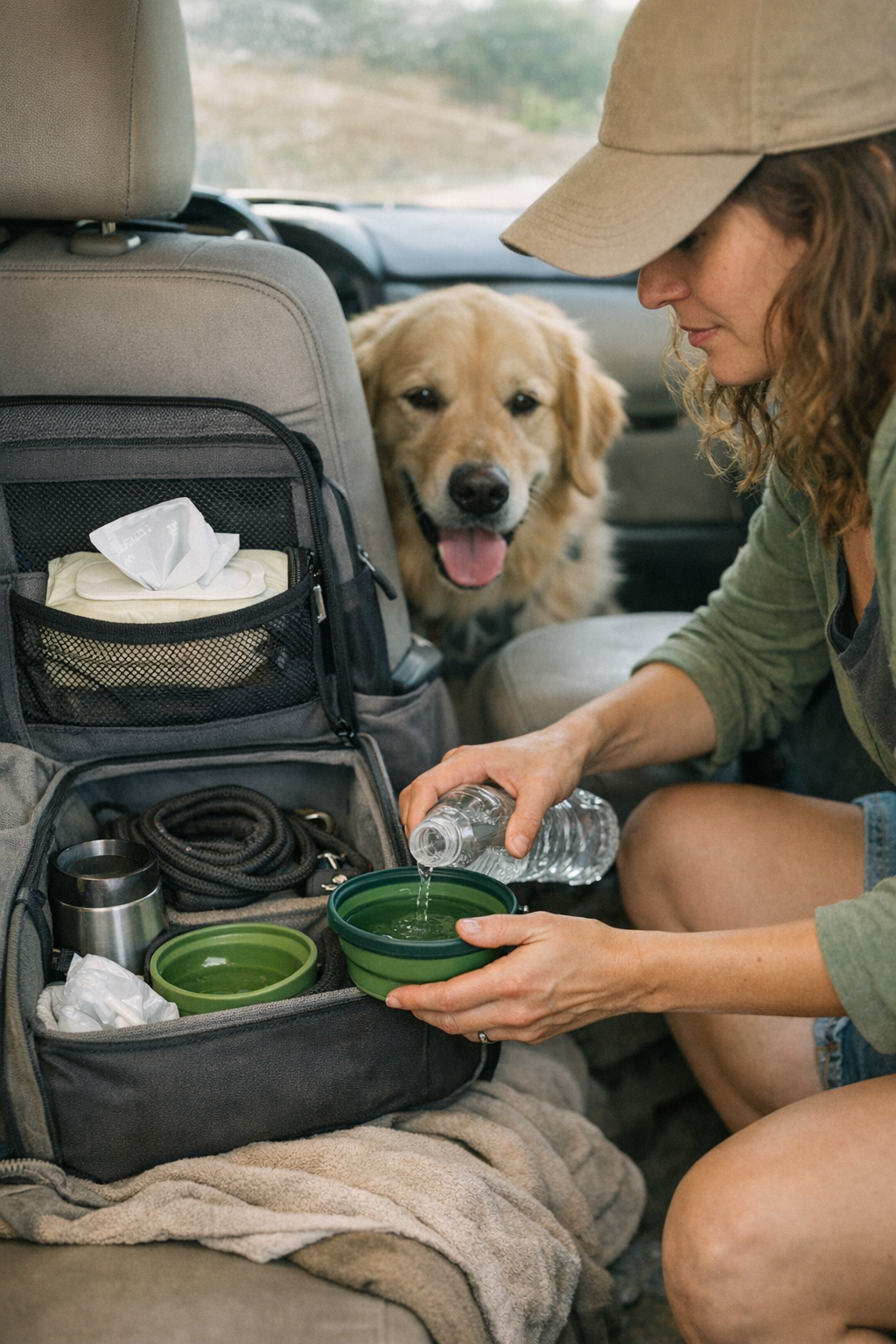
The real test of any pet travel setup isn’t how it looks leaving your driveway—it’s what happens when you stop, start, reach, and reset again and again. That perfectly zipped bag with wipes “in their place” feels smart until you’ve made three quick stops, handled muddy paws, and fumbled for the one thing you actually need. Suddenly, the bag that promised organization starts slowing you down. You’re prying at deep pockets while your dog wriggles to escape, searching for wipes layered somewhere beneath snacks and leashes. Each “prepared” section demands an extra step you don’t have time for, and what looked efficient now delays movement, interrupts cleanup, and piles on low-level stress. This is the gap PawGoTravel is built around: what holds up for a photo, and what holds up to real, repeated use.
When “Neat” Stops Being Useful: The Hidden Costs of Layered Packing
Most pet travel bags look neat on day one. Bowls, wipes, and leashes each have their tiny designated spot—a zipped compartment, a nested pouch, a spot under the main flap. That order feels good until routines stack up and fast access matters more than photo readiness. You rush off for a trail walk, wipe paws before re-entering the car, dig for a forgotten leash, or try to swap water bowls in a crowd; suddenly, every hidden pocket becomes an obstacle instead of a solution. The benefit of tidiness disappears when you’re racing through the same pack-and-unpack cycle at every stop.
Organization that works when everything’s still goes sideways during real-life pet travel. A restless dog shifting next to you, a call from across the parking lot, or an unexpected mess—these moments turn tidy layers into a source of real friction. That instant when you need one urgent item, every extra zipper or stacked compartment steals back the time you thought you’d saved by packing “right.”
A Familiar Scene: The Stop-and-Go Scramble
Midway through a road trip, you slide into a crowded rest area. Your dog’s awake and energized, pulling you toward the exit as you try to grab a bowl. But the bowl’s jammed at the bottom, trapped under jackets and straps. Unpacking one thing shifts another: leash clips slide behind bag dividers, wipes disappear inside zippered pouches you never should have closed. Rummaging for even the most basic item turns a fast pit stop into a disjointed pause, made harder with a dog leaning across the seat, ready to jump.
Frustration in the Dog Zone: Repeat Trouble Spots
The friction isn’t obvious at first, but shows up with repetition. After the fourth stop, you catch yourself reaching through three layers for a leash or wipes—again. Every “protected” item means another pause, another shuffle, another break in flow. Neatness masks how often your hand lands on the wrong section, reminding you that eliminating surface mess isn’t the same as making your pet travel setup truly work under pressure.
The dog-handling zone becomes a repeated logjam. As trips unfold, each hidden item makes transitions (in and out of the car, between leash and seat, cleanup and restart) slower. The cumulative drag of reshuffling isn’t dramatic, but it chips away at both patience and rhythm—it’s not just minor delay, it’s real friction that piles up across every outing.
The Split Between Owner and Pet Gear
Owner and pet gear inevitably collide. Water bowls end up under human snacks. Wipes migrate beside hand sanitizer. Your dog’s leash gets tangled with your spare hat. What looks compartmentalized spills over in motion, forcing you to reorganize after almost every stop. It’s not just about knowing where each thing is—it’s about how easily you can reach what matters when the dog’s squirming, bags are shifting, and you’re trying not to lose your spot in the flow of travel. Even a small fumble can turn a simple stop into a micro-chaos scenario that resets your whole kit.
Visual Order vs. True Accessibility: Why Most Setups Break Down
On paper, more sections seem like a solution. In practice, every extra pocket or zipped layer is one more point of failure when the pace speeds up. Repeated use exposes the gap: a setup that’s “ready” at the start actually blocks you when speed or one-handed handling is needed. After a couple of stops, you’re not using the compartments as planned—you’re bypassing them, leaving things half-zipped, or staging wipes and bowls in plain reach out of desperation.
Friction peaks when the item you needed “just in case” has to be tugged out from under three other “organized” tools. Even a single zipper slows the snap decisions and free hand you need during live travel—especially as the dog tugs, waits, or tracks in another layer of mud to clean. Function drops and impatience rises, all because usability got traded for visual calm.
Why the Problem Grows Over Time
Initial excitement about compartmentalization fades fast as the day wears on. Small inefficiencies—hunting through pouches, flipping open sections, untangling clipped gear, squeezing wipes out of too-tight sleeves—multiply with use. Every slow search is an interruption; every repack turns a quick stop into a drawn-out reset. Your setup didn’t get messier, it just stopped keeping up with real timing. And dogs don’t wait while you fix your system.
Shifting to Real-World Flow: Making Essentials Instantly Reachable
The most useful setups shift from hiding every item to keeping vital gear at hand. What matters: fast wipes, one-grab bowls, leash clips exactly where your hand expects them—not wherever looks neat. In practical terms, this means:
- Wipes in a mesh pocket: Grab, clean, done. No hunting, no unzipping. Resets for the next muddy paw in under five seconds.
- Bowls in seat-side slots: Lift, fill, and move—without unstowing half the bag or forcing your dog to wait longer for water.
- Leash clip on a soft loop: No more digging past covers or struggling at the car door. The leash is instantly where you reach, even with a restless passenger.
One tweak—the decision to make wipes accessible on the bag’s outside—turns cleanup from a self-imposed obstacle course into a smooth step. The best layout is less about maximizing storage than about minimizing lost motion, especially during those quick, repeated transitions travel demands. Your setup answers real travel logic, not just best intentions.
Open Access: Managing “Mess” Without More Layers
There’s a difference between exposed and chaotic. Leaving high-use items in visible, reachable spots isn’t a mess—it’s practical. The urge to tuck everything away makes sense—until it breaks your flow. Prioritize access over hiding, especially for wipes, bowls, and leash connectors. The result: fewer full-bag reshuffles, less interruption, more reliable restart after each stop—even if your kit looks a bit more lived-in by the end of the trip.
Recognizing the Repeated Trap: Looks Ready, Works Slow
Most pet travelers repeat the same cycle: pack for neatness, discover in the middle of the trip that their “organization” is undermining them. The weak points never disappear—just shift around. A bowl still ends up under three layers. Wipes still end up somewhere inconvenient. If you find yourself reaching, digging, and compromising at every stop, the real cost isn’t a mess—it’s momentum lost, patience spent, and flow interrupted by your own setup.
Real progress means being able to clean up, grab water, and handle your dog on the move with seconds, not minutes, wasted. The difference is tangible every time you loop from trail to car, seat to stop, over and over. When setup supports repeatable, fast moves, the whole trip gets lighter—your bag and your mood included.
Small Wins that Add Up: From Friction to Flow
The most effective pet travel setups don’t feel perfect—they simply erase the hassle that usually returns in motion. True comfort isn’t about impressive packing, it’s about not noticing your kit at all while juggling cleanup, leash handoffs, and routine surprises. Each minor fix—making one item truly accessible, separating what the dog needs from your snacks, simplifying resets—pays off with every trip, and every stop where you don’t have to think twice about what’s next.
Find more thoughtfully designed, real-world pet travel gear at PawGoTravel.