
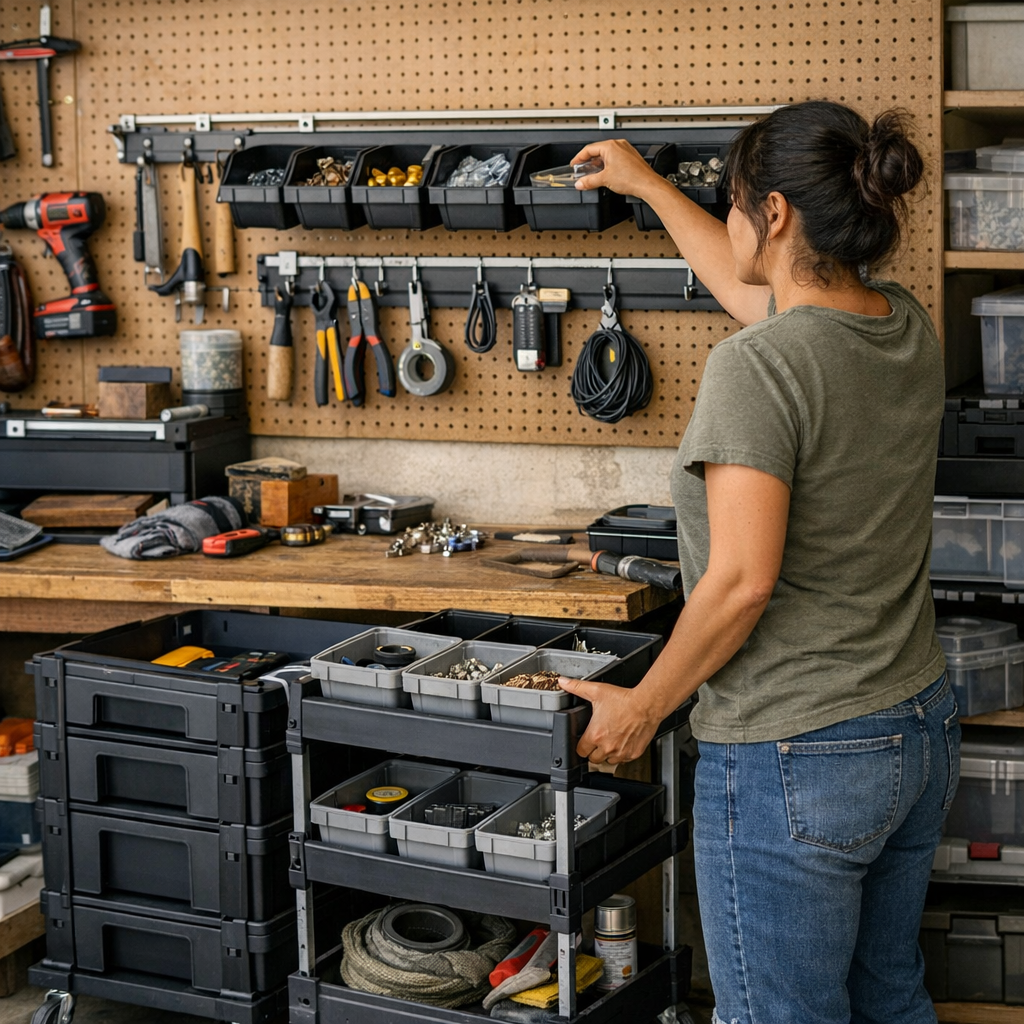
There’s a satisfying moment after reorganizing a workshop: new bins snapped into place, rails mounted, every tool sorted and labeled. Everything looks sharp, uncluttered—a grid of order ready for real projects. But beneath that first-glance neatness, true usability gets tested the moment routine work returns. Within days, the gap between a wall that looks organized and a setup that actually works starts getting wider, and the friction seeps back into every session.
How “Organized” Falls Apart Once Work Begins
On install day, hanging up rails and stacking modular bins feels like a meaningful upgrade. Each tool is visible, fasteners are easy to spot, and the worktable finally breathes. Yet after several evenings of real work—fixing a mower, starting a half-finished build, or just tackling small repairs—the weaknesses that weren’t obvious up front start to show themselves.
Flat carts and open shelves tempt you to use any free spot as a drop zone. It becomes second nature to lay down a wrench on whatever surface is closest, especially when bins get crammed or hooks fill up. Overflow creeps in: a pile on the corner, stray screws in an empty cup, clamps parked in new, less-logical places. Soon, you’re moving last night’s pile before you even start, and those extra steps eat time and motivation. Organization lives on the surface, but workflow starts to lag underneath.
One Evening, a Dozen Interruptions
Imagine it’s 8:30 PM and you’re halfway through swapping hardware on a bench. The mobile cart, meant for convenience, now blocks the aisle because everything temporarily lands there during frantic moments. Hooks on the wall hold what’s in progress, but start to cluster, hiding must-have tools under layers of what’s “mid-project.” By cleanup, the once-clear bench is a patchwork: drill here, pliers there, tape measure across the bins, and a slow, backward puzzle to figure out where each piece belongs. Most “modular” layouts fail at this stage—not because of lack of storage, but because every open surface or oversized bin quietly attracts overflow and breaks the rhythm of return.
Surface Order vs. Return Flow: Where Friction Lives
Every storage system looks good in the after-photo. But setting something down and getting it back in the right spot without pausing the flow—that’s the real test. A setup that interrupts routine will show its cracks fast: you shuffle parts from bench to cart, then from cart to shelf, always one small step away from a reset that drags out longer than planned.
You feel a weak return flow as extra steps and slow movement: digging behind taller bins to find a driver, shifting piles on a flat cart, bending around rolled cabinets that now serve as rerouted paths. Space gets used, but not in ways that speed up work. Instead, you’re reshuffling or sidestepping to recover pieces buried under yesterday’s overflow—and your “organized” wall fades into a static backdrop while the chaos shifts from surface to surface.
Early Warning Signs of Bottleneck Zones
Bottlenecks rarely announce themselves. A cleared workbench becomes an ad hoc tray for every misplaced screw. A run of bins along the wall looks busy, but if only three or four keep getting used, the rest turn into ignored storage or places where old hardware simply disappears. The isolated corner with an untouched basket—or worse, a catchall of scraps and half-empty tubes—absorbs more odds and ends than actual projects, gradually slowing you down every time you pass.
That “just this week” overflow pile is really a recurring symptom. Any surface that isn’t defined with intent turns into the room’s memory hole. Slow invisible buildup leads to regular frustration and increasingly sluggish resets.
What Real Tweaks Make Immediately Better
One practical fix: mount shallow, open bins directly above the bench at eye level. This fundamentally changes cleanup and return movements. Instead of “just setting it down for now”—which becomes “finding it tomorrow”—putting away frequently used bits, pliers, or screws is a single, direct motion. The friction of circling the bench or detouring past a blocky cart disappears. Defined, purpose-built sections make destruction of flat, ambiguous surfaces possible—your bench doesn’t become a holding zone for every stray item anymore.
Signs It’s Time to Tune Up Your Setup
- You push or reroute the cart several times just to get across the space.
- Piles overlap, and tools drift from assigned bins to stacked layers without clear lines.
- Your bin wall still makes you dance around obstacles or hunt for essentials hidden in visual noise.
- Open areas keep attracting a daily mess—resetting takes longer every night.
- Corners and bottom shelves never get touched for actual projects but bristle with unused or forgotten gear you’re reluctant to move.
None of these issues are dramatic on day one. They compound over time, as the system collides with real, repetitive use. What works isn’t pristine perfection, but practical design—one that channels your actual habits and lets returns feel like a step in your working rhythm, not a “clean for the weekend” ritual.
Finding the Right Mix: Open, Closed, and Accessible
Closed bins keep small hardware from wandering, but only work when you can open, reach, and stow in one fluid step. For tools grabbed constantly, open hooks and rails along the active wall win every time—they cut the cycle into seconds, not minutes. Strong setups blend both: closed for the loose stuff, open for the daily drivers, and everything sorted small and clear. Oversized bins or catchall baskets? They’re just future junk drawers in disguise. Dividing the wall into clear, labeled, bite-sized homes means no searching, less stacking, and nearly automatic cleanup with each pass.
Tuning for Daily Use, Not Just a Clean Photo
Decluttering is barely half of the work. Any open table or shelf that’s not broken up will pull in overflow and slow resets, every single session. Segmenting surfaces, tightening “return” paths, and reserving open zones for only what cycles in and out daily removes endless minor annoyances, whether it’s a one-car garage or a backyard work shed.
Status-check after two weeks by watching the patterns: Which spots get dumped on, which bins go untouched, which corners block easy movement, and which surfaces force you to pick up the same batch of pieces more than once per project? Fix these with tighter modular zones, refined bin sizes, properly spaced hooks, and carts that don’t double as holding pens. The true win isn’t a wall that photographs as tidy, but one that resets itself, session after session, without dragging you back to zero each time.