
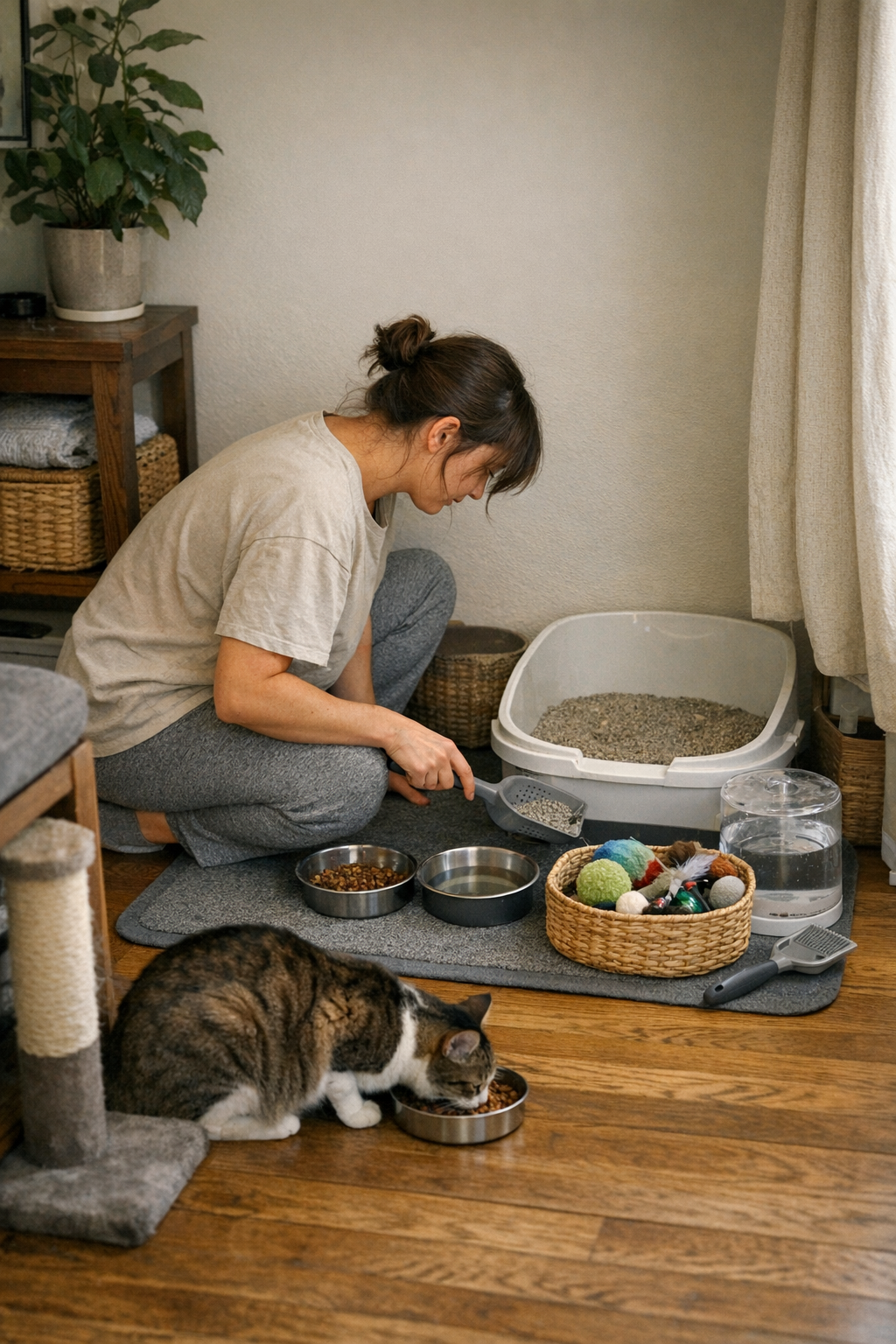
The room looks right—until you actually have to use it. At first glance, everything appears settled: food bowls lined up by the kitchen, water tucked away, toys out of sight, litter gear stashed just far enough to feel separate. It’s calm for about five minutes. The moment your real cat-care routine begins, that “calm” setup flips—feeding means a back-and-forth path, water refill is always a detour, and cleanup is a multi-step scrabble through cabinets and corners. Organization that looks tidy on Sunday morning turns into a practical slog by Wednesday, when the scoop has migrated again, the toys have resurfaced in the walkway, and you’re piecing together a reset before the coffee’s even finished brewing. That tidy room? It slows you down, every time.
When Neatness Backfires: The Real Cost of Scattering Cat Gear
The more you spread out cat supplies for the sake of visible order, the more small hassles collect. One bowl by the fridge, water only reachable by threading around a table, litter tools hidden for “visual calm.” The room looks uncluttered, but your mornings fracture into pointless errands—find a scoop you can never seem to park in the same place, hunt the mat after it’s been nudged away, reroute just to grab a paper towel. With every task separated, the distance between what looks clean and what works in practice widens. Over a week, small annoyances pile up: crumbs trail past “clean” lines, toys creep back into footpaths, and every reset repeats the collection game.
Instead of letting mess build, you’re letting effort spread. The space feels controlled but demands extra moves, every time routines repeat. It’s not chaos—it’s slow grind.
The Cumulative Weight of Daily Detours
No single disaster—just a pattern that wears you down. It’s taking three trips instead of one just to refill water and food, because the bowls and scoop belong to different corners. It’s trying to wipe up a spill only to realize the towel’s too far, so you leave it “for later.” Every piece has a home, but the homes are in the wrong places. What you gain in visual calm, you pay for in detours and micro-resets. When real routines stack up, the scattered setup gives itself away: care tasks start taking attention before you ever reach the cat.
Smooth surfaces and open sightlines matter less if you’re doubling back for every step. Setup in theory organizes a space; setup in practice should keep you moving forward, not pausing for corrections.
The Breaking Point: When Retrieval Overtakes Care
You know it’s gone too far when “cat care” mostly means fixing the setup. Most of your time is spent searching for a scoop that never stays put, reaching behind the trash for that elusive toy, re-walking the room to assemble the basics. Feeding isn’t just a quick pour; it’s an obstacle route because each tool ends up elsewhere by the end of the day. Even a well-hidden water bowl becomes the reason you’re zig-zagging around the kitchen instead of making breakfast in one pass. A setup that looked reasonable or even “designed” eventually starts breaking down your routine instead of serving it.
A Split Setup in Real Life
Picture this: you step in, intent on feeding your cat while getting your own breakfast. Food’s on one side of the room, water stashed wide for “splash control,” toys migrated back into the middle of the shared space and under the sofa, litter scoop already missing from memory. The task list feels short, but real movement means piecing together what should be one step—now four. Not messy. Just slow, always a little off, every single day.
Consolidation: Turning Cat Care into a Single Stop
The best fix isn’t a new gadget—it’s moving essential items closer together where you already walk. Group your high-frequency items: food, water, scoop, toy bin, even a small mat, and plant them along a route you already use. Instead of chasing each task into its own corner, everything’s a single stop. Mornings become a loop, not a hunt.
Keep it simple: a basket under the sideboard, a low tray, or a bin that parks next to the main path. Feed and refill without shuttling between stations. Stash the scoop directly above the litter mat or right beside the main food bin. Toys drop in a basket instead of rolling back under furniture. Each reset gets handled along your normal walk, not in staged cleanup rounds.
Containment over Separation
Pooled gear actually makes cleanup easier. Crumbs, water drips, stray bits of litter and toys—when they land together, you sweep, wipe, or declutter one area, not three. Maintenance rides on actual use, not on a chore schedule. The space stays managed with less repeat work because you don’t need to track down what’s been put “out of sight.”
How the Routine Actually Changes
The change isn’t just visual—it’s the pressure points vanishing from your day:
- Refills and resets become a single action, not an improvised route through the house.
- Toys that escape are easy to return—no more crawling under furniture or crossing the room just for a plush mouse.
- Splashes, crumbs, and scatter get wiped up as part of your main movement, not as surprise extra chores hours later.
- Litter cleanup happens at the source, scoop always within reach—reset before spread.
- Shared spaces stay more open, because cat gear doesn’t keep drifting into the paths you use most.
The setup doesn’t erase signs of cat life—it just cuts the reset burden so routines don’t stall out. Real improvement shows up as effort dropping away, not just as an empty floor.
Imperfect but Better: Small Annoyances Stay Contained
No arrangement takes the mess out of the cat routine. Toys still get batted into odd corners, the mat sometimes bunches or holds a little more litter than it should, water finds a way to splash, and crumbs escape. But when the core gear is centralized, these annoyances hit one spot—not the whole house. You don’t have to start over to regain order; a quick sweep or restack resets most of the area. The difference is visible: single-step cleanup replaces recurring searches and workarounds, and the friction that used to wear down your mornings shrinks to a few quick motions.
Perfect isn’t the point. Usable speed and less interruption are. The payoff isn’t in the photo but in the day-to-day flow: no more criss-crossing the room before you can even start the next task.
Tips for Building a Setup That Stays Useful
- Pick a spot on your regular path: Near the kitchen entry, next to the main living area, or at any point where you already move. The less you detour, the more likely the setup holds in daily use.
- Contain with visibility: Use open bins or shallow baskets for instant access—closed boxes just slow you down and hide things you’ll need to chase later.
- Design for easy resets: If you can’t clean up a scatter or stray with one motion, the layout needs fixing. Bins should be low enough to sweep around, and mats should let you reset bowls without fighting friction.
- Watch shifting comfort: Some plush mats cushion spills but drag when you want to slide a bowl. Notice when comfort slows the reset, and adjust.
- Troubleshoot runaways: If a scoop or toy keeps leaving the zone, use a corner stop or rethink the bin—it’s usually one weak link asking for a minor fix.
Why Centralizing Cat Essentials Actually Works
Centralizing isn’t about minimalism. It’s about function that fights routine burnout. When food, water, mat, cleanup supplies, and toy bins anchor a single area, you stop paying the daily penalty for a scattered structure. Fewer detours, quicker resets, less “where did I put that?” means upkeep drops behind the scenes. Split setups may look sleek but usually cost you calm in the long run—clean lines, slow routines. A workable structure lets you reset in one loop, handle messes where they start, and keep both home comfort and sanity intact.
Find practical indoor-cat setup solutions and gear at StillWhisker.