
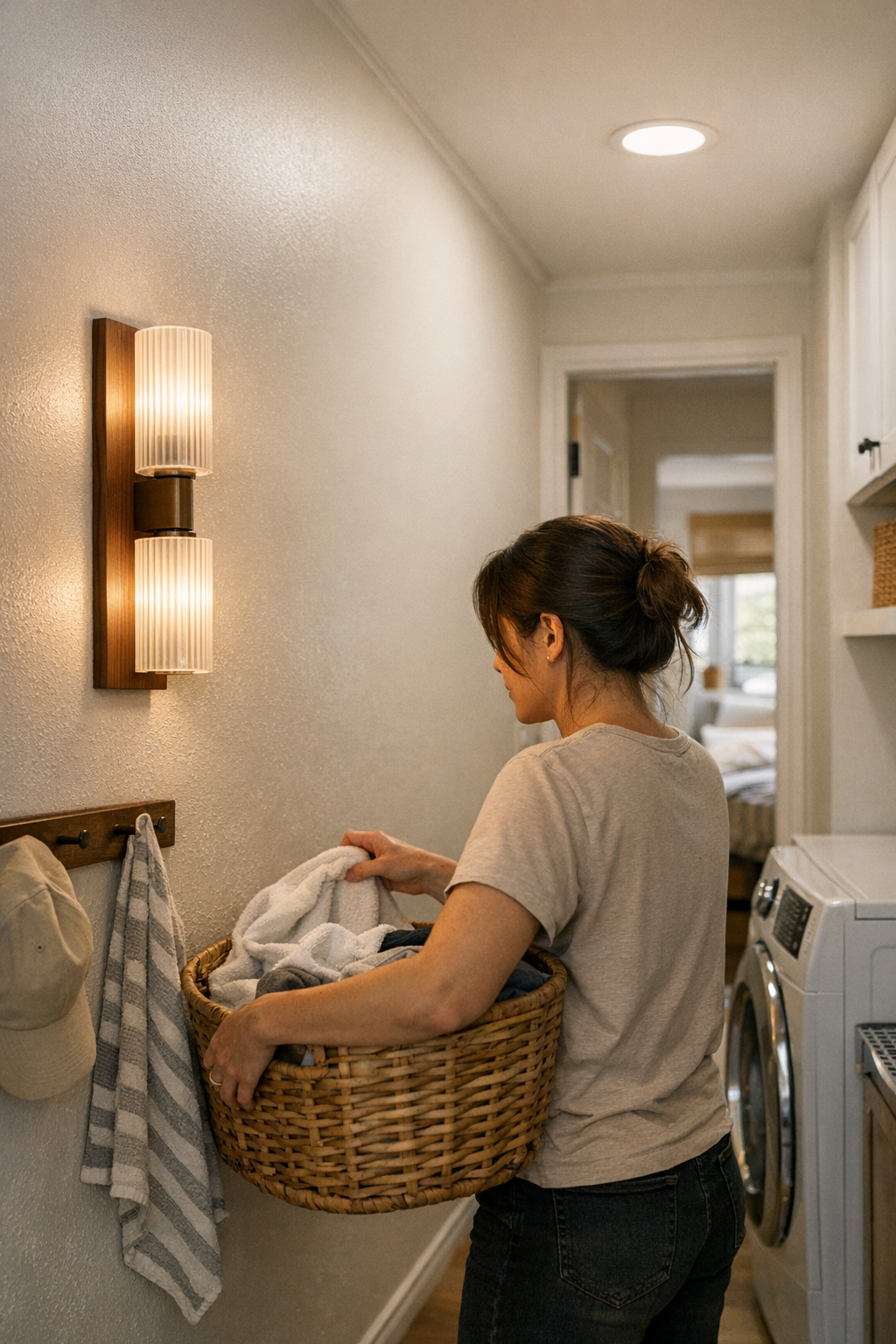
Rooms often look bright but fall short when it matters. A new flush-mount ceiling light can make a hallway or laundry room glow in photos—yet in routine use, frustration sets in fast. Shadow pools gather behind doors, stair landings fade at the edges, and half your reflection is lost to dark bands in the mirror. Every day, the central fixture promises brightness, but basic movement—bending at a cabinet, carrying laundry, reaching for a switch—exposes the weak coverage. The gap between looking “lit” and seeing what you need grows wider the more you actually use the space.
Where the Light Fails—Not in Design, but in Use
Most rooms start with that “bright enough” feeling. A single flush ceiling fixture—a standard for hallways, laundry corners, bathrooms—spreads light in a broad, flat circle. But as soon as sunlight fades and the day’s routine kicks in, the compromise becomes hard to ignore. The weak spots aren’t design mistakes; they’re a mismatch between how light is delivered and how rooms are used in practice.
- Take a stair turn at night: that missing handrail or stray slipper blends into the gray, right where the ceiling light’s reach fails.
- Walk a hallway: the center line stays visible, but step off path—toward a coat hook or baseboard—and clarity drops, hesitation follows.
- Face the bathroom mirror: overhead glare sharpens the tiles but cuts half your features into shadow, no matter how new the bulb.
- Stack laundry near a side vent: full brightness in the ceiling, yet the floor edge hides socks and lint in persistent dusk.
Single-point, central lights rarely match the reality of movement, corners, and task lines. Each time your routine bends away from that fixture’s aim, the difference shifts from a small annoyance to a daily interruption.
Lighting Friction That Repeats Every Day
A ceiling fixture covers basics, but the cracks show fast in real routines. Most people develop odd workarounds: you tilt at the mirror for better face light, move slow down a half-shadowed stair, or use a phone flashlight to double-check along a wall.
- Carrying a laundry basket past dusk? Your arms cast their own shadows and the floor turns unreliable—missed socks or stubbed toes waiting along that dim margin by the vent.
- Cleaning up? Clutter and dust hug the baseboards or vanish behind the trash can, untouched by the main wash of light overhead.
- Shaving, tweezing, or putting on makeup? The upper glare creates harsh contrast, forcing you to lean or angle uncomfortably, rarely seeing yourself clearly all at once.
It’s not parlor-trick inconvenience; it’s repeated, invisible drag. Guests or photos don’t notice, but you do—every time you try to finish a chore and hit a patch the ceiling light never really touches.
Chasing Shadows: Common Problem Zones
Certain spots in nearly every home keep echoing the same problem: central ceiling light does not follow the habits, edges, or angles that matter in real life.
Hallways and Corridors
Evenly lit overhead, but as you walk, the side walls and corners slip away. Anything dropped near the wall is instantly hard to find, and the walk itself feels easier at noon than at 9 p.m. The main bright spot stays centered, while routine use happens in the dimmer outskirts.
Stairways and Landings
Hauling a box upstairs? Sudden shadow at the turn means you check your footing by habit, not by sight. Reflected glare from light paint makes riser edges and step depths harder to judge, upping the risk of hesitation or stumble—especially late in the day.
Laundry and Utility Spaces
The ceiling glows, but baseboard shadows hide stains, and an out-of-sight sock sits beside an appliance for days. Corners and under-cabinet runs never fill in, no matter how high-wattage the fixture claims to be. Each week’s “quick clean” misses what the main light can’t reveal.
Mirror and Vanity Zones
Ceiling lights drop all illumination downward, deepening shadow on cheeks and under the chin. No angle at the counter feels fully visible. Even premium bulbs can’t fix the core setup: light that doesn’t land at eye level leaves grooming plagued by partial clarity.
Real-Life Fixes: Lighting That Follows Your Routine
Turning a “lit” room into a usable one rarely means adding more watts. The real shift happens by placing wall sconces, hardwired task fixtures, or low-profile supplementary lighting exactly where the ceiling’s spread leaves a vacuum—along walls, near task edges, or at mirror height.
A Laundry Hall Example: Small Fix, Big Impact
Picture a narrow pathway to the laundry closet. A new flush-mount ceiling light makes it look finished, but under the elbow bend at a vent, shadows linger. Installing a slim wall sconce, placed at turn level and halfway down, resets the feel. Now, grabbing a basket or picking up stray clothing, you find nothing left behind at floor level. The change isn’t dramatic in the doorway, but during actual use, it immediately removes mishaps and second-guessing.
Mirror and Vanity: Lighting Where You Look
For grooming, ceiling-only lighting always cheats you out of balanced visibility. Putting a hardwired wall fixture or vanity sconce at face height erases the split-shadow look, letting you work in true clarity—no more awkward posture or missed details. You see your features as they are, not in two-tone halves.
How to Spot Trouble Spots in Your Own Space
Solving lighting friction doesn’t require a renovation. Take a slow walk through your rooms at night, with only the installed fixtures on—ditch the phone flashlight, ignore boost from windows. As you move:
- Pause when you instinctively squint, lean, or stall—those are immediate cues for where light is failing your routine.
- Check dim bands along wall edges, at stair landings, near floor vents, or under cabinets—any area you instinctively skirt or avoid during chores.
- Watch your face at the mirror. If shifting your stance is the only way to see both sides evenly, it’s a sign a true task or vanity light is missing at eye level.
Details missed repeatedly are never just a bulb problem. Light that feels bright in the air but leaves dark, awkward corners needs aim, not extra output. A compact wall light or fixture at the edge does more than any ceiling upgrade alone.
Why Real Lighting Satisfaction Comes from Repeated Use
Many rooms trick the eye into “looking” bright, but comfort and clarity only build up over weeks of routine. The test isn’t an empty room—it’s every repeated step or chore: late-night walks through a corridor, side sweeps in the utility nook, daily checks in the mirror. Each exposes the central light’s blind spots, making clear why relying on one fixture turns into recurring friction.
Step back: how often are you squinting, shifting or slowing down for a patch left dim by the ceiling setup? The more often it happens, the more value there is in adding a wall sconce, task light, or vanity fixture at real working height. Most rooms never need a lighting overhaul—they need light that tracks the messes, movements, and mirrors that actually matter. Once you see the pattern, options open: a better-lit hallway, a mirror that shows your whole face, a laundry corner that stops swallowing socks.
See what real-world lighting can do for your hallway, utility, bathroom, or mirror zone at LightHelper.