
Cardboard entryway bins look tidy on day one—but by the end of a wet week, their limits are impossible to miss. What seems like a quick, low-cost solution for shoes, jackets, and bags quickly breaks down once daily weather hits your threshold. Boxes soak up moisture, sag under the weight of real routines, and turn from “neat storage” to a slow-moving obstacle that makes coming and going harder. If your hallway starts each week looking decent but midweek finds you stepping around shoes and shoving a crumpled bin back into place, you’re seeing the true friction of a setup that looks organized but doesn’t survive repeat entry and exit.
Why Cardboard Fails Where Weather Meets Routine
Cardboard’s surface neatness hides its weakness in real use. Every time rain or snow soaks gear, that humidity seeps in—you won’t spot damage after the first day, but the breakdown adds up. By midweek, box sides are softening, corners curl, and the layout you reset on Sunday gets blurred as shoes start drifting outward, jackets bow the sides, and bag drops split the seams. Instead of holding the zone, the bin starts losing its shape, bleeding mess into the path. What begins as containment becomes a daily negotiation: dodge the shoes sliding out, rescue the bags slumped across the edge, and re-align jackets that no longer stand up. The cost isn’t just appearance—each shift steals time and adds hassle to every entry and exit.
Reset Friction: The Slow Creep of Disorder
No matter how you line things up after a weekend reset, a cardboard box can’t withstand the pace of real re-entry. One shaky landing—an armful of groceries dropped fast, a backpack slung on top—and the sides buckle again. Shoes you arranged in a tidy row spill wide as the box can’t hold a straight edge. Push a bag in too quickly, the bottom sags, and you’re forced to waste seconds every morning shuffling everything back, instead of just passing through. In busy homes—shared entryways, kids hustling to catch the bus, a pet weaving around legs—every uncontrolled drift adds up. The promise of a quick reset turns into a cycle of micro-repairs, as “just tidy up a bit” becomes the baseline, not the exception.
Every arrival means shoving a box back from the walking lane, scooping up shoes that have spread out, or wrestling a jacket back from drooping sideways. Those seconds become expected. Instead of storage easing the route, it continually blocks and slows it—even small resets mean every crossing of the threshold feels heavier than it should.
Thresholds Are Unforgiving: When Space Fights Back
Entryways rarely give you room to relax—especially in narrow halls or household drop zones. When space tightens, even a modest cardboard bin that was “out of the way” turns into a hazard. Shoes that once fit inside spill toward the main path. Open the door with hands full and the softened box jams the swing, or you kick a boot into the next room. Overflow isn’t an aesthetic problem—it’s real lost time: pausing with a door propped open in the rain just to shovel stray gear back into the bin, or bumping a bent box every time you grab a coat. Instead of a clear return flow, you get trip hazards, slowdowns, and frustration at the moment you’re supposed to be moving forward.
Picture it: three days of wet weather and evening routines run late. The storage that started the week as an island of order becomes a cluster of half-dropped gear straddling the bench and walkway. Cardboard is no match—once slumped, it never regains structure. Damp edges go soft, corners fray, and the “quick fix” becomes a reset you resent repeating. No matter how many times you sweep things back, the weak container keeps multiplying mess at the most-used threshold in your home.
Real-World Improvement: How Durable Bins Change the Pattern
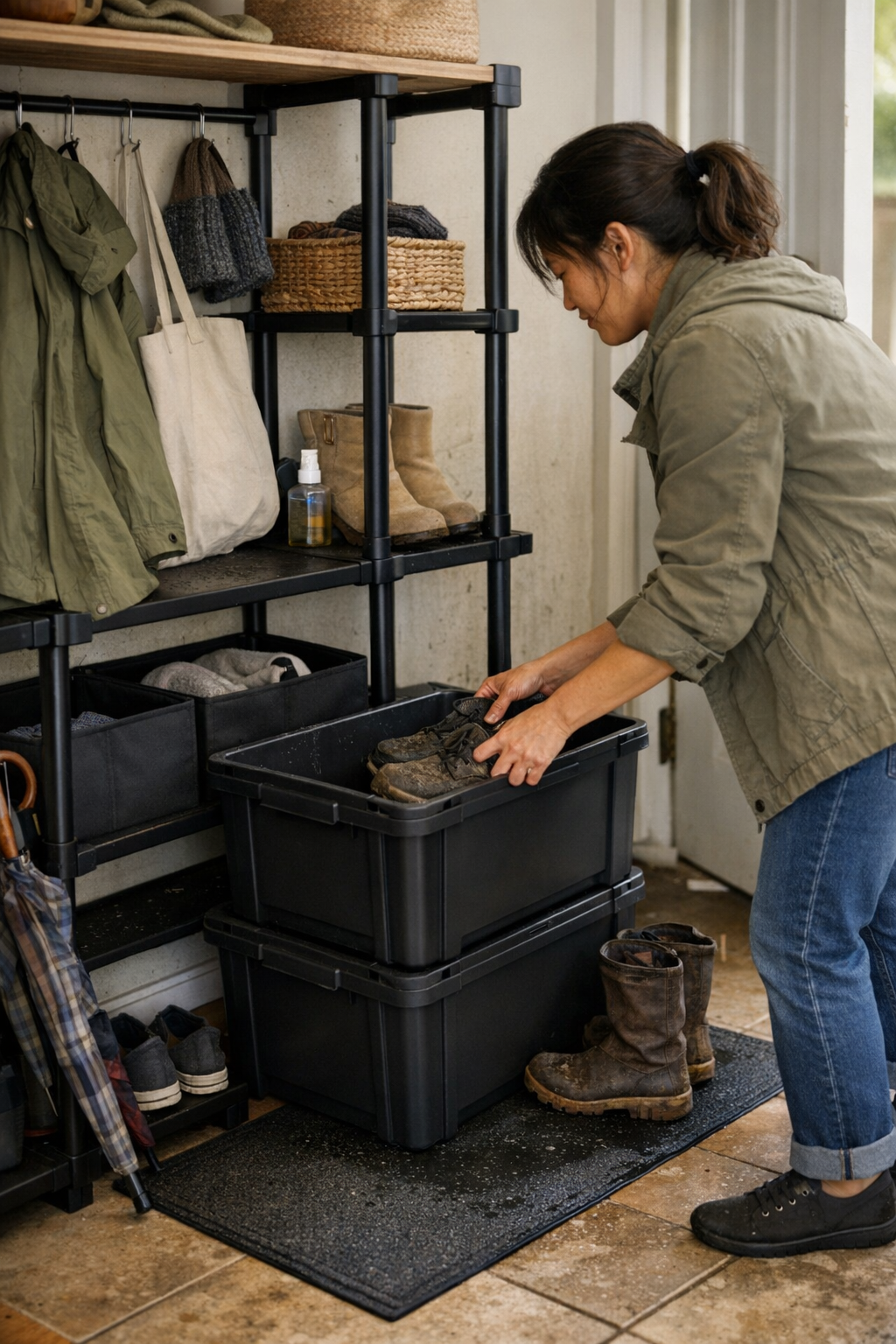
Swap in a weather-resistant bin and the daily flow changes immediately. Instead of patching up the same softening box, you get a structure that stands up—literally. Drop muddy shoes, hang up a wet jacket, toss in a heavy bag; the container holds its form. The lid shuts with one motion, gear stays where you left it, and the path behind you clears. One hand is enough to move the bin, even after a busy day—no awkward reshuffling, no checking for leaks, no scanning for stray edges or puddles. The difference isn’t cosmetic: durable bins absorb the shock, block moisture from creeping into the rest of your storage, and never fold under the pressure of fast-moving routines.
When a wet week ends, the only evidence is a quick wipe-down. Mud collects at the bottom, but never seeps through. Edges keep their right angle—no soft collapse, no trail of sloughed-off cardboard. The job of resetting shrinks to what it should be: one clear step, not a multi-part rescue mission. The transition zone holds, instead of demanding your attention at every crossing. Over time, you notice what no cardboard ever achieved—reset is a fast afterthought, not an ongoing obligation every evening.
Visual Appeal Isn’t Enough: Why Cardboard Is Best Left “Upstairs”
There’s a place for cardboard bins—out-of-season storage, top-shelf closets, or shallow stash zones where humidity never lingers and access is occasional, not constant. Use them to stack rarely worn hats or categorize light gear in dry bedrooms. At the door, though, cardboard fails the main test: resilience. It looks orderly at first, but can’t stop daily migration, can’t support the heavier stuff, and won’t keep overflow in check when routines speed up or weather turns. For transition spaces, surface neatness collapses under the stress of real movement and moisture—even the tidiest box at the season’s start will become unpredictable, shapeless, and in the way.
Seeing the Early Warnings: Signals Your Setup Is Breaking Down
Look for:
- Box sides bowing out after the first rainstorm, exaggerating the shoe row spill
- Sneakers tipping or sliding into the path, tightening walk space
- Base of the box collapsing, making vertical organization impossible
- Cardboard fibers breaking loose, leaving trails near the drop zone
- Increasing reset time—more minutes lost each night to restoring minimal order
Each sign is a flag that your setup is working against you—not with you. These aren’t minor annoyances; they add moments of forced attention at the very point in your day when you need movement, not management.
The Real Difference: Function That Survives Repetition
Moving from cardboard to a real weather-ready bin isn’t an upgrade for style—it’s a way to restore routine momentum. The difference is predictable, not just visible: resets become a single, sure movement; the threshold keeps its shape; overflow is contained rather than spread; the floor avoids puddles and trip points. Where you once tiptoed around semi-contained mess, now you move cleanly through the doorway, bags go down without risk, and gear lines up without escaping into the main living area. After weeks of uncooperative weather, the difference compounds: you stop expecting minor repairs every evening, and gain a front zone ready for whatever comes next.
If you’re stuck in a routine of shuffling bins, squeezing past the drift, or patching up a system that just can’t keep up, you’re not being too picky. You’re noticing signals your entry zone isn’t built to survive actual use.
See more transition-space storage solutions at Betweenry.