
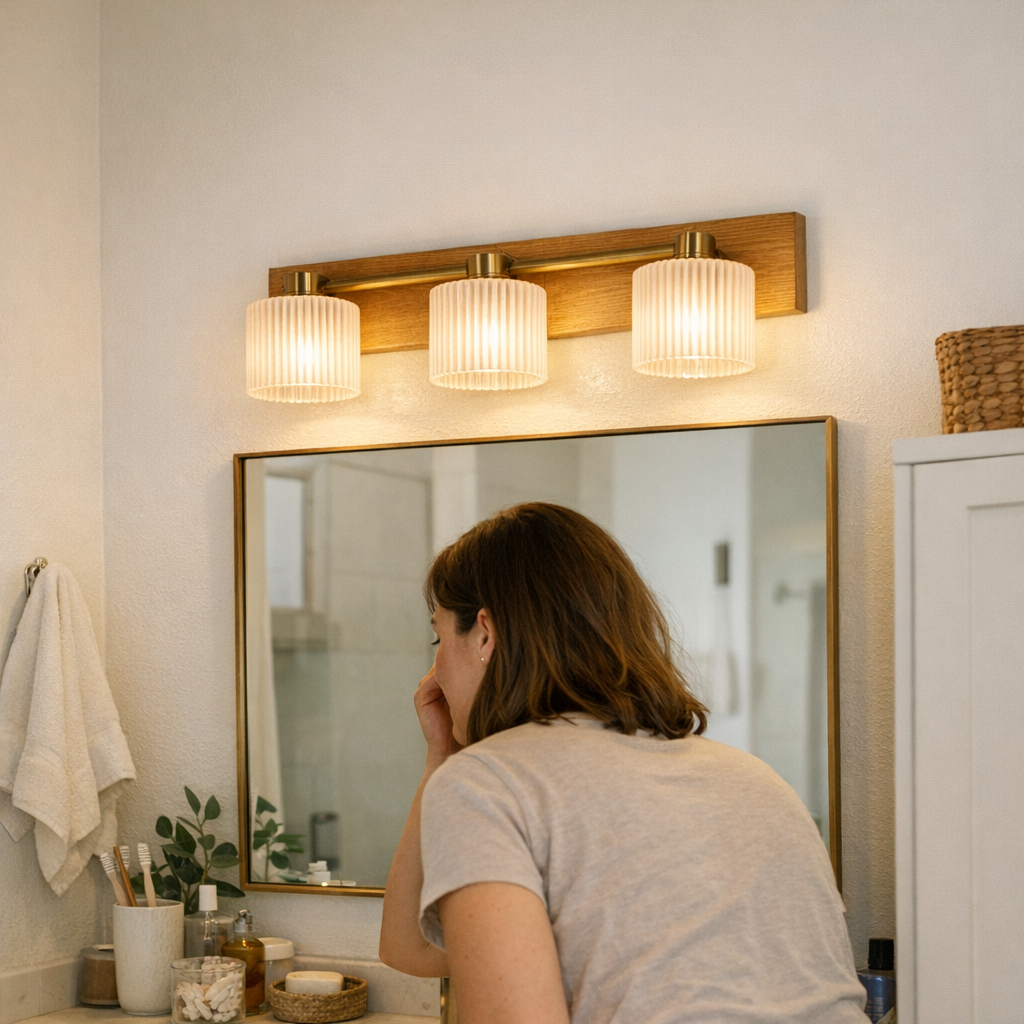
“Centered” lighting fails fast—just not where you notice it first. On day one, everything can look right: a flush-mount ceiling light square in the hallway’s middle, a sconce precisely above the bathroom mirror, a bright pool in the living room’s core. But week after week, friction piles up. The hallway that looked “done” now asks you to reach blindly for that lost shoe in the closet’s gray corner. The bathroom’s centered fixture leaves your face half-lit, half-vanished every morning. Even the living room’s glow can form islands of glare and dead space—the chair you actually sit in somehow always on the edge of the brightness, never at its heart. Lighting that fits the room’s geometry rarely fits the way you move, work, or see.
Why the Geometric Center Rarely Matches Real Life
The measured, centered fixture feels logical—flush mount or sconce, right in the blueprint’s crosshairs. In the real world, symmetry promises evenness but delivers a brand of inconvenience you only discover after repeated use. Rooms ignore the neat math: Sinks sit off-center, closets eat space at one end, and your daily routines—shaving, grabbing towels, taking the last stair—cut right across the “plan’s” blind spots.
Take a narrow hallway—drop a ceiling light in the geometric middle, and the closet at one end stays in shadow every time you need it. Each night, it’s the same: you cross into darkness, floor vanishing, searching by feel. In the bathroom, a wall light centered to the vanity—not your reflection—means mornings spent squinting at the bright half, guessing at the shaded half. The flaw isn’t in wattage or style. The flaw is lighting to a diagram, not to the way people actually use and cross each space.
When Blueprint Lighting Creates Everyday Friction
The trouble with “design-perfect” lighting shows up in small, accumulating failures:
- Stair turns: The landing is in shadow, even though the fixture is centered on the plan—making each descent or climb hesitate at the same dim patch.
- At the mirror: As you lean closer, the light splits your face: one side is all glare, the other side fades out—never balanced, always annoying.
- Night hallway walks: The path glows in the middle but drops off on one side, or by the closet, or at the far door. You adjust your route or slow down every time.
- Kitchen counters: Under-cabinet lighting leaves your usual work edge in stubborn shadow—the place you chop, pour, or sort is always just out of reach of clean light.
These aren’t mere annoyances. They break the rhythm of a room. Every time you shift, stoop, or squint for better clarity, it’s not the bulb failing you—it’s the entire approach. Rooms aren’t meant to be posed; they’re meant to be used, and lighting fixed to abstract centers keeps interfering with routine comfort.
Small Shifts, Big Difference: Adapting Fixtures to Real Use
You don’t always need new fixtures or complex rewiring to escape central-lighting traps. Much of the time, comfort returns with a simple adjustment: moving a fixture a few inches, splitting up the coverage, or realigning toward actual activity zones.
Bathroom Mirror: Sync the Light, Not the Plan
If your main sink and mirror are offset on a long counter, a perfectly centered ceiling fixture lights the room but leaves your reflection lopsided. Nudging that flush mount even two inches closer to where you stand at the mirror balances the field—no side lost in shadow, every shave or face wash clear-eyed. The entire experience sharpens without a single extra lumen, just a smarter placement.
Hallway and Closet: Cover the Movement, Not Just the Geometry
In a narrow corridor, a lone mid-point light leaves each end washed in gloom. Adding a second flush mount near the closet or nudging the original toward the storage zone can finally erase those persistent pockets of dimness. Suddenly, grabbing laundry at night, the darkness isn’t a second obstacle. The room shifts from “lit everywhere but where you need it” to “always clear where you move most.”
What Signals a Poor Lighting Center?
Lighting can meet all the drawing rules and still betray you daily. Common signs:
- Glare in the mirror above an offset sink, blinding one side and shadowing the other—never a full, clear view
- Consistently dark ends by closets, cabinets, or doors, no matter how many times you swap the bulb
- Always needing to tilt, lean, or step off-mark for clear sight—folding, brushing, sorting, or cleaning
- Light lines directly in your eyes when passing through a hallway or alongside a cabinet run, not above or behind where it helps most
If you’re always compensating—bending, squinting, pausing—the “right” center on paper is wrong in the real room. That’s not a quirk; it’s correctable misalignment.
Realignment: How (and Where) to Shift Lighting for Better Comfort
Room comfort starts with matching light to movement, not floorplan geometry. Here’s where small changes make outsized differences:
- Stair landings and corridors: Shift a flush mount toward foot traffic or install a second fixture at the landing; focused clarity matters more than general glow.
- Mirrors and vanities: Adjust wall sconces or over-mirror lighting to match your stance, not the counter’s full width—a single inch’s move can banish repeated shadow.
- Task counters and under-cabinet areas: Align fixtures or strips where you prep or read most, not just in the center; mark activity, not symmetry.
- Hallway ends and storage nooks: Illuminate where you actually pause or put things away; these dead zones are where abstract “centering” gives itself away every time you use the space at night.
Lighting for Life: Turning Measurement into Usability
Reliable comfort in any room isn’t about mathematical perfection. It’s about whether every step, turn, and task happens in steady, clear, shadow-free light—not just under a broad haze in the middle. If your lighting never makes you squint, hesitate, or guess, the setup is tuned to your real routine, not just the architect’s plan. Sometimes that means nudging a flush mount, adding a semi-flush near the stair, or giving the laundry corner a dedicated light—small structural decisions that eliminate recurring inconvenience.
When the lighting in your home finally follows you—rather than forcing you to track the blueprint’s center—you’ll notice. Not in the way a guest notices, but in the absence of hesitation and in the ease of daily repetition. Centered lighting looks organized; well-placed lighting feels right, every time you cross the space.