
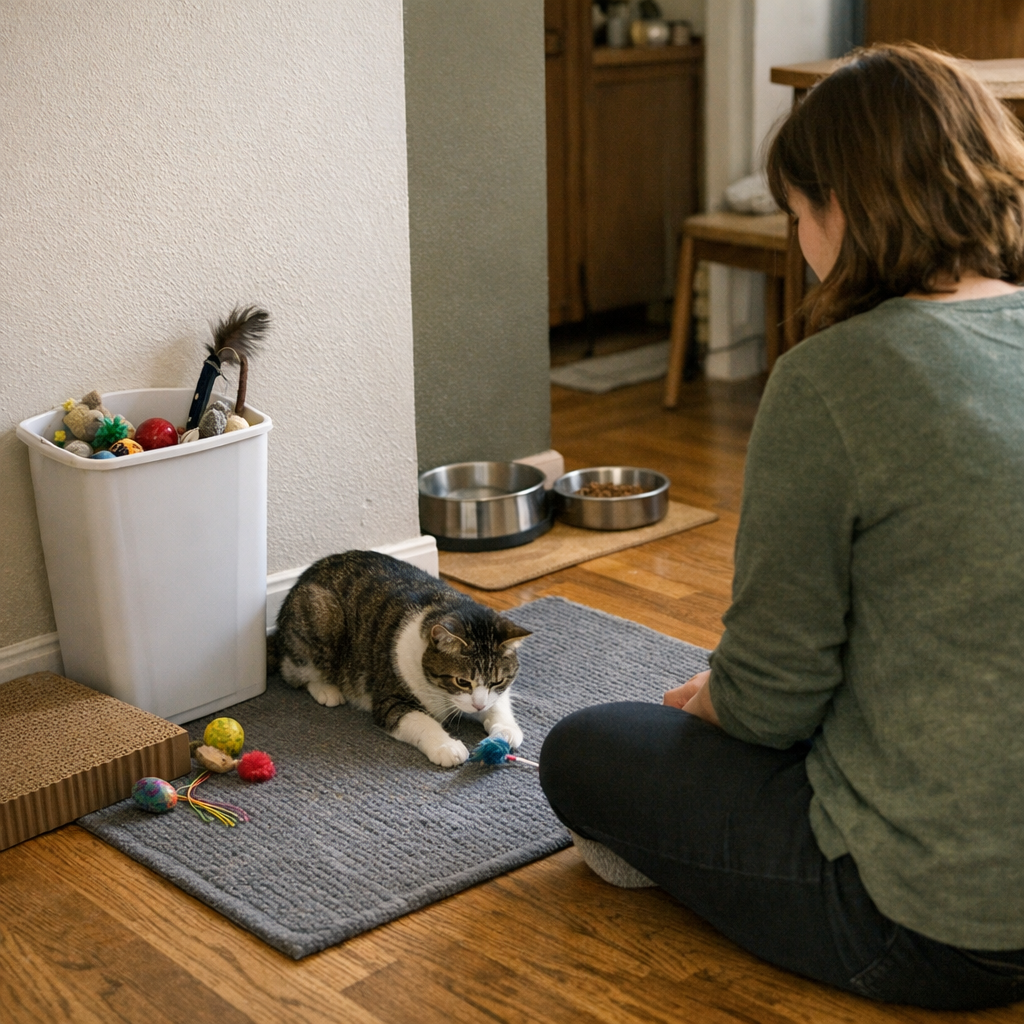
Cleanup always sounds simple until you run it on repeat. A toy storage bin fixes scattered “cat stuff” for the first day: the room looks clear, and chasing a wand toy doesn’t have to mean crumbs in every corner. But reality sets in the third or fourth time your knee clips the bin edge as you refill the water bowl—or the moment a stray plush squeezes underfoot right where groceries come through or the next meal is prepped. Suddenly, it’s not about less mess. It’s about constant, minor reshuffles that stack up across the day and quietly reverse your win.
When Convenience Becomes Collision
At first, the logic is obvious: keep the toy bin by the play mat, clear the clutter in one scoop, and get space back immediately. It works—if you reset every session and never rush. But in actual use, routines overlap: you’re tidying toys at breakfast when the cat dashes for kibble, or you sweep up after play while juggling an armful of laundry. That’s when a once-perfect setup starts crowding everything else. The bin drifts into pathways, a crinkle ball rolls under the water station, and the one bin meant to fix chaos becomes the obstacle you keep bumping on every short trip. Each skipped reset, even one in a busy week, spreads toys and storage just enough to get in your way.
It’s rarely a meltdown—but it’s never “done,” either. A space can look presentable and still snag snacks, snag feet, even slow down the next refill loop. Overlapping routines—feeding, playing, sweeping up—turn neatness into a daily maze.
How Toy Drift Breaks the Daily Reset
Routine is relentless: you feed, clean up, play, reset, and repeat. The failure point isn’t dramatic; it’s one skipped or distracted reset when something else needs attention—like scooping litter or dealing with a water spill. That’s when system cracks show:
- Toys find the wrong areas. Stuffed mice wedge under feeding mats, or catnip fleece ends up soggy on the edge of the water tray. Mealtime means taking one extra minute to fish toys out of spill zones—or worse, missing them until the next accidental step.
- The bin turns obstacle. Drift just a couple inches, and suddenly it blocks the path to refilling the fountain or sweeping up shed fur. What felt “tucked away” in the morning juts into your route by afternoon.
- Micro-adjustments drain time. Instead of a single pass, pickups turn into two or three sweeps: move the bin again, nab that runaway spring, clear the mat line. The upgrades you hoped would save cycles only create new friction.
The space doesn’t collapse into chaos, but the routine is slower, and the reset never feels complete. Every shortcut today adds a complication tomorrow.
Why the “Perfect” Spot Decays Over Time
Every setup looks organized when freshly reset: toys neat, mats aligned, bins in position. What you don’t see is how quickly convenience sours as tasks pile up. By midday, the “tidy” zone feels crammed, and the energy needed for one more adjustment outpaces any initial time saved. True weak points show up only as the day layers: the bin blocking the hallway for a second time, a plush mouse dusted with shed fur after a sweep, a toy spring sitting damp by the water dish. One rushed moment, and the order blurs fast.
- You sidestep the storage every feeding refill and nudge toys aside, again.
- Playtime leftovers show up where cleaning can’t reach—like in front of a drippy water fountain or pinned behind furniture legs.
- Quick sweeps miss what’s beneath the visible layer, so tomorrow’s mess drifts out where it interrupts something else.
What once took seconds now takes minutes, and each reset only half fixes the overlap. Chores start to repeat themselves—but slightly more awkward each time.
Seeing the Difference Between Tidy and Truly Usable
An indoor setup can look under control and still jam up your basic movements when things get busy. Toy bins rarely block you outright at first. But the pace of daily life forces small compromises: you step over a lid, dig for a wanted toy while two others tip out, or find reset routines dragging as you avoid knocking the whole thing sideways again. Over time, tidiness without boundaries only creates extra layers to undo.
- The shortest walking line gets blocked by a bin corner you barely notice until your shin brushes it, again.
- You spot a favorite cat toy but have to empty half the bin to reach it—meaning more mess after you’re done.
- Each pass-through gives you an extra reminder that even “put away” can still mean “in the way.”
Real convenience isn’t about proximity—it’s about staying out of the crossover. The most common mistake? Using visible tidiness to hide daily friction. The wrong fix always trades one small problem for another that you notice the next time you move.
One Adjustment That Loosens the Chore Cycle
The single most effective shift isn’t a new organizer, but moving your current setup just outside daily collision zones. That means the toy bin lives a mat’s width away from food and water—far enough not to snag a refill pass, close enough for cleanup to stay quick. Out of the main path, and just past the “cat chaos” spill line. In reality, that’s a couple feet, or the edge of a bench, or one square of floor your cat doesn’t race past at top speed.
- Toys collected after play don’t bleed into meal prep or get stuck by the water.
- Resetting happens once; hunted-for objects don’t require second sweeps under or behind stands.
- You avoid working around your own cleanup. Access stays easy, but nothing blocks the next run-through of basic chores.
- Now, when routines overlap—scooping bowls, toy pickup, mat wipe-down—they don’t force you into makeshift fixes that only last until the next rush hour in your home.
The smallest move changes the feel: instead of “fixing things again,” those chores stop interrupting one another. The shift is easy to miss at first, but after three days you’ll notice what you haven’t had to redo.
Practical Boundaries: Small Changes, Real Results
Create a hard boundary between play and feeding. Just one mat’s width—about 18–24 inches—acts as a neutral zone, stopping toys from drifting into food and water territory. The result: less cross-contamination, no more feathery debris appearing mid-meal, and a lot fewer plush toys getting caught up in dried kibbles or water splashes. The bin itself is easier to access but never blocks the hand-off between one cat routine and the next.
Choose bins that reinforce the boundary, not just hold clutter:
- Open bins let you scoop and drop without pausing. Reset cycles stay quick, even on busy mornings.
- Lidded or fully enclosed bins trade off a few seconds of visual calm for longer stalling—most people skip the extra step, leaving toys out to “get later.”
- Slim, corner-hugging options fit behind low benches or next to shelf lines, keeping the boundary visible and blocking drift without taking over the whole room.
If there’s no defined border, use a mat as much for your own cue as for the cat’s. Everything inside the edge gets put back, everything outside is out of play. In time, your cat’s habits help—less toy spread, less guessing games with what you’ll find underfoot when the lights go out.
How Repeated Routines Reveal Weakness—and the Solution
Repetition is what exposes every setup’s flaw, and repetition is daily life with indoor cats. Maybe the same plush mouse turns up four times a week behind the trash can, or the bin gets kicked out of position each time you pass with groceries. These aren’t failures, just bright signals for precisely where your structure needs its nudge—or a new boundary to divert mess before it interrupts another routine.
Moving toy storage out of the overlap zone won’t make your home magazine-clean, but it does break the loop of endless re-dos. Over the course of a normal week, you’ll spend less effort battling sideways sprawl, and more time actually enjoying what works—letting cleanup and comfort reinforce each other instead of fighting for space and attention.
For more ideas on practical indoor-cat arrangements that reset easily and work under real conditions, visit StillWhisker.