
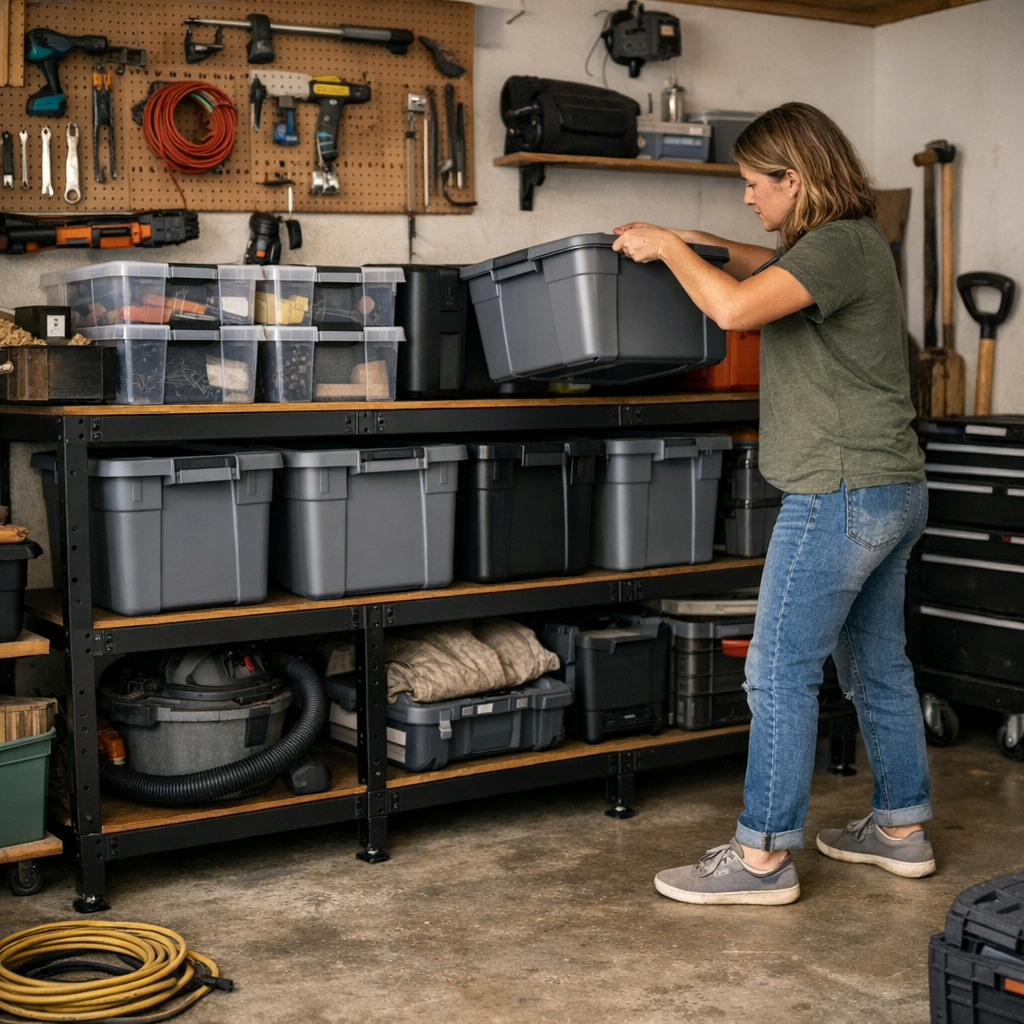
The comfort of floor storage is always temporary. At first glance, the bins along your garage wall or the crates at the edge of the workshop look deliberate—labels crisp, floors swept, everything lined up for action. It’s a transformation you notice immediately. But by Wednesday, those same neat lines force a slow shuffle: bending for the lower bin, shoving a stack aside to reach the bucket underneath, inching a cart just to clear a path. That sense of control unravels every time you hunt for a tool or make space for the next project. The system that’s supposed to keep you moving quietly becomes what stalls you mid-routine.
Order That Only Holds on the Surface
There’s a crucial gap between storage that fits the room and storage that fits the way you actually use the room. Floor-based rows of bins deliver a sharp first impression—until repeated grabbing, returning, and shifting churns that order into a daily obstacle course. The slip is so subtle you hardly notice it at first: ducking beneath a low shelf, sliding a bin a few inches, leaving one out “for now” because the next job is coming up fast. But these small detours pile up fast. Before you know it, the bin by the door is always askew, and your main pathway is a zigzag around another stack growing in the corner. What looked efficiently stored now shapes how—sometimes even whether—you get the job done.
The Cumulative Drag of Repeated Moves
Picture unloading new supplies midweek. The intention: quick, easy access. The reality: bins edge-to-edge, barely enough room to wedge in another container. An open box half-blocks the entrance. Your first project is now a slow step-and-shift routine—buckets moved, bins nudged, hunting for a part that’s buried under last project’s leftovers. Each week, categories blur as labels land on the wrong bin, and the top layer becomes a precarious stack that dares you to pull from the bottom. Over time, “organized” becomes an endurance test of stacking, restacking, and working around your own system.
Blocked Paths, Dead Corners, and the Hidden Cost
The breakdown happens quietly, away from that first-day order. It’s not a pileup overnight—it’s a space that loses its flow, task by task. The cart doesn’t go back where it belongs because bins block the route. Wall space below knee level fills with storage, but above it, nothing is usable; gear overflows into empty corners that were supposed to stay clear. Floor bins—once a tidy grid—become a real-life Tetris: bump one, and the others shift off-mark. Now the space isn’t flexible, it’s stuck—forcing improvised piles, awkward detours, and a pattern of always working around clutter instead of clearing it.
Everyday Friction, In Practice
- You try to grab a drill at the back—but two bins and a cart are blocking access, so you pull out half the row, only to put them all back minutes later.
- Resetting for the next project means balancing stacks, hoping the lid stays on. An accidental shove and it all slides off-mark—again.
- That simple evening repair takes longer; the path you cleared last weekend is now blocked by an overflow bin from Monday.
- You realize you’re carving out more time managing storage than working on the project itself.
Why Real Routines Outpace Floor Storage
If your bins store holiday décor or untouched archives, floor setups work for a time. But day-in, day-out use—gardening, repairs, the workbench routine—reveals the friction fast. More bending to dig beneath the last stack. More detours when a cart or hose blocks the “main” route. Tools and parts never quite make it back to their slot, so categories blur; overflow bins migrate from one zone to another, turning spatial order into a moving target. In setups with any real rotation, the footprint that looks organized on Sunday becomes the slow-down you dodge all week long.
When Visual Order Becomes Practical Disorder
You don’t notice efficiency slipping away until it’s gone. Suddenly, every retrieval has its own obstacle course: stepping over the end of a bin line, twisting around an out-of-place cart, bending and re-stacking more often than actually using what’s stored. The path is “clear” only if you’re willing to rework it—so you start avoiding certain supplies, or stacking odds and ends elsewhere “just for now.” What was meant to speed up projects now eats up whole afternoons with routine shuffling just to restore that illusion of order.
The Game-Changer: Lifting Storage Off the Floor
In one garage, the breakthrough came not from buying more bins, but from lifting storage a modest six inches off the floor. Suddenly the daily bends, shuffles, and stumbles faded. Carts rolled cleanly underneath, aisles stayed open, and bins became easy to access—no toppling, no triple-stack, no detours needed. Without adding a single square foot, the difference in everyday movement was immediate: the setup actually encouraged order to last, not unravel.
This isn’t magic—just a smarter use of space. No more sliding boxes to get the one you need. No more dead spots in the corners. Cleaning up stopped being a full-on production; it became a two-minute reset. You could finally see and reach everything in one step. The whole footprint performed more like an active workspace—and less like a storage unit you dreaded sorting.
Four Ways to Quiet the Daily Friction
- Break the stack habit: Store bins in a single layer. Toppling, digging, restacking—it all disappears. Need something? One move. Done.
- Lift with intention: A low platform or modular shelf means rollers fit beneath, bins pull out fast, and you’ll stop using open floor as overflow parking.
- Spot the overtime signals: If you’re bending, shoving, or re-sorting bins more often, your setup’s overdue for a rethink. The moment it slows you down, change it.
- Test your reset: Returning things to place shouldn’t feel like a chore. If it does, your system isn’t built for repeat use—fix the pain before it becomes baked into your routine.
Let the Workspace Move With You
No setup eliminates all effort. But the right one keeps friction low, even when projects, tools, and routines change. Floor storage might look decisive, but if every return to your garage, workshop, or shed brings a new obstacle or detour—even a small one—the organization is only skin-deep.
Refining your layout doesn’t demand a total overhaul. Just raising storage, rethinking the footprint, or swapping stacks for modular shelves can flip the routine: no more sidesteps, no more daily blockages, and no more abandoning projects because it’s not worth the reach. If resets feel like a chore or your “organized” area leaves you reshuffling, don’t blame yourself—pivot the setup. Protect your pathways, keep your best gear within arm’s reach, and build a space that actually works with you, not against you.
Find modular storage solutions built for real-world use at StackNest.