
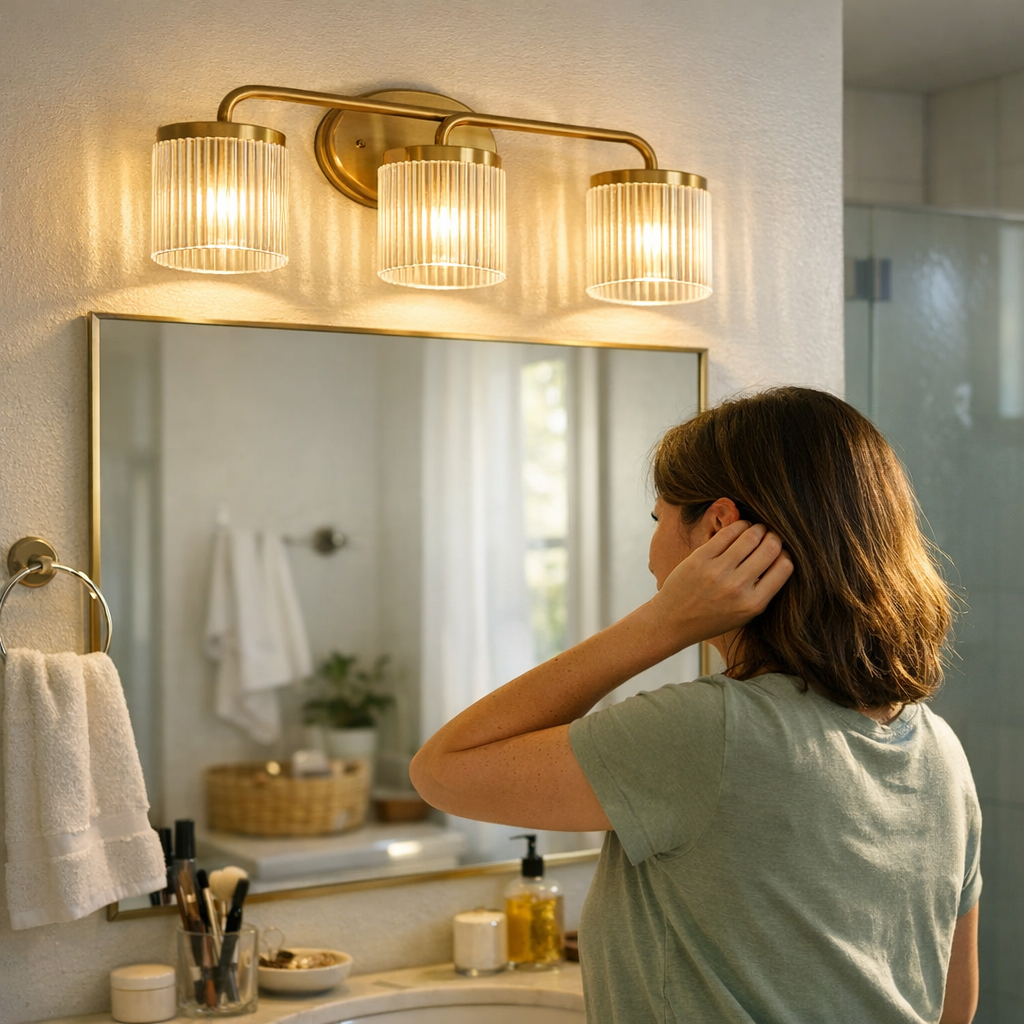
Most indoor lighting mistakes don’t announce themselves all at once. They reveal their flaws every time you reach the stair landing and hesitate because the next step disappears in dimness. The bathroom mirror looks well-lit—until morning hits and you’re forced to lean or squint just to shave or see both sides of your face evenly. What looks “done” at first glance quickly exposes glare, blind spots, and shadow patches as soon as you begin your daily routine.
Where “Good Enough” Fails: When Repeated Use Uncovers Awkwardness
You can meet measurement guidelines and still end up with lighting that sabotages daily comfort. The blueprint might check out. But when you pace the same hallway every night, the slight dark edge at each end creeps in. Cross the living room and realize that one reading chair stays in half-shadow, no matter how many times you nudge the lamp. Or step into the bathroom and watch the difference: one cheek bright, the other sunk in grayness, the result of a “centered” fixture that never took real reflection lines into account.
These aren’t dramatic flaws. They’re subtle annoyances that stack up. A semi-flush ceiling fixture, placed a few centimeters off center in a corridor, can cast a persistent shadow you learn to avoid without even thinking. A wall sconce on the stairway, installed a touch too high, leaves the lower steps unlit—enough to make you slow down at the turn. These mistakes don’t show up in still photos, but they wire themselves into daily movement: small hesitations, involuntary squints, extra steps just to find clear visibility.
Mirror Lighting: Shadow Imbalance and Persistent Glare
No flaw draws attention faster than the bathroom mirror that throws your face into uneven light. Vanity lights, “properly” installed by number, can create persistent shadows or a direct glare line slicing across your eyes. The visible imbalance is instant—one side washed out, another left dull, the effect only growing worse if the fixture sits just a fraction too high and bounces straight into your sightline. Every basic task—brushing, shaving, makeup—becomes unnecessarily awkward, all for want of a few centimeters’ difference in placement.
The Real Cost: Patching, Scarring, and Recurring Frustration
Missing the mark with lighting isn’t a quiet mistake. Every attempt to fix it—moving a flush mount, realigning a sconce—leaves patched holes in drywall, visible blemishes, or mismatched paint spots that don’t quite disappear. Even a small error can haunt you: you see the patch each time the light turns on, or find yourself still pausing at the same dim spot. The result is a space that looks finished but never feels fully comfortable, with each workaround becoming part of your routine.
Movement Paths Overrule Measuring Tape
The difference between “good” and “actually good” lighting comes down to how the setup follows movement, not just where the tape measure says a fixture belongs.
If you only mark placements by drawing lines on paper, you’ll miss the spots that matter—where your shadow always falls as you lean over the kitchen sink, or where the stair sconce fails to reach the bottom tread. The practical fix is simple, but often skipped:
- Mock up live placements: Hold the fixture or tape it temporarily where you think it belongs.
- Walk every path: Take the routes you’ll walk at night—hallways, stairs, kitchen routines, mirror moments.
- Check from use angles: Open doors, move along counters, use the space as you do in real life, and watch for surprise shadows or stray glare.
It’s rarely more than a two-centimeter correction that solves the persistent shadow or erases the daily squint. One exact scenario: a bathroom mirror lit perfectly head-on when standing straight, but the moment you open the door or lean sideways, a dark wedge appears. Shifting the fixture mark just slightly can dissolve these phantom shadows, saving you that morning frustration for years to come.
Minor Shifts, Major Difference in Daily Flow
Tiny misalignments nag more the longer you live with them. In the laundry room, the flush mount positioned closer to the door might leave the wall cabinet in constant shadow—a hassle that gets under your skin each time you reach for supplies. In kitchens, even bright rooms expose their weaknesses if the under-cabinet strip misses the working edge or leaves a corner dark. Food prep slows, and what’s supposed to be bright, usable space becomes another task to work around.
Spot the Signals: How Misaligned Lighting Shows Itself
You don’t need an expert’s eye to notice when your lighting isn’t working. Watch for:
- Hesitating at a stair turn because the bottom vanishes into shadow
- Turning or ducking at the bathroom mirror to dodge a harsh shadow line
- Shifting your desk or seat to avoid glare cutting across your work
- Crossing a hallway where the light seems to vanish near the far wall
- Reaching for a counter or sink edge that’s never fully lit, even in a bright room
These aren’t one-off inconveniences—they become part of your daily pattern if left unresolved.
Avoid Repeating the Patch Job: Check Placement in Real Time
Don’t gamble on perfect placement from a drawing alone: Test fixtures in their real positions before final installation. Use painter’s tape or a temporary hook, turn on the light, and walk the space. Let shadows, sightlines, and coverage show their truth before you ever put a hole in the wall or ceiling.
Spending ten minutes to check—before anchors and drills—can save you hours of repairs and years of eye-rolls each time the glare or shadow returns. Minor tweaks in mockup allow you to catch the persistent annoyances early, instead of living with them day after day.
Lighting for Real Life: The Difference Between “Bright” and Truly Clear
A room can look finished and still force you to pause, squint, or step around the same awkward shadows forever. The setups that actually work anticipate movement, task spaces, and the risk of uneven spread—so you don’t find yourself dodging the same problem every time you walk through or look in the mirror. Hallway flush mounts that cover both ends, stair sconces that light every tread, under-cabinet lights that reach the full work area—these get chosen for how the space is used, not just how it looks when empty and new.
Start with the flow of daily life—where you stand, walk, reach, and look—then mark fixture locations to fit those behaviors. Spaces lit for real use don’t just look good; they feel easier every day, with no hidden friction or puzzling shadow trying to trip you up.
For practical lighting that fits real life, see the full range at LightHelper.