
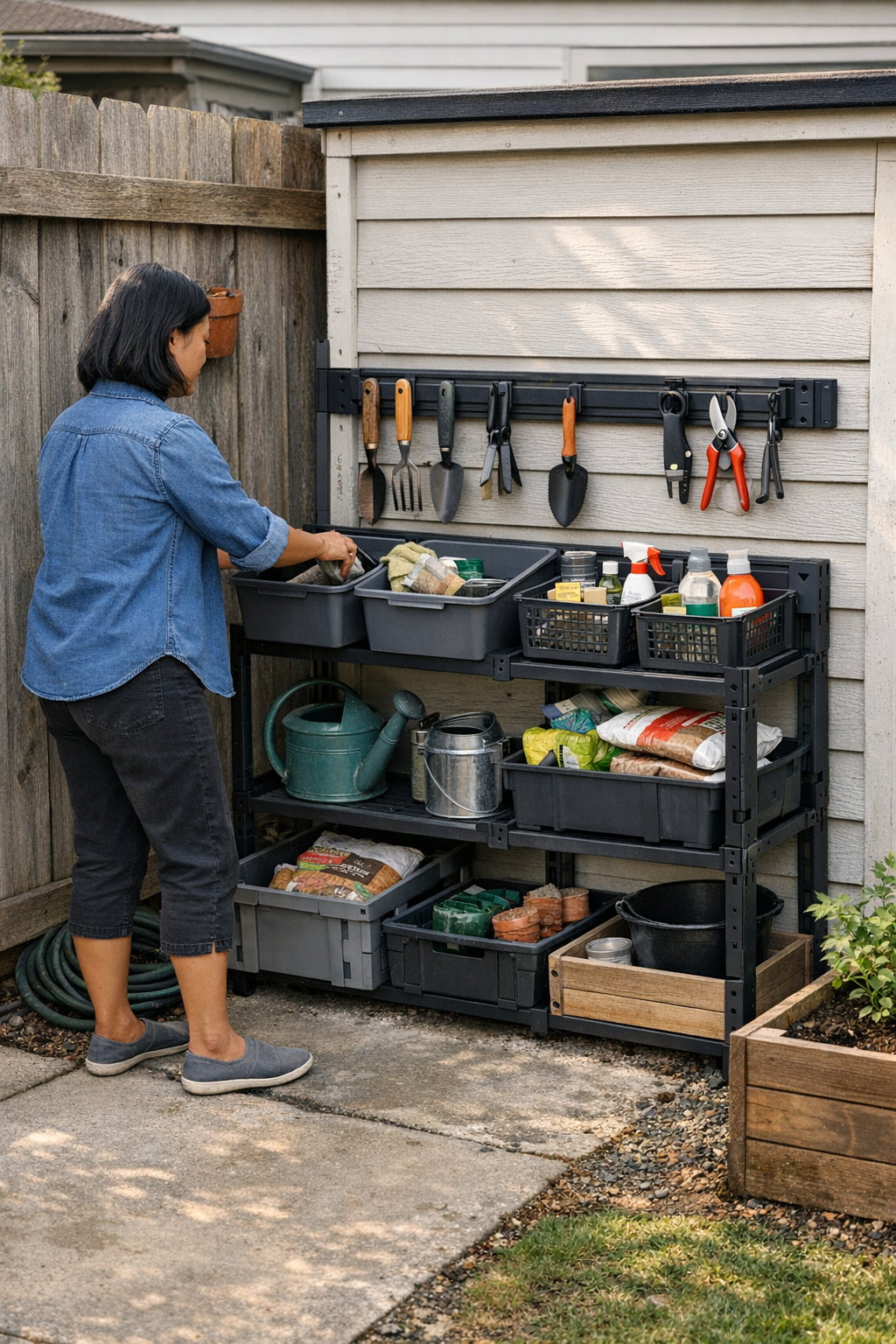
Most outdoor storage looks tidy—right up until your yard actually gets used by more than one person. It’s easy to nod at a wall of hooks or a row of bins and call it organized, but within a weekend of kids, housemates, or visiting relatives grabbing and returning tools, the friction sets in fast. A garden corner that starts efficient becomes jammed and unpredictable—a trowel lost under spades, a rake wedged sideways, a bin lid refusing to shut. The routine slows, the path clogs, and what was “storage” turns into a quiet mess with every round of use.
Why Shared Tool Storage Breaks Down So Easily
Disorder creeps in the moment people use the yard differently. A setup that handled solo use suddenly reveals blind spots: one person lifts a rake onto a top hook, someone else can’t reach and leans it in a corner, another just drops their tool at the nearest available spot. A small shovel blocks a broom’s handle; a tangle of gloves piles up behind bins. Every quick return becomes a rearranging act. By the end of the day, what should be a two-second task stretches into shuffling, tugging, and digging for what you actually need.
The design of bins and racks promises clarity, but repeated use exposes their weak points. Bins designed for “overflow” rapidly swallow everything—handles tangled, trowels buried, smaller gear impossible to fish out without pulling half the contents onto the grass. Wall hooks, mounted too high or too tightly, become unreachable for some and ignored by others. Soon, tools are abandoned below, and the wall “storage” becomes mostly wall decoration. Pathways constrict. The reset each evening drags out, and the corner meant for quick storage becomes a bottleneck instead.
Blocked Paths, Stalled Resets, and the Cost of Overflow
Walk along any fence-line or side-yard utility zone that sees real use, and you’ll find the story: organized hooks for brooms and rakes, a mid-sized bin for hand tools, a space cleared for the wheelbarrow. By midweek, a familiar creep begins—a shovel propped against a bin because no hook fits, then another tool on top “just for today.” Bin fills up? The spillover lands on the ground, transforming a path into an obstacle course. By Saturday, getting the hose means moving a rake, three spades, and the lid of a bin that now serves as a makeshift shelf.
The end of a work-heavy day doesn’t bring a quick reset. Instead, it’s a hunt through buried gear, sorting gloves from plant supports, undoing tight clusters of handles, or recovering a lost kid’s toy from the dead corner where overflow always piles up. The ten or fifteen minutes of “reset” rarely splits evenly; it falls to whoever is left cleaning up, again and again. Over weeks, frustration outweighs organization, and the rounds of effort just reinforce the trap.
Crowded Floors and Wall Space That Doesn’t Help
Grabbing another rack or bin feels like a solution, but the effect is usually more clutter—floor space gets choked, not cleared. Small tools slip beneath larger ones, and that extra bin for “miscellaneous” quickly fills with everything no one wants to put away properly. The wall may have five more hooks, but if they’re out of reach, too bunched, or tucked behind some plastic storage, they’re just decoration. Each return turns into a minor puzzle: where does this actually go? If you have to push things aside to make room, your system is already giving out.
It shows in the daily patterns: a wheelbarrow blocking the path to the shed, a rake stuck against the gate, a rolling tangle at your feet every time you open the storage unit. The surface “tidy” only lasts until real movement happens. Every extra step—moving three tools just to return one—just slows things down and makes every task feel heavier.
Small Adjustments That Actually Rescue Your Flow
True improvement rarely means adding more storage—it means adjusting to your routines. After lowering the most-used tools to arm’s height, close to the entry, spontaneous pileups practically disappeared. Breaking up wall space by category—pruners here, digging tools there, handles with room to breathe—does more than look neat. Suddenly, anyone returning something can see what goes where, and nothing blocks another item’s spot.
One change made a bigger difference than expected: marking a 60 cm “clear zone” near the wall—a strip where nothing is supposed to sit, ever. If that path gets blocked, it’s a fast sign the system failed, so it gets fixed right away, not left to stew. The result? Resets are faster, even when two or three people return tools at once. Instead of dodging piles, they actually use the space as intended.
Real-World Fix: Assign and Adjust
Hooks and racks only work when assigned—mixing everything together is a guaranteed mess. Specific assignments build real habits: pruning gear always on reachable hooks, heavier tools grouped tightly, less-used items tucked out of the path. Dumping “miscellaneous” into one giant bin creates a black hole for anything you want to find later. Every stray item is a sign to reconsider the routing, not make another pile.
Imperfect Setups Are the Real Test
No outdoor organization lasts pristine through storms, weekend projects, or a yard full of kids. The true win isn’t photo-perfect storage, but the way a setup resets under pressure. If every tool can return without shoving, stacking, or blocking the next movement, that’s the difference between a functional yard and another space eaten by frustration. Consistency matters more than perfection—systems that forgive messes and reset quickly actually survive real use week after week. That’s what keeps the path open, your time intact, and your corner of the yard shifting with the rhythm of real life instead of stalling out with every busy weekend.