
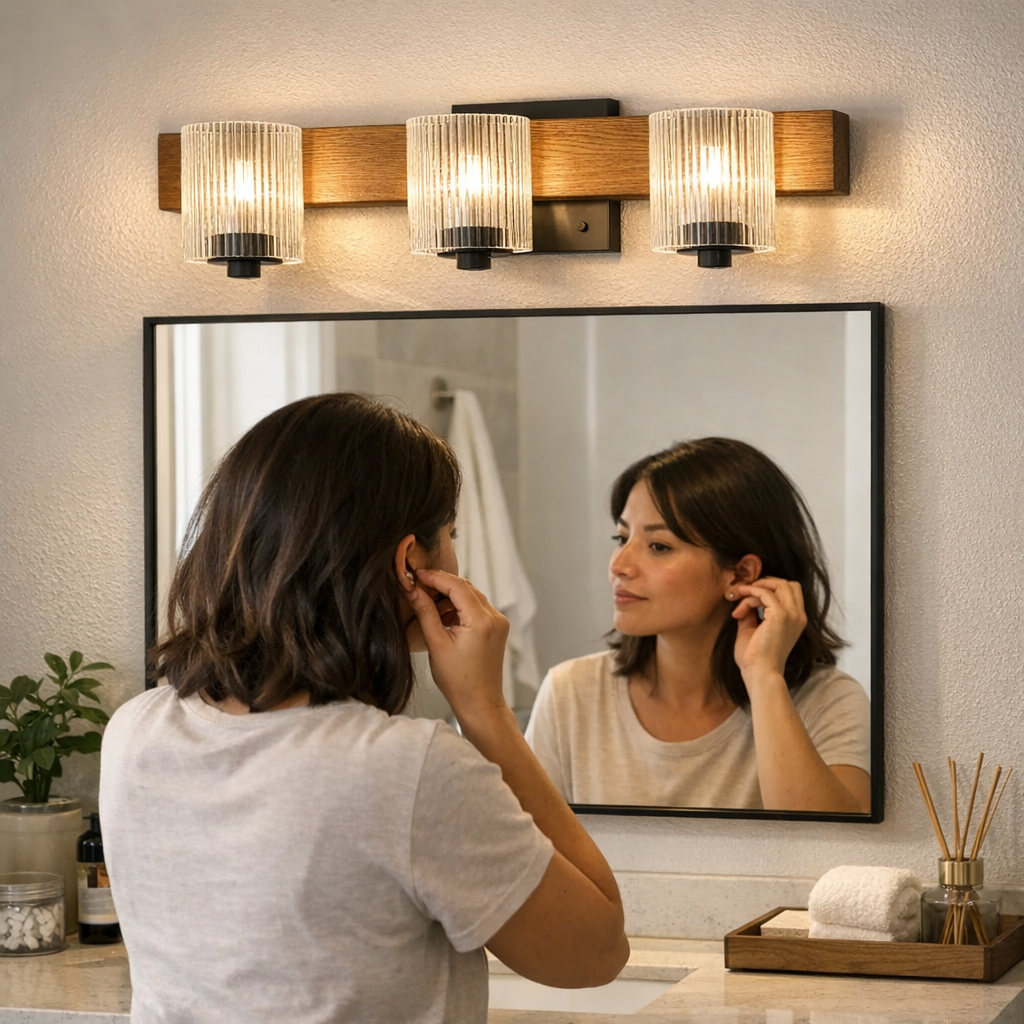
The wrong mounting hole doesn’t ruin a room in one dramatic moment—it quietly disrupts every routine. A flush-mount ceiling light just off-center in a low hallway forces you to squint past glare each time you cross at night. The vanity fixture you trusted to the template delivers shadows on half your face every morning, making you adjust your stance or tilt your head to get half-decent mirror light. Most people don’t realize how quickly a minor mounting misfire becomes a permanent source of irritation—one that colors how you move, clean, check your reflection, or work at a countertop. This is the part of indoor lighting that rarely gets fixed later, and yet it’s the reason a space keeps feeling “off” long after install.
Why Mounting Hole Placement Matters—Beyond the Installation Guide
Lighting fixtures may come with standard mounting holes and template guides, but real walls, ceilings, and routines rarely match the instructions. The placement you pick sets up the entire behavior of light and shadow in your space—whether the fixture is a flush-mount in a narrow hallway, a wall sconce by the stairs, or vanity lighting above a mirror that doesn’t quite line up.
Trusting the default position or quickly marking holes by eye is where the real problems start. You might not notice with every switch-on, but a dozen little moments reveal the miss: stairways with edges lost in shadow, bathroom mirrors split between glare and gloom, hallway lights aimed too low or too high, sending harsh light right at eye level or leaving safe movement in doubt. The imbalance never improves with use; it only multiplies as routines repeat and minor inconvenience turns to daily friction.
Everyday Use Reveals the Gaps
Lighting failures aren’t theoretical—they show up in how you move and work, again and again. Picture a hallway that looks centered on install, but as you walk through at night, you find yourself dodging bright glare and pausing at darker patches near doorways. Lean in at the bathroom mirror: one half of your face is crisp, the other indistinct, so you start shifting your stance or stooping for better balance every morning.
Task lighting signals the same problem: under-cabinet fixtures mounted an inch too far back throw part of the counter into shadow, forcing you to reach farther or move cutting boards to avoid the dark. In a laundry or utility zone, the “bright” ceiling fixture leaves the far side of the hamper or counter in gloom, requiring a portable lamp or a hand-shield against glare to get chores done. These annoyances do not go away, no matter how sleek the fixture or how high the wattage—they come straight from flawed mounting logic.
How Skipping a Simple Check Becomes Ongoing Irritation
Most persistent lighting problems are rooted in small, overlooked alignment mistakes. A flush or semi-flush mount not matched to the movement path turns movement into a series of micro-squints and shadowed pauses. A wall sconce installed to match wiring, not activity, pulls the main beam too low or high, blinding you on every late-night pass. Vanity fixtures that don’t center on the functional mirror turn shaving, makeup, or even handwashing into a daily frustration—never disastrous, but rarely comfortable.
These aren’t dramatic errors—they’re the compromises that never settle. The room looks “done” but behaves unpredictably. You change your own habits to work around what should have been fixed: stepping wide on the stairs, craning at the sink, tilting mirrors, rearranging cutting boards, adding stick-on LEDs where a better mount would have prevented the problem. No flashy fixture can overcome poor mounting logic that ignores real use.
Real-World Example: Mirror Lighting That Misses the Mark
Consider a bathroom where the mirror’s edge falls just a few centimeters off from the wall box—but the installer uses the hole template anyway. The vanity light looks straight across the top, yet every morning you’re fighting shadow on one cheek, or bright flare along the mirror’s edge. You end up squinting, switching sides, or holding still in awkward positions just to see clearly. The annoyance is never huge—but it’s always there.
Solid hardware won’t rescue that missed alignment. Lighting comfort, especially in spaces you use closely—like vanities or task counters—depends on where the light actually lands, not just where the box allows. This is a spatial, not just structural, detail—and it is visible in daily, not just one-off, use.
Small Fixes Make a Lasting Difference
Moving a mounting bracket by even a centimeter shifts the entire quality of a space—what’s visible, what’s shadowed, and what keeps frustrating you. Rushing to match the mount to wiring or wall boxes ignores the realities of real use. A better approach: measure and align mounting holes based on how people actually stand, walk, work, or look in the room, not just on paper diagrams.
In one bathroom install, shifting the fixture 17mm to properly line up with the mirror—not just the wiring—removed daily shadow complaints and glare from the faucet, turning the mirror into a functional surface, not a guessing game. That tiny repositioning turned mornings from an adjustment routine into a normal, interruption-free task. It was a small step—but the effect lasted for years, proving that “close enough” ends up just missing the point.
The same principle holds for hallways, stair landings, and work surfaces: light centered to your real path, not just the nearest stud or drill hole; fixtures at heights that match eye level, not just ceiling height; under-cabinet strips that meet the working edge, not just fit the cabinet run. Repeated use is where the improvement shows—a room that finally lets you stand, move, and see without workaround habits or unfinished gaps in comfort.
Tips for Reliable, Frustration-Free Installs
- Don’t assume the factory hole or template is final. Check wiring, but also compare against doors, mirrors, and the paths you use most.
- Mock up the install before drilling. Painter’s tape and a cardboard cutout reveal where the light will hit (and miss), showing shadow lines and glare spots before you commit.
- Use a level for every fixture—especially panels and linear lights. Even a small tilt throws the whole lighting pattern and makes the mistake painfully visible in long hallways or above counters.
- Weigh the tradeoff: perfect wire coverage vs best light position. If the box and wiring force the fixture off-ideal, consider spacers or minor bracket adjustments—clarity and comfort count long after the wiring is hidden.
Spending five extra minutes at install saves months of small, repeating annoyances. When holes are placed where the light actually helps—balanced on the mirror, centered on the stair run, crossing the hallway at the right height—the room supports your routine instead of forcing you to work around it.
The Real Test: A Room That Doesn’t Interrupt the Routine
A finished room with bright lighting can still feel wrong every day. What matters is not surface brightness, but whether the light makes daily movement, task, and mirror use easier—or leaves you fighting glare, dark corners, or imbalanced reflection. Fixing mounting alignment quiets the friction you notice only when the job is done “close enough.”
If your fixtures look good but don’t quite work, start with the mount, not with upgrades or troubleshooting. A single corrected hole is often the fastest route to a room that finally works the way you thought it would at install.
Shop practical indoor lighting for every space with LightHelper.