
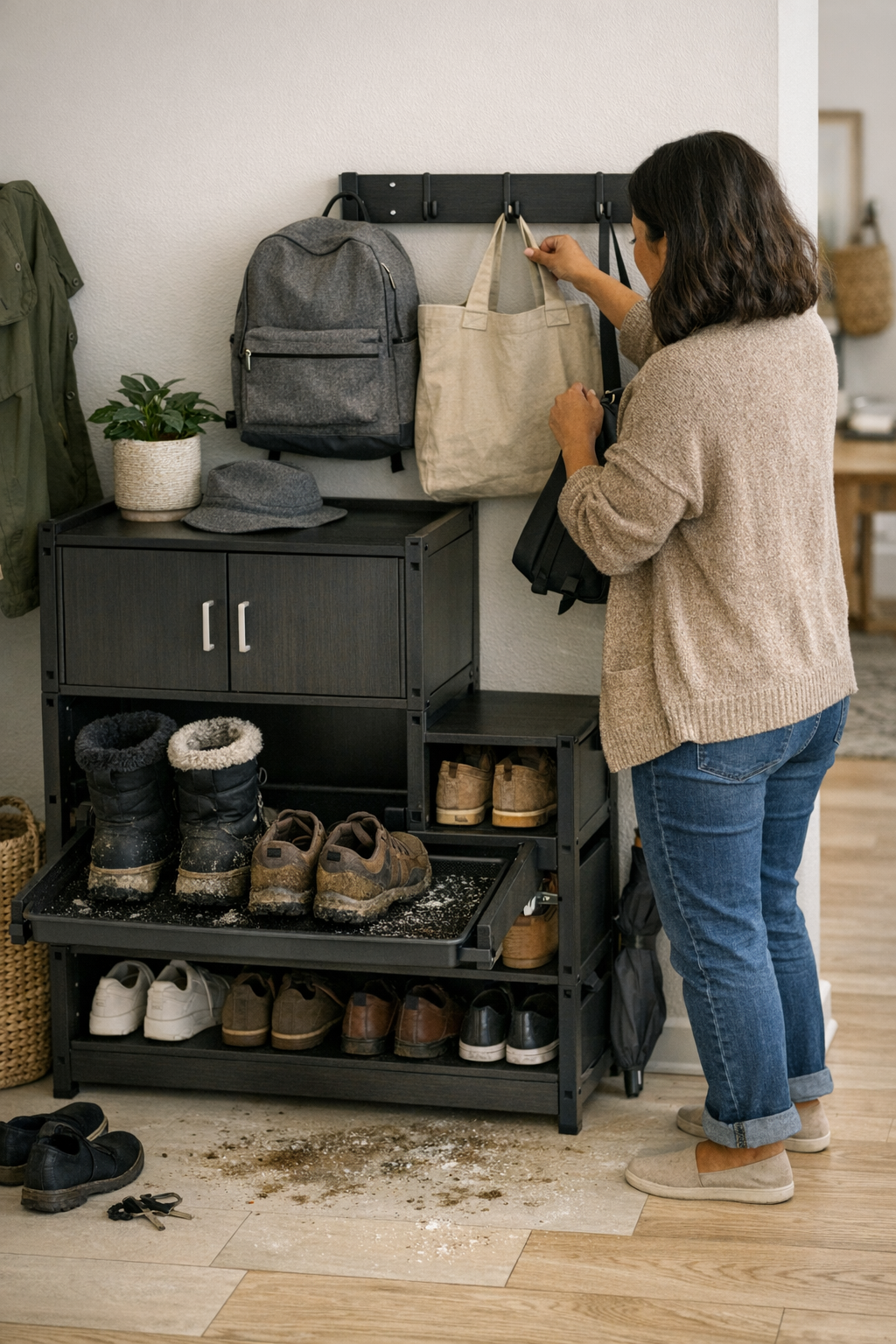
A light entryway floor doesn’t hide the facts: every misstep, mud drop, and stray pebble shows immediately, turning the threshold into a daily challenge. The minute you cross the line, pale surfaces betray the pattern—grit clustered by the bench, thin tracks creeping along the door, yesterday’s soil left as proof of another rushed return. Even with steady cleaning, a bright entry never stays neutral. Everything you carry in writes itself across the floor, while salt marks—so obvious on dark flooring—quietly disappear here, only surfacing as ghosted streaks long after they’ve eaten into corners. The real obstacle isn’t aesthetics, but the way daily clutter quickly narrows the passage and forces you to reset the space before you can even pass through properly.
Where Grit Gathers: The Immediate Reminder and the Hidden Fade
On a light floor, shoe dirt shouts for attention as soon as it lands. Every scuff and new dust pile makes itself known, triggering a reaction—a quick brush, a vacuum pass, a sigh that the cycle repeats. This isn’t sentimental: the mess builds in real-time, and the bright tones offer no room to ignore it. Meanwhile, salt stains—so aggressive on a dark entryway—just become soft blurs, visible only later, often ignored until you move the shoe rack and see the accumulation. Your choice in storage—open bench, rack, sealed cabinet—only shifts which mess remains in view and which accumulates invisibly, making every reset feel like a different kind of battle with the same debris.
Open Benches: Appearing Controlled, Drifting Out of Sight
Open benches and neatly lined shoes promise visible order in theory, but lose ground fast when life accelerates. Stand-up rows don’t stay put: boots tilt out, sneakers inch forward, and kids’ shoes fill gaps with sideways placement until the whole edge is a zigzag instead of a line. Every piece of dirt left behind becomes a mark you can’t not see. Bags, dropped for “just a minute,” multiply at the bench edge and rarely return to their hooks—gradually shrinking your walk path. It’s a clean look that turns into high-maintenance pressure: you notice the drift every time you squeeze past, but tidying feels constant, never finished.
Closed Cabinets: Cleaner Surface, Quieter Buildup
Shutting shoes behind a cabinet door creates surface calm, but lays the groundwork for surprise resets. Out of sight, sand and stones slip off footwear and gather where you don’t see them: in hinge grooves, under trays, hidden at the kickboard. Without visual reminders, cleaning lags behind accumulation, so the gritty layer builds until one day you slide out a pair of boots and step straight into the mess you forgot you brought in. Bag hooks inside can help with overflow, but any item that enters while still wet or sandy will quietly shed debris till you eventually confront the heavier reset you were avoiding.
Real-Life Drop Zone Drift: How Fast Things Get Blocked
Across a standard week, clutter doesn’t space itself out—it snowballs across the entry threshold. It takes only a couple of overlapping returns—two people home at once, or bags from errands dropped together—for a manageable shoe tray to spill over, with boots nudging out and sneakers bypassing the intended drop zone. On a light floor, you notice every misplaced item and feel every extra step needed just to carve out room to sit or pass. After one harried morning, the bench turns from a seat to a backup surface, paths squeeze, and soon you’re sidestepping an improvised obstacle course instead of entering your own home smoothly.
When “Out of the Way” Just Means “Building Up”
Piling bags in corners or forcing shoes into tight rows doesn’t solve the pinch—it shifts the block from visible to physical. A lunch bag placed “for now” remains for days, and by midweek, a single tote morphs into a stack that monopolizes the bench end or narrows the passage down to a single, awkward lane. Attempts to “organize” by stacking higher or squeezing tighter reveal what the setup won’t handle: repeated use tests the real capacity of the zone, and every pass-through gets slower as items pile in, making resets feel like big chores instead of habits you can keep up with.
Pairing Storage: Finding a Realistic Balance
Combining closed storage with targeted debris catch zones stops visible clutter from turning into invisible buildup. A mesh boot tray, set precisely at the drop point, pulls mud and grit off shoes before it can spread, shrinking the cleanup area immediately and cutting the urge for constant sweeping. Wall hooks set above or beside the bench prevent bag drift and free up floor space—the difference between a slow buildup and a pass-through that stays usable all week. This isn’t about pushing the mess out of view; it’s about rerouting the inevitable traces of return into points you can reset fast, with minimum effort and maximum reliability.
The Ongoing Routine: What Stays, What Gets Stuck
Light-floored entries require frequent, micro-cleanups—skip a few days, and you lose the zone. A quick brush or once-over with the vacuum is a daily ritual, not a deep weekend reset. For cabinets, treating the inside as a visible part of the floor and cleaning it once a week cuts down on surprise grit. Open benches make more sense when paired with a habit: every return, shift bags up onto their hooks and nudge shoes back into line before the mess multiplies. The point isn’t a perfect look, but a passage that doesn’t stall your day, no matter how many times you cross it.
Smarter Storage = Smoother Returns (But Not Perfection)
The strongest entryway setups for bright floors prioritize quick resets, clear path access, and flexible routines. Pairing trays and racks for visible, easy dirt containment with well-placed modular benches and wall hooks shrinks both scatter and slow buildup, side by side. The aim is not showroom perfection—it’s the difference between a daily reset you actually perform and a zone that slips back into full-block mode as soon as you look away. Entryway control is practical, always in motion, and only as smooth as the habits your storage quietly supports—not just the impression it makes when nobody’s at home.
For practical entryway storage solutions that work with real routines, visit Betweenry.