
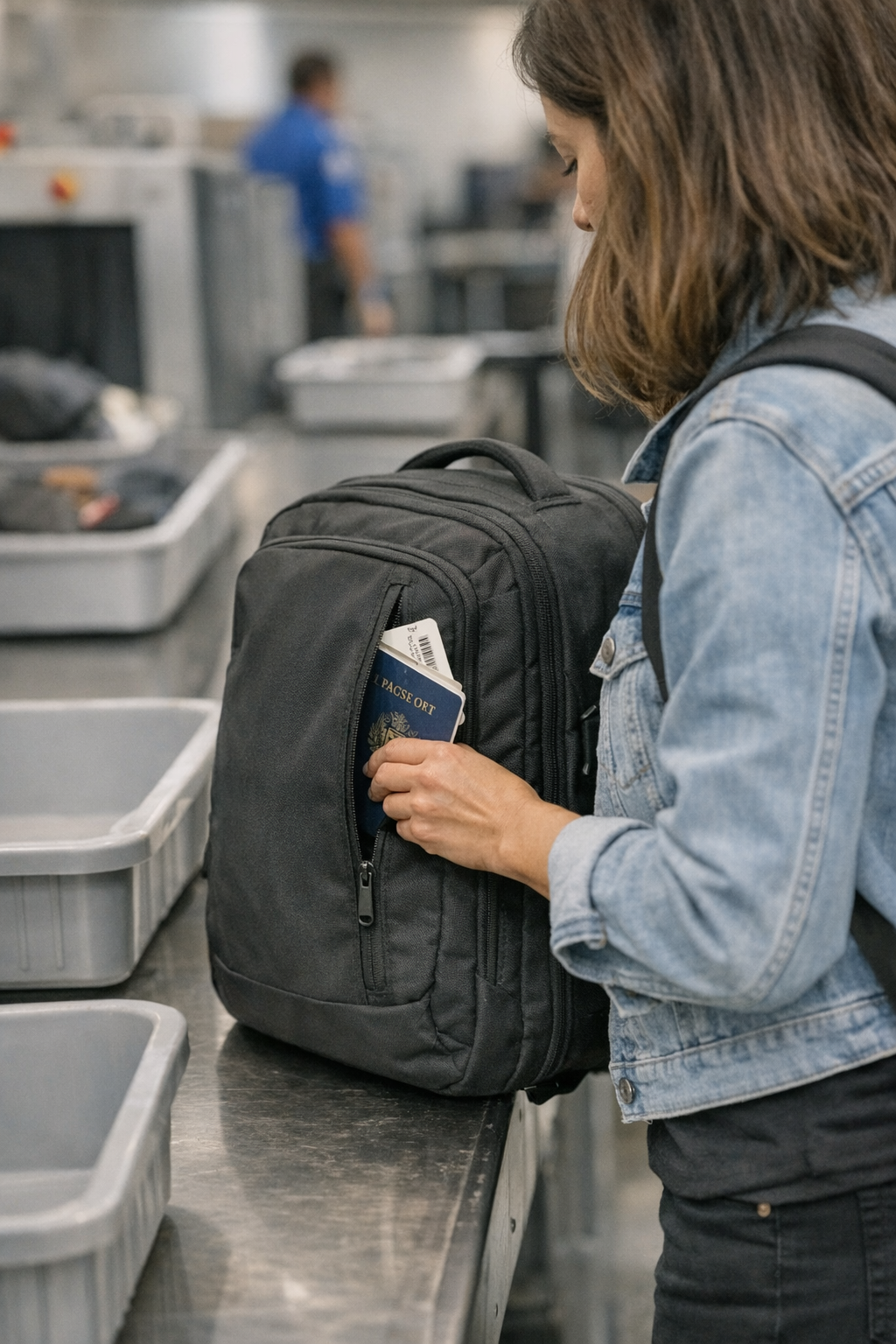
The illusion lasts until you’re actually moving: that carry-on, cleanly packed at home—zippers aligned, pouches in military rows—begins to unravel as soon as you hit the first airport checkpoint. Grab your passport in a busy boarding line and the “order” vanishes; you unzip, dig under organizers, and your charger, boarding pass, or earbuds are out of sight and out of reach. What looked efficient on your bedroom floor quickly turns irritating when the travel sequence starts: trays stacking at security, agents waving you forward, items hidden under the wrong pouch, and seconds slipping away as the line backs up behind you. Carry-on neatness at home misses the two-minute reality of crowded terminal flow, where every smooth movement matters and every delay compounds.
Why Visual Order Isn’t Enough
The bag looks ready: cubes stacked, pouches in place, a visible “system.” But static order is not functional order. The difference shows up fast—in the boarding queue, at security transfer, or faced with a last-minute gate switch. What counts isn’t how perfectly everything fits when zipped shut, but how your setup actually responds when you need to retrieve, reset, and move. In the crush of real travel, every slow reach becomes its own interruption.
The pattern repeats: reaching for your ID with your bag half-unzipped and one handle draped over your wrist, you realize the thing you need most is blocked by layers—cables, pouches, anything you organized for “space” but not for access. Each pause triggers a small but stacking penalty: awkward shuffling, that pressured feeling as you dig, the chance you set something down and almost forget it. These are not dramatic disasters, but invisible leaks in your airport flow that add up trip after trip.
Repeated-Use Friction: When Packing Logic Fails on the Move
The flaws don’t show while packing—they show up on the move. That “secure” boarding pass, slid behind a cable pouch, or your headphones paired with toiletries for neatness, create invisible obstacles you don’t see until it counts. Stacked systems that seem fine when untouched end up doubling your effort in motion. You find yourself repeating the same annoying steps: digging for a charger beneath your toiletries, pulling out unrelated gear and trying to stuff it all back before the next checkpoint. Each repetition reveals that the setup does not actually fit fast-use behavior; it merely looked organized until tested.
Real inconvenience slips in as:
- Fumbling for your ID while the line compresses and the agent already expects it in hand
- Unzipping multiple layers only to realize what you need is in a third, half-buried compartment
- Stalling in the boarding lane, neck craned as you dive for an item blocked by pouches built for “order” not speed
- Wrestling your bag from the overhead bin and finding essentials out of sequence, prompting another rushed repack in the aisle
- Needing to “restore” visual order after every quick retrieval, instead of having flow return automatically
Where Most Carry-On Setups Start to Struggle
The weak points grow obvious during:
- Security checkpoint tray transfers: When retrieving your laptop or liquids means negotiating around charging cables or wrestling cubes, wasted seconds stack up—and so does stress.
- Document checks: If every scan or ID check leads to digging through double zippers and misplaced pockets, you end up both slowed and visibly flustered.
- Seat entry: Tight aisles punish hesitation—a five-second pause to find headphones or gum becomes a line of shifting passengers and abrupt seat drops.
- Overhead-bin retrieval: Buried essentials force you to unpack publicly, blocking the aisle and holding everyone up, sometimes twice as you reassemble order under pressure.
These aren’t dramatic malfunctions—they’re micro-interruptions that steal rhythm and undo the ease you were aiming for. Miss them once or twice and you might ignore them. Repeat them every trip, and the flow of travel begins to fade.
Designing Carry-On Flow: Beyond Adding More Pockets
Most travelers respond to disorder by multiplying compartments: more pouches, more cubes, more organizers. But the breakthrough comes not from cramming in more, but from structure—assigning clear, accessible zones for movement, not just static order:
- Create a single, vertical outer-zip pocket for the things you always grab: passport, boarding pass, charger, earbuds. No mixing with bulk and no “shared” space with items used less often. This pocket becomes muscle memory—one zipper, one retrieval, zero delay.
- Separate your fastest-access gear from core packing: If you find yourself opening the wrong pocket or moving aside “just-in-case” gear to get to everyday essentials, you’ve got the signals reversed. Assign every pocket a clear purpose and stick to it, or flow breaks down fast.
- Enforce the access cycle: After every checkpoint, item, or document retrieval, drop essentials back into the same outer zone. Repeat the motion until it becomes automatic—no searching, no second-guessing.
How Travel Changes When Zones Are Actually Clear
With clear zones, subtle but powerful improvements show up on every leg of your trip:
- Documents and IDs are in hand instantly on approach, never forcing a halt or fumble in line
- Security routines smooth out—no digging, no guessing, just fast, repeatable access for the tray and back
- Seat and aisle moves turn predictable—essentials on top, nothing forgotten or delayed in the shuffle
- Recovery after retrieval becomes a habit, not a chore: your hand always finds each item exactly where it belongs
It might not feel dramatic by the first checkpoint, but by the third or fourth airport transfer, the old pattern—pausing, shuffling, apologizing to the person behind you—simply stops happening. The friction disappears, and movement starts to feel automatic.
Spotting and Fixing Avoidable Friction
If you’re repeatedly opening multiple pockets for the same item or wrestling to close the main compartment every time you use it, those are signals your setup is causing friction, not smoothing it. Small holdups multiply fast over an entire journey. The neatness you see is not the friction you feel.
The strongest carry-on setups don’t just look organized; they behave frictionless in actual use. That comes from maintaining an open path for what you reach for most, never blocking your own retrieval, and baking in a pattern where return and access feel automatic. By the end of a true travel day, you notice what isn’t happening anymore: no frantic searching, no misplaced documents, no string of hurried repacks. The absence of scramble and the restoration of calm is the payoff for structure that actually fits movement, not just packing plans.
Ready to rethink your carry-on for real movement, not just static perfection? Visit CarryOnSupply for thoughtfully structured travel tools that make every reach, return, and repack easier.