
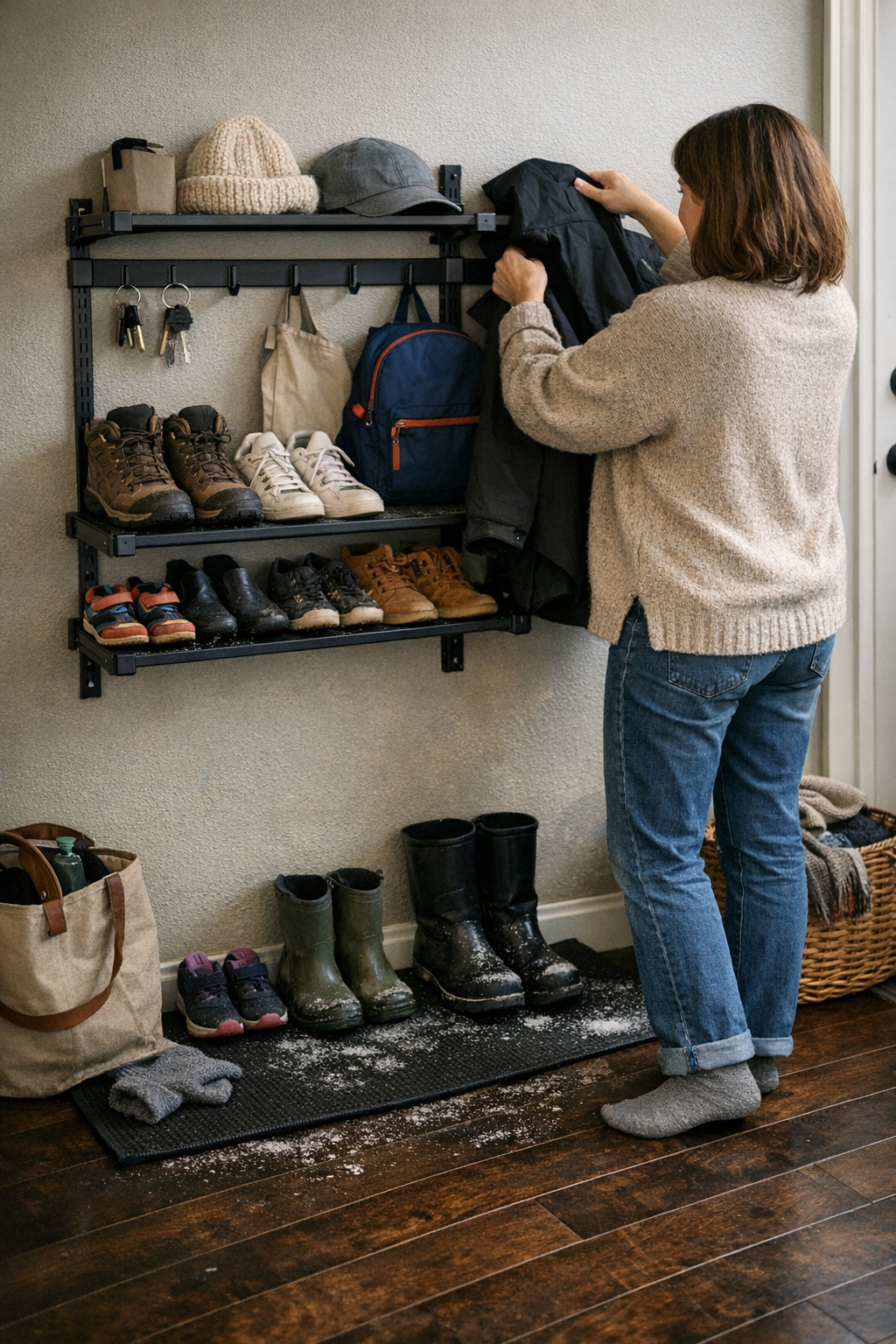
If you have dark floors in your entryway, the reset never lasts long once winter hits. That deep finish tricks you all autumn, hiding a regular layer of dust and dog hair—until the first snowfall. Suddenly, every boot streak, salt ring, and slush trail carves out the traffic paths you thought were under control. What looked clean two days ago now displays every routine: stray salt under the shoe bench, white halos where boots pause, a path narrowing as gear collects. And the floor refuses to let you forget what’s being dragged in.
The Threshold Bottleneck: When Entryway Storage Makes It Worse
Any entry storage sounds better than a bare, muddied threshold. But most setups—benches, baskets, those tidy shoe rows—start leaking weaknesses fast on dark floors after a few wet days. The first round of snow boots leaves thin salt lines curling around the mat edge, debris wedged beneath a seat, and clutter pushing right up to where the walkway pinches. You reset things, then watch temporary drops morph into a new norm. The bench you hoped would anchor the zone becomes the very center of overflow. Structure that looked promising stiffens the routine, trapping dirt in all the wrong spots while shoes migrate and bags pile higher.
Entryways live under pressure, not in a still photograph. What begins as neatly arranged cubbies and controlled rows can unravel within a week. Overnight guests, late arrivals, or a bad weather streak—all it takes is a few off-script moves and the supposed organization becomes a semi-permanent tangle. What was meant to contain mess now silently collects it.
Where Salt Trails Gather: The Stress Points
Salt marks don’t spread evenly—they zero in on the weak points. That cluttered edge beneath the bench, the corner of a shoe tray, the patch under wall hooks where bags or backpacks get flung during a rush—all become hotspots where routines jam against each other. Each salt line hardens into a timeline: here’s where boots sit, here’s where drop-offs miss bins, here’s where two strides cross and force a sidestep around someone else’s shoes or bag.
Add winter guests, or just one busy family morning, and even an “organized” setup blurs under pressure. Shoes escape “their” row, baskets choke with gloves and hats, bag straps creep into the walking path, and soon the salt and slush collect exactly where you need clear ground the most. With dark floors, this isn’t just visual mess—it’s an actual, gritty line along your main route, one that only deepens every day no one resets.
The Myth of the ‘Tidy Lineup’
Orderly rows and low benches look sharp in the first hour, but they rarely survive reality. One rainy pickup or two hurried school mornings and every planned lineup starts drifting. Salt stains contour around shoe piles; you have to pull half the row just to sweep under it. Each clean-up becomes a project—no more fast resets, just delayed deep cleans. You feel it: what was supposed to be quick maintenance has turned into stop-and-sort every time the weather goes sideways.
Real-Life Arrival: Where Routines and Setups Collide
Picture an average February afternoon. Three people burst in—boots squish, bags slam, shoes scatter. The walkway shrinks, salt smears mark each step, and the neat threshold you counted on for quick resets now clogs up before you can react. By Sunday, loose shoes and gear hug the walls, overflow lands beneath coat hooks, and the so-called drop zone has become a bottleneck you have to maneuver around.
When the bench can’t keep up, shoes overflow the edge, slide toward the wall, or land in zones never meant for footwear. Wall hooks snag as emergency catch-alls. Each new drop or return slows the flow, making resets less frequent and the path more crowded. Storage isn’t the fix if it just shifts the mess or blocks the most-used route. There’s a payoff for every organized look: the wrong layout means routine clogs and resets that get postponed—until the mess becomes the new normal.
Lifting the Pattern: How Wall Storage Can—and Can’t—Shift the Cycle
Wall-mounted or modular storage seems to break the pattern—lifting gear up, freeing floor space for sweeps and spot cleans. It’s the promise: move the clutter up, make resets easier. But only if the design matches actual use. Place a wall rack too high, and every trip turns into awkward reaching; hang it too low, and you just shift the line of mess upward while shoes and bags still collect underneath. The edge between improvement and new problem appears fast in real life.
The visible shortcut: A wall-mounted shoe rack, set about two shoe-heights up, keeps the floor clear for fast sweeping. Pair with a tight, washable mat just beneath—ideally something compact you can shake out or rinse weekly. Instead of fighting salt spreading under every furniture piece, you reset the zone with a mat dump and a broom in minutes. The walk-through stays open, but only if the format matches your real traffic pattern. Miss the mark, and clutter just piles up below or shifts sideways out of view.
Even a smarter setup leaks clutter on high-traffic days. Quick exits, arms full of groceries, one tired parent after work—gear lands where it lands. The reality: the right structure only works if quick resets can keep up with the living pressure. Drifting clutter isn’t a design flaw, it’s the cost of any routine that fills faster than it empties.
Transition-Zone Tactics That Actually Work
Containment doesn’t solve everything—reset speed is what really matters. On dark floors, a workable entryway setup isn’t just about stashing gear out of sight. It’s how fast the main passage clears after the next round of arrivals. Storage that works interrupts those daily pileups, keeps walkways open, and lets you wipe down the zone before it turns into a weekly burden. The gold standard is a space you can reset in under five minutes—before the salt trail hardens or a guest ever sees it.
Try these two for real-world difference:
- Use a purposely small mat or removable tray for shoes: Pick one just big enough to catch what drops, but easy enough to lift and shake out in seconds. Bigger mats only collect more piles and slow down resets.
- Clear the drop zone every Friday, fast: Set a five-minute reset—remove whatever’s drifted out of place, wipe the mat, and restock only what’s in daily use. Weekly turnover prevents that semi-permanent stack that blocks the threshold by midweek.
The Difference Between Looking ‘Neat’ and Staying Clear
Honest storage matches your routine instead of staging your entry like a catalog. The real win isn’t perfection. It’s a resettable space: one you can sweep, wipe, and move through without tripping over boots or side-stepping salt lines. No more wrestling gear out from under a crowded bench or squeezing between layered piles. When the setup fits the rhythm of arrivals, the main threshold finally works for you—resisting winter’s grit without demanding all your spare time.
Find practical entryway storage and modular setup solutions at Betweenry