
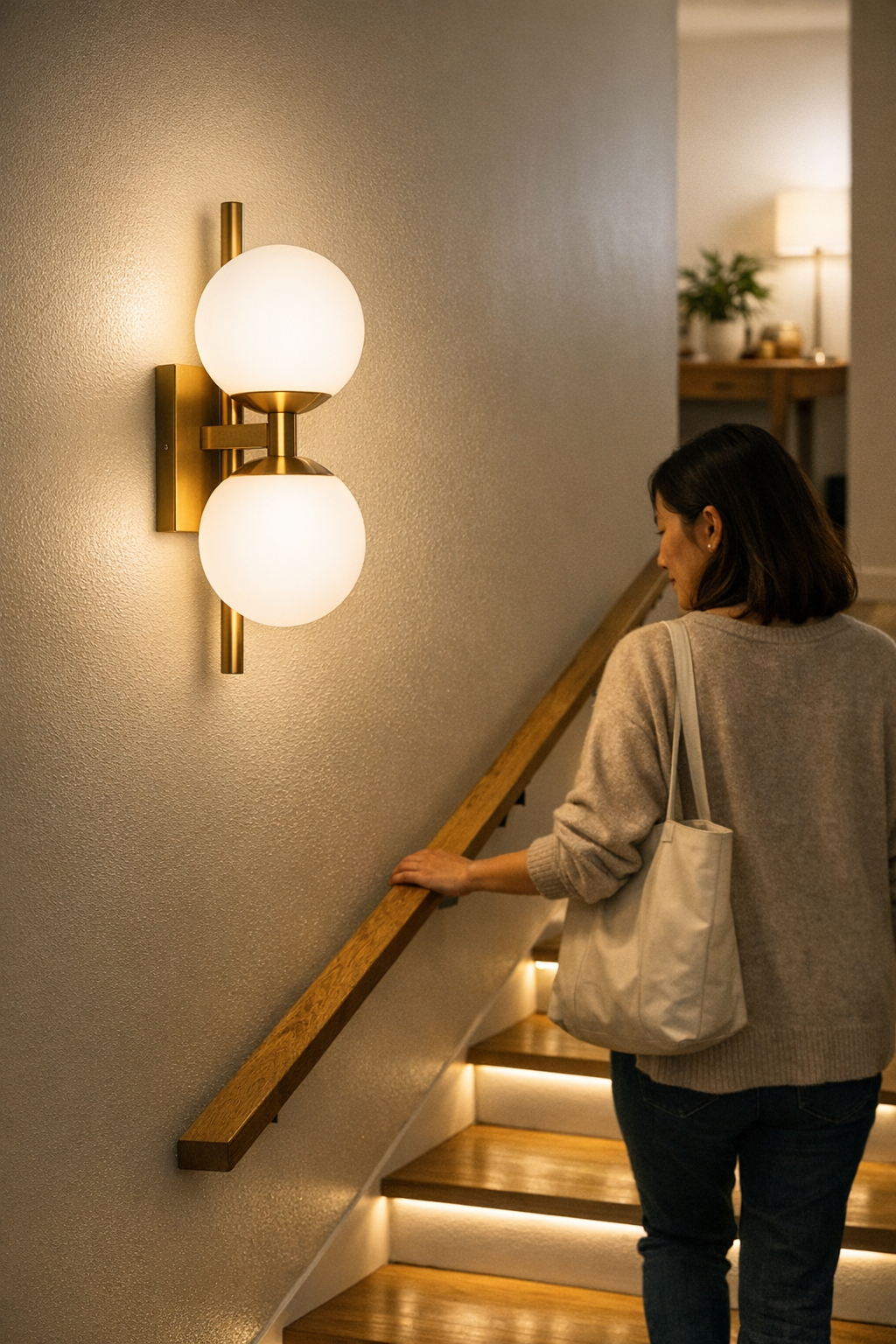
Stairway lighting isn’t truly judged in the packaging, on a display board, or in empty daylight. It’s tested at the friction points—when your hands are full and a stair edge blurs into shadow, or when a guest slows and squints at the last step while the hallway behind is dark. The surprise isn’t how lighting looks at a glance, but how a setup fails or irritates the real user: a half-visible step here, a shadowed tread there, a moment’s hesitation that repeats every evening. Stair lighting done wrong isn’t just a visual compromise—it becomes a pattern of small risks and repeated, invisible adjustments you never wanted to make.
Why Stair Edge Clarity Matters More Than Brightness
Not all “bright” stair lights deliver actual safety or comfort. The common mistake: assuming the most powerful or streamlined fixture solves everything. In reality, general brightness throws light where it’s least needed, bleaching out details on smooth treads, smudging the stair edges, and letting corners fall away into shadow. You notice it at night—someone hesitates at the landing, slows at the top, or makes unconscious micro-adjustments as their foot hovers, guessing at the next step. These hesitation points multiply with every pass, from quick commutes in a family entryway to careful night trips in a shared apartment stairwell. The real problem is not light levels—it’s the missed definition where you move.
Signs the Setup Isn’t Holding Up
Does anyone—resident or guest—move tentatively near the first or last step, especially after dark? That’s not just cautious habit. It signals a stair lighting setup failing where it matters most. If you catch visitors tilting their heads to “read” depth, or regularly see someone pause to test the landing with a toe, you’re watching the cost of bad edge clarity. In homes, the drag shows up whenever someone slows at dusk, clutches the rail tighter, or asks for help going down. Even pets will linger at a dark transition. Stairways that force you to double-check your own footing turn flow into effort every time the light shifts—or when a single bulb fails.
The absence of crisp edge cues creates daily, automatic caution. Most people assume this is just how stairs feel after sunset. But the repeated burden—watchfulness where you should have trust—wears on everyone in the house.
Where “Clean” Lighting Schemes Start to Fray
“Minimalist” fixtures impress in photos: smooth wall plates, hidden wires, no surface clutter. But once real life takes over, weaknesses show. A ceiling downlight may leave corners murky and treads washed out, especially if the surface is shiny or the stairs curve away. Carry something broad—a laundry basket, messenger bag, or kid’s backpack—and you can block the only light, projecting a confusing shadow across two steps at once. Every “clean” lighting solution is only as reliable as the shadow it leaves behind. A perfect showroom look loses its worth the first evening someone misreads a tread because the angle hides a step or a bright spot makes depth harder to gauge. Clean lines that can’t keep pace with real movement end up as another visual tick box—one that doesn’t hold up in daily use or low light.
Habitual Frustrations That Reveal Poor Lighting
- Pausing mid-stair to re-find the next tread with your foot
- Using your phone flashlight to check the bottom steps at night, even when lights are “on”
- Kids asking for “the good light” instead of using the main switch
- Reaching hard for the rail after sunset just to feel steady
If these frictions are familiar, your setup looks finished but isn’t actually livable.
Lighting That Makes Each Step Clear—From Any Angle
The best fix isn’t more overhead light, but targeted edge illumination. Continuous step-edge or wall-side lights—such as low-profile LED strips installed just beneath the overhang or along the wall—cast subtle, readable shadows on each riser. It’s not about maximum output but about how the light maps the edge: every step’s profile pops, whether daylight is gone or someone’s shadow blocks the main fixture.
In these setups, you’re never guessing if your foot has landed on the last tread, or whether there’s another drop. Edge definition holds up from both directions—going up with arms full, heading down with tired eyes. With real edge lighting, you avoid:
- Dim or disappearing steps, even if hands or baggage block a ceiling lamp
- Corners fading out, especially on stairs that twist or change width
- Gaps in confidence: people flow, not pause, from top to bottom
The result: stairs become background—no more stopping to interpret where each step begins or ends, even in the weakest ambient light.
Cable Management: The Often-Overlooked Factor
Lighting that fixes visibility but ignores cable logic creates its own mess. Exposed power runs, taped cords, or slapdash cable routes distract the eye and collect dust. Worse, they risk creating real tripping points in narrow, high-traffic runs. Even a short, out-of-place cable along the baseboard stands out more than you’d expect in a stairwell—especially when sightlines are already focused on the floor.
Clean, concealed cable management isn’t decorative—it’s a safety and comfort upgrade. A tightly placed LED strip, with power lines guided behind trim or within purpose-built channel, respects the space as much as the user’s movement. Ignore this, and you’ll notice the problem fast: cables start to drift out, need re-tucking, or collect mess. Retrofits that “almost” solve the problem end up being redone after the first few months, often because cable chaos outlasts the lighting’s novelty itself.
Small Tips for Real-World Stair Lighting
- Test your setup at night, hands full—don’t trust the “installed” look until you try actual movement
- Make sure every angle—including up and down—has consistent edge visibility, not just overall light
- Invest in mounting or support pieces that make cable runs invisible, not merely less obvious
“Finished” Is Only Real When the Use Is Seamless
Installation can trick you: a new light may look flawless at noon, but if daily patterns reveal stray glints, dark zones, or constant distraction from a wandering cable, you’re stuck with setup friction that no “designer” look covers up. The stairway that actually works is one where nobody has to pause or recalculate—a result built not on looks alone but on the invisible work of lighting choices, edge visibility, and support logic that fades into daily use. “Finished” isn’t aesthetic; it’s the absence of friction—the simple, repeated comfort when each step feels obvious and safe. In the end, the most successful stair lighting is barely noticed by the people who count on it most.