
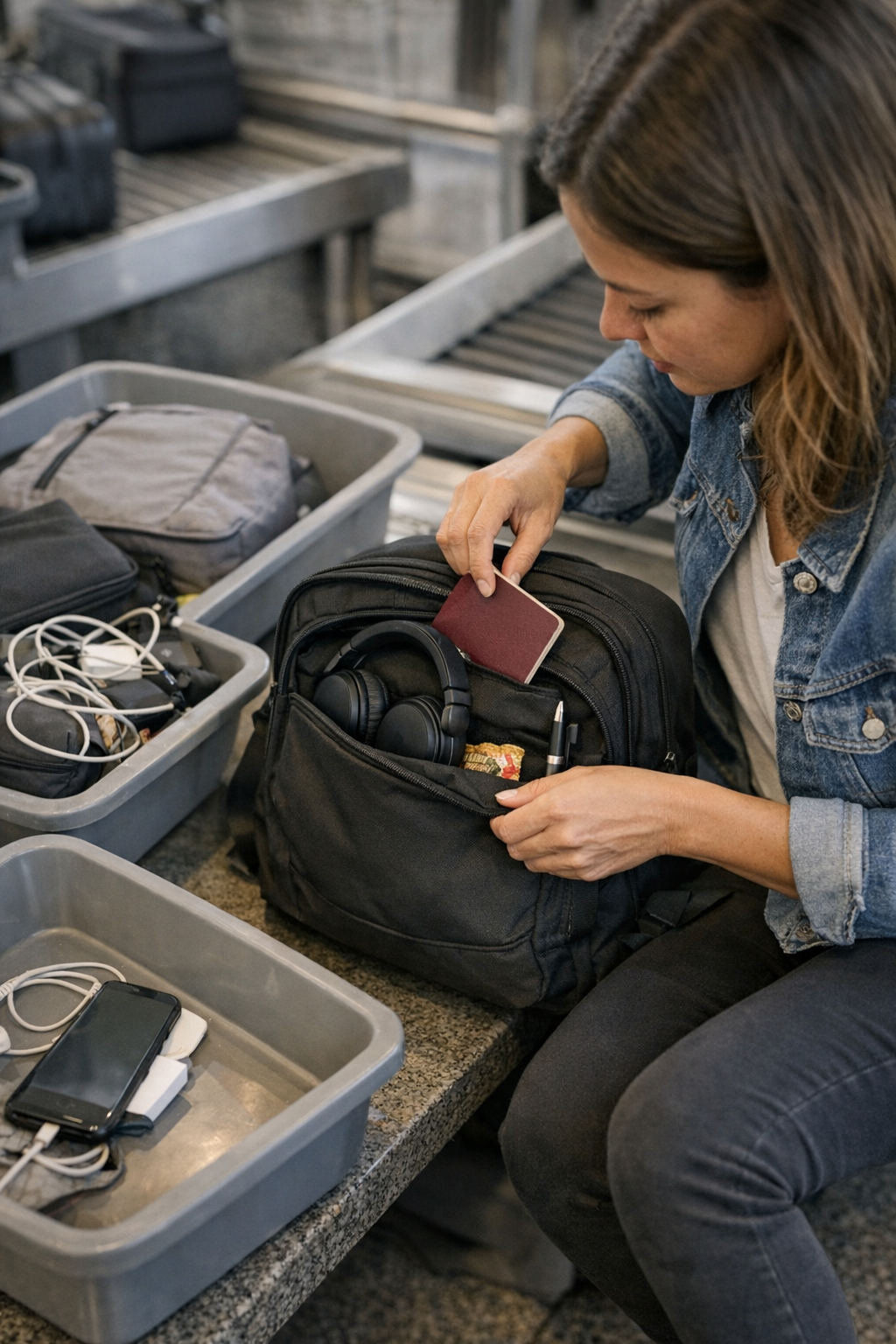
Every carry-on traveler gets blindsided by the same hidden problem: your bag looks streamlined and organized before you leave, but friction piles up fast in real airport movement. On the hotel bed, it’s all zipped pouches and color schemes—until you hit security, boarding, or a cramped aisle and realize “organized” doesn’t mean “fast.” The downside isn’t visible mess. It’s the repeated delays, the blocked quick grabs, and the misplaced essentials that stall your flow from the first checkpoint to the plane seat—no matter how neat your system looked at home. The most common overlooked flaw? The gear you use over and over gets buried just when you need it most.
When Visible Order Breaks Down: Overlapping Paths and Everyday Friction
A bag full of packing cubes, tech organizers, and light pouches feels like a win—until real travel starts. The trouble usually reveals itself at the first airport hand-off or security tray: a charger tangled with headphones, toiletries sharing space with your passport, and boarding documents buried under a snack pouch. That “quick access” pocket you packed so intentionally? It becomes a bottleneck the second you try to pull your ID. Banishing clutter visually doesn’t protect against the friction caused by overlapping paths—hands double-backing, shuffling, and digging for single items, while lines move and time compresses.
Every traveler recognizes this: you reach into what should be an easy-access spot only to find three categories of item jammed together. What started as organized structure at rest collapses into repeated, distracted searches on the move. Quick access pockets get crowded with the wrong mix, and the penalty is paid every time you have to dig sideways to get what you need.
The Cost of Repeated Interruptions: Micro-Delays Compound
Each “one-second” search adds a ripple of interruption. Miss your passport on the first reach at security and you stuff it back into any convenient gap—meaning next time, it’s buried deeper. By the gate, your careful visual order is already a memory; now you’re forced to rummage, swap, and restore, introducing small but persistent slowdowns. Each unzipped layer or pouch moved isn’t just a single hassle—it’s cumulative friction, turning every checkpoint and repacking moment into a minor choreography problem that gnaws at your focus, energy, and time.
The Retrieval Spiral: Where Systems Fail Under Movement
Picture yourself shuffling up in a boarding line. You reach for your boarding pass and fumble through a cable pouch, loose hand cream, and headphones stacked right above your doc wallet. Instead of a one-motion grab, you’re running a step-by-step obstacle course: unzip, move, lift, shuffle, dig, restore, rezip—while the line surges forward and your “order” gets shakier. It doesn’t stop at documents, either. Whether you’re pulling snacks, pens, or earplugs, every extra layer adds drag. If you’ve ever found yourself repacking mid-aisle, or apologizing to a stranger for blocking the bin, you know the design failed the moment friction repeated itself under speed.
Beyond Looks: Packing for Real Airport Movement
There’s a real gap between a carry-on that looks sharp and one that stays usable with every flight segment. Pouches, cubes, and organizers create great order when laid out flat—but once you start reaching for high-frequency items (passport, headphones, pen) on the go, even a single extra layer becomes a time tax. A system that looks perfect sitting still often forces you into mini-searches and awkward repacking during live travel flow.
The real cost isn’t just looking for things; it’s the travel fatigue from stacking tiny tasks. Every time you restore a “system” after a rushed search—putting cords back, re-zipping every pouch, flattening stray documents—the unnecessary work eats into what should be your smoothest moments. If you can’t reliably return to a single, predictable path for repeats like document checks or seat entry, you end up improvising every cycle, burning energy on things that should be frictionless.
Where Setup Fails: Security, Boarding, Arrival, and the Overlap Trap
The tension spikes at live pressure points. Security moves fast: trays stack up, people hurry, and your system has to work instinctively. If your passport and headphones fight for the same pocket, you risk dropping something or holding up the line—everyday overlap at its most visible. Even after security, the pattern repeats at the boarding gate and aisle: searching a crowded access pocket for snacks or paperwork means slower entry and more stress, not just for you but everyone behind. Seat entry gets awkward too if your single “catch-all” pouch blocks the way in a cramped row, or if a tight outer pocket needs a wrestling match to produce headphones.
The overhead bin sums this up. Real travel exposes that a perfectly compressed bag—zipped tidy, color-matched—can still be a failure if grabbing one essential means lowering the whole bag, opening the main compartment again, and repacking half your stuff. Chasing visual neatness above practical access turns movement into a chore the moment reality kicks in.
Better Setup: Isolation Beats Perfection
The essential fix: don’t chase visual perfection—separate essentials for true access.
Dedicate a single pocket or slim pouch for the short-list items: passport, headphones, pen, and snacks. Not mixed with chargers, toiletries, or anything you only use once per flight. This structure—one predictable path for routine retrieval—means you never have to guess or double-back, and your main compartment actually stays closed, reducing chaos with every use. You won’t eliminate all friction, but you strip out the unnecessary steps that do the most damage to your travel rhythm.
It’s not about stacking more organizers. Selective separation kills the problem at its root. Any setup that demands repeated cross-searches for essentials is working against you. When frequent-reach items get their own zone, the time saved is immediate and the improvement doubles over longer, more demanding itineraries. Predictable motion—one zipper, one grab, one return—spreads calm through the whole trip.
One Small Change, Real Flow Gains
After just a couple flights, the pattern is inescapable: single-motion access for high-use items is the real test. Each layer you eliminate gives you back seconds, and the effect is tangible when fatigue builds at the end of a multi-leg day. Real carry-on effectiveness isn’t about the tightest packing at departure; it’s about whether you’re still moving smoothly after six or eight retrievals on a crowded travel day, with every step demanding new access.
Smoother security flow, faster gates, stress-free seat entry—these aren’t soft wins. They’re the byproducts of a packing logic built for repeated, live use, not for a tidy Instagram shot. If you want a carry-on routine that actually holds up under pressure, trade appearance for access where it counts.
Carrying Choices That Survive Repeated Use
The recurring solution breaks down to two rules:
- Essentials—documents, headphones, snacks—need their own dedicated pocket or pouch. Mixing them with once-per-trip items kills repeat access.
- Don’t let single pockets become grab-bags for every category. Blending chargers, pens, and snacks forces overlap, multiplying slowdowns during every live retrieval—security, boarding, mid-flight, arrival.
If you’re restoring order more than moving through it, your setup isn’t meeting the demands of real trip flow. You should be able to reach, retrieve, and return essentials in a single motion at every point—not just at the start, but through every cycle of the travel day. Once you’ve adjusted for true repeated use, the entire carry-on process moves quieter, smoother, and with fewer built-in delays—no visual trickery required.
For practical carry-on travel tools designed for repeated access and low-friction movement, visit CarryOnSupply.