
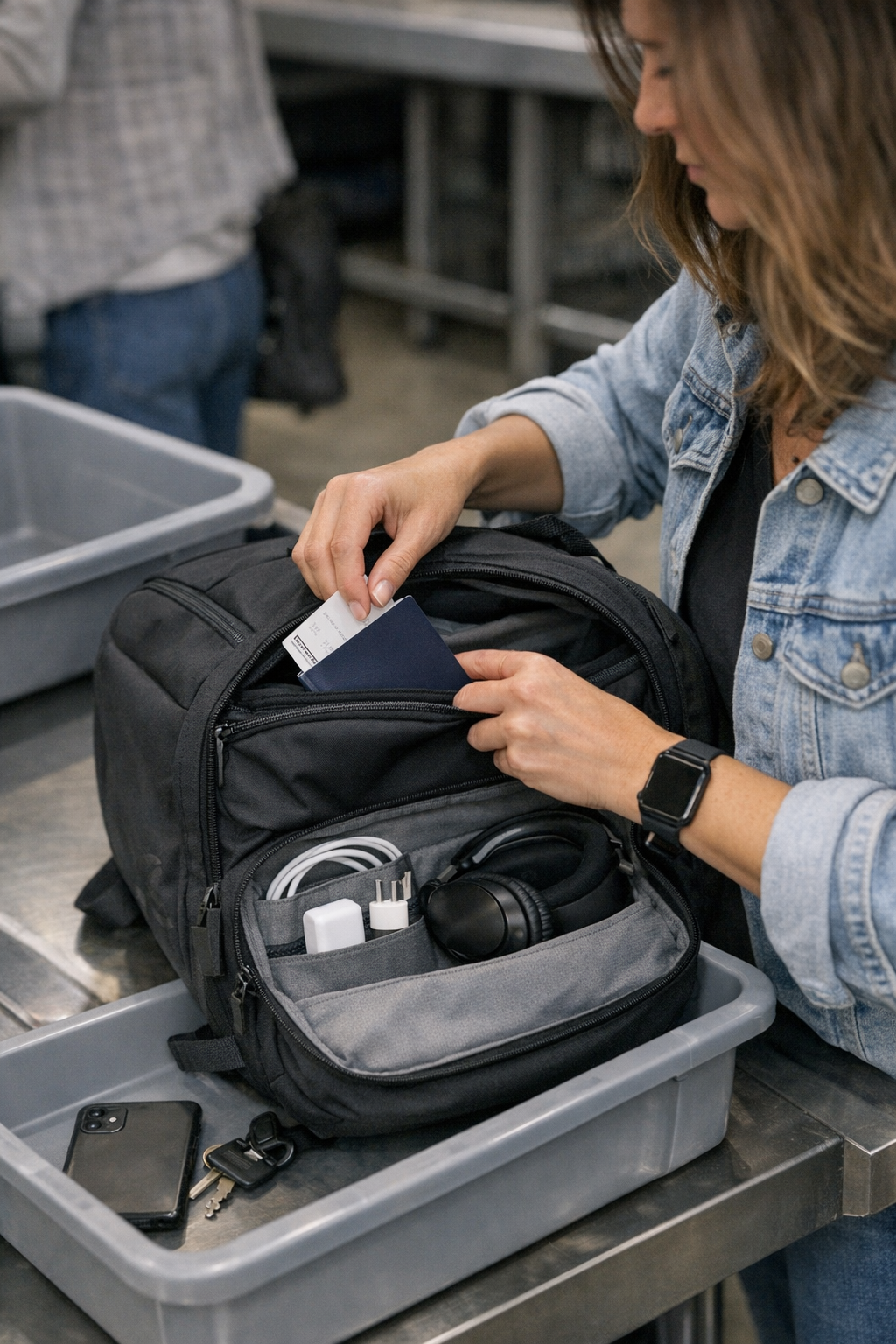
Minimalist carry-on setups rarely survive real travel pressure without exposing new problems. A bag that looks streamlined at check-in starts to falter the moment you need your passport at security and your charger in the boarding lane. What feels sleek on the hotel bed—one compartment, two slim pouches—becomes friction in motion: cables tangled over passports, travel documents buried under headphones, repeated fumbles just to get through a checkpoint. The supposed clarity of “all-in-one” packing quickly turns against you during airport transitions, where every delay is magnified by a moving line, a crowded tray, or the pressure to clear the aisle quickly. Instead of efficiency, you get repeat interruptions—proving that a minimalist approach can quietly undo itself when the pace of travel speeds up and access demands become constant. Welcome to the overlooked world of everyday carry-on overlap, where CarryOnSupply products are built to target exactly this kind of real-in-use snag.
The Problem with Minimalism in Motion
One main pocket can’t separate your needs when it counts. Minimal packing looks orderly until you’re forced to access something mid-transit. After a single round of security-to-gate and boarding-to-seat, the promise of “less to sort” backfires. Every reach disturbs the whole setup: retrieving a passport tugs a USB cable loose, grabbing a charger shifts your boarding pass, returning your ID means you have to shuffle tech aside first. In fast-moving scenarios—security lines, impatient boarding groups, or the press of passengers behind you—each access becomes its own interruption, stacking invisible delays right when the pressure is highest.
Real-World Delays Exposed
The illusion of control breaks down fast in the security line. Open that “minimal” carry-on, and suddenly you’re balancing a phone, charger, cables, and passport in one hand while digging for a boarding pass that slid beneath the headphone pouch. There’s no solid surface. You’re juggling everything midair, hoping not to drop a travel document in front of tired strangers or security staff. Even when you zip your bag shut and it looks smooth again, you know the next move will mean repeating that awkward scramble—order outside, chaos underneath. No matter how well you started, the rhythm of repeated use exposes the gaps.
Invisible Overlaps: When Simple Packing Loses Its Edge
Slim setups hide messy trade-offs instead of removing them. As soon as the real trip begins, neat compartments blur—chargers slip into the document sleeve, paper edges stick to tech, and what started as two tidy pouches merges into one lumpy blend. That shallow at-home document pocket now folds under the thick reality of stamps, larger passports, extra passes. Reach for your ID and it drags out a cable, slow or silent but visibly annoying. Each movement becomes a micro-correction, chasing after a moment of order that looked achievable but keeps slipping under repeated shift and retrieval.
Where “Order” Fails Under Real Pressure
Boarding exposes every shortcut. As the line shuffles forward, you’re pressed to produce documents, headphones, and your phone in a space barely wide enough for a single bag. Suddenly, you need two hands and both elbows to get your ID or gate pass out without dropping something. Pockets overlap and items shift; what looked efficient now demands awkward maneuvers in front of an impatient crowd. Instead of flowing easily, you’re pausing in the aisle, hands full, bag slipping from your shoulder, grip slipping from your routine.
Every Minute Counts: Where Bottlenecks Become Visible
Between security and boarding, you might have less than two minutes to put your bag and yourself back in order. This is when small inefficiencies spread: pulling your phone from a shared sleeve tugs a charging cable free, picking out a boarding pass scatters headphones you didn’t intend to move. You look packed and organized, but real retrieval is always a step slower—or an extra shuffle deeper. With no spare surface and no privacy, there’s no easy repack until you reach your seat, so each tiny delay builds. By the aisle, three unnecessary steps now stand between you and your headphones, all thanks to a setup that was supposed to save time.
Repeat-Use Weak Points Everyone Feels
The test is never in that first clean pack. It’s halfway through the aisle, bent sideways as another passenger waits, fishing for a charger that’s slid beneath your passport. You pull one and the other comes, suddenly holding both in view of a full row—or worse, dropping them just as you squeeze past. Supposed minimalism has now turned basic access into a public juggling act, making every retrieval slower, messier, and harder to hide.
What Actually Changes When You Split Essentials
Layered separation isn’t more bulk—it’s less noise, fewer mid-journey resets. The first real fix isn’t a bag full of accessories; it’s separating core essentials by access task. Move your passport and boarding passes into a dedicated outer zip pocket—one you never share with tech. Group all chargers, cables, batteries into their own sealed pouch away from documents. The result: what you need appears in a single move, by muscle memory, with nothing else in the way. No more digging, no more items sliding out with every reach, no more juggling three tools to access the fourth. Even during quick tray dumps or cramped seat entries, the right thing comes to hand immediately, and everything returns to place without a repack routine.
Streamlined on the Outside, Predictably Functional Inside
You still keep that clean outside. But now, every repeated touch becomes direct—no friction, no mid-aisle struggle, no accidental repacking effort. That promise of minimalism is finally realized in function, not just form: no silent time leaks, no overlooked steps, no awkward trade-off between tidy and usable. Travel rhythm is restored. The smile is internal, but the flow is real—the moment where your setup actually makes movement easier, not just better looking.
Find carry-on travel solutions that work the way you actually move at CarryOnSupply.