
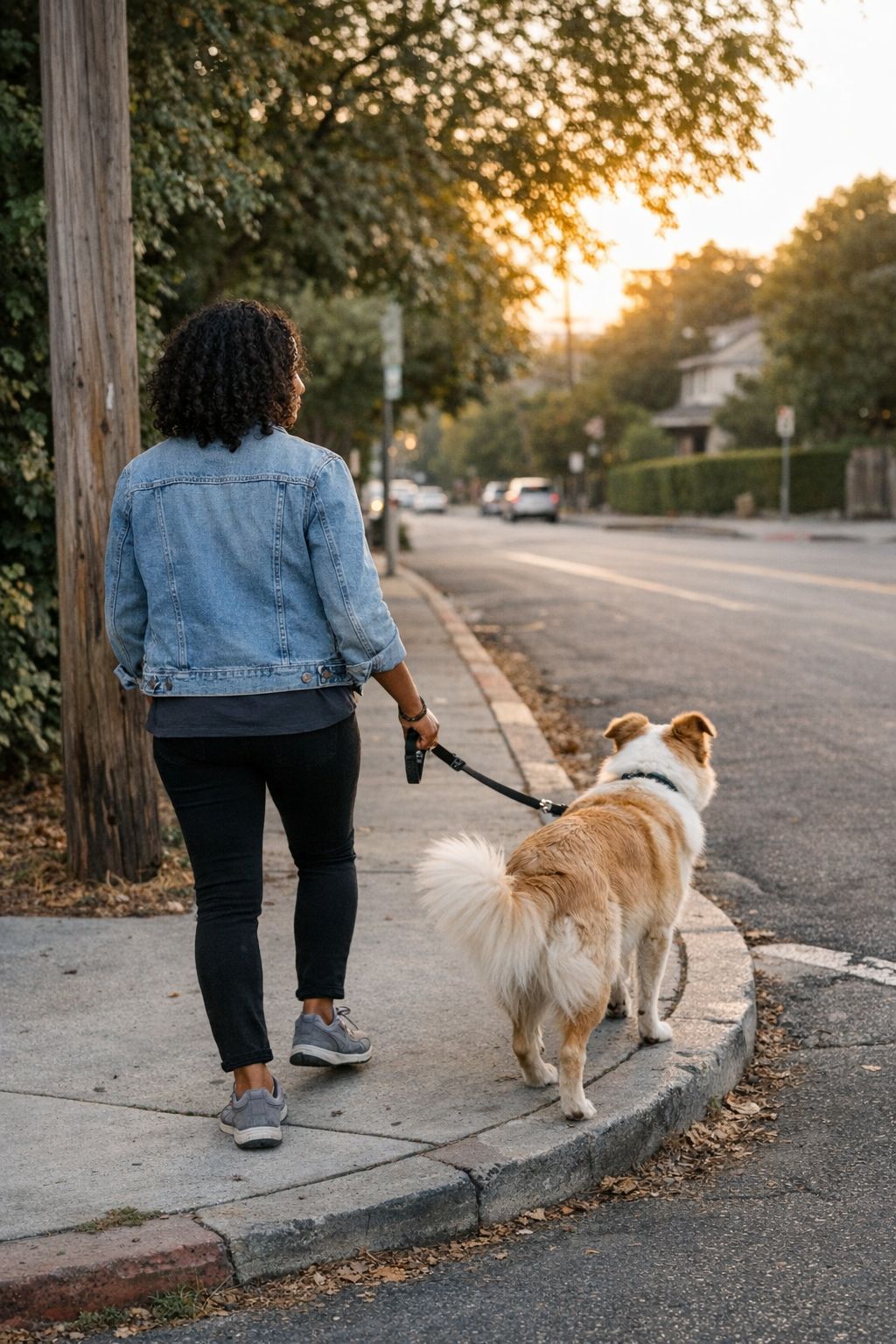
Every dog walk has a point where daily convenience quietly unravels. It doesn’t shout, but you feel it: that hesitation near the hedge, the fumble for a leash at the door, or the awkward pause at a narrow curb—the moment when what should be routine starts demanding double the focus. For most owners, it repeats in exactly the same spot. One overlooked pause or skipped cue—more muscle memory than decision—turns a predictable walk into a string of leash surges and mid-block interruptions. This isn’t chaos or disobedience; it’s the silent build-up of missed moments, and it keeps showing up no matter how organized your entryway or how fine-tuned your gear seems. Smooth on paper, but every evening you’re left fighting the same delay or tug, wondering why the routine never quite resets.
The Everyday Walk: Where Setup and Rhythm Collide
Walk routines get assembled from habit—leash on a hook, poop bags somewhere by the door, dog ready to go. It’s supposed to be seamless. For a few blocks, it is: you match steps, pockets are stocked, you know every corner by instinct. But then comes the spot you always skip—a subtle slow-down you forget, the leash tightening a second too soon, or a curb approached with one eye on your phone instead of your dog. Routines survive on these little signals, and when one slips, so does the flow. Now you’re adjusting grip, nudging for alignment, and the rhythm you relied on disappears. Each walk starts with a neat setup and still ends in frustration, signaling the real split between “organized” and “ready for repeated use.”
It’s never about willpower or stricter correction. It’s the friction that sneaks in between expected comfort and what the real routine demands—an overlooked moment here, a silent shortcut there. The leash pulls taut, your dog surges or holds back, and suddenly you’re managing conflict where there should be calm. You react through the rest of the walk. Routine doesn’t save you—unless it’s lived through, it just covers for yesterday’s mistake until it shows up again.
One Missed Turn—And Why It Refuses to Stay Small
The pattern is frustrating because it hides in plain sight. Skip the pause at a wide turn, forget the deliberate slow-down at a driveway, or step ahead at the corner because someone else is walking by—now the leash tightens, the dog senses urgency, and the pace jumps. Even when you recover, the damage lingers. Every new block: more checking, more “wait,” more mid-walk restarts. The tiniest surge becomes the new template for the whole outing, until you’re back home with both of you a step more wired. The reset that should have happened mid-walk just gets carried inside, tension leaking into the hallway, kitchen, and any attempt to settle afterward.
It never feels dramatic, but friction compounds. A leash that was loose now feels like a silent warning. Your dog’s ready to pivot from calm to restless in a blink—and you both know where and why it started, even if you don’t say it out loud. Consistency in the small moments, not just gear, is what keeps the routine from breaking down.
The Quiet Cost of Skipping the Pause
Owners get tricked by routine’s appearance: supplies by the door, leashes at the ready, everything visually in order. But routine only works if it survives repeated use. That two-second pause before a corner, the extra second letting your dog check in near the hedge, or the deliberate leash slack when you step onto the curb—these are the parts that reset the walk and strip away friction. Miss them, and the rest of the routine slowly loses its grip.
It doesn’t take an outright mistake, just a shortcut: grabbing a leash from under a pile and delaying, watching your dog interpret your pause as “permission to lunge,” or rushing a turn and tangling the leash around your hand instead of letting it move naturally. Over time, these micro-missed connections build into a pattern that’s hard to diagnose but always annoying to live with. When the flow falters, both owner and dog start bracing for rough patches where smoothness should be automatic.
- Digging for a waste bag while your dog slips into “go” mode—turning a loose leash into a two-handed scramble.
- Approaching a corner, then realizing you’re blocked by another pedestrian and the leash was never reset—now you’re tangled, correcting after the fact.
- Rushing to keep up through familiar shortcuts, only to find your dog is now using every pause as their own signal to speed ahead.
As these glitches add up, what looked like a reliable setup becomes a repeating weak point. The tidy entryway or organized supplies don’t change the underlying loop—when missed cues keep happening, neatness just hides the friction, it never removes it.
How Rhythm Breaks: The Aftereffect of the Skipped Slow-Down
A two-second mistake can tangle your walks for days. Allow one corner to go un-paused, and the leash turns from support tool to obstacle. Mental autopilot kicks in—trusting the routine—while your dog recalibrates to the new rule: “more tension means I lead or react.” Suddenly, every approach to a turn is a test. You’re half a step behind, fixing grip at each block, losing the original calm that made the walk useful in the first place.
This cycle never fixes itself through luck. The first lost pause sets up a domino effect: walk stops mid-block, corrections escalate, and once inside, your dog keeps pacing or hanging in the entry, expecting more motion instead of settling. The routine feels broken even when the gear or layout looks right. Until you spot the actual pause or shortcut you keep missing, the same struggle repeats—even after the rest of your routine seems stable.
Real-World Friction Zones on Walks—And Back Inside
- Entryway gridlock: Leash or harness is tucked behind bags or shoes, slowing you down and priming your dog to tug at the first chance.
- Muddy cleanup choke point: Towel or wipes are “there” but not in reachable sight—leads to quick paw prints across the house before you can react.
- After-walk energy overflow: Dog paces or circles inside because the missed leash reset outside never let them finish winding down.
The Reset: Pausing on Purpose (Not Overhauling Everything)
The smallest fix isn’t dramatic training or a busy new setup. It’s a two-second pause at each turn, just long enough to slacken the leash and let both of you regroup. You don’t freeze or make a show; you slow just enough that momentum returns only when the routine is aligned. Suddenly, you find leash slack cutting through more of the walk, and the loop—turn, regroup, walk—stays intact for whole blocks at a time. The benefit isn’t flashy, but it’s unmistakable: less awkward tugging, fewer micro-stops, and a smoother reentry when you get home.
- Signals your dog not to surge, breaking the association between pause and excitement.
- Avoids catch-up corrections, lowering frustration for both sides of the leash.
- Extends post-walk calm, so settling back inside happens naturally—without a separate reset routine.
This kind of pause won’t fix every outside distraction or sudden burst of energy, but it resets what routine is supposed to protect—usable calm, not just a collection of neatly placed supplies. It’s not about never slipping up, but about making the walk easier to recover without launching a new project every time something drifts off rhythm.
Spotting the Change—In Walk, in Setup, in Home Flow
After a few days of deliberate pauses, the difference shows where it counts. Now your dog checks in at every stop without circling or pulling. The leash stays loose even at your old trouble spot; you step back in without a hallway standoff, and the kitchen stays clearer instead of doubling as a pacing ring. The routines that once felt full of little snags stretch out and reset more easily, and you notice fewer after-effects trailing into the evening.
The deeper lesson isn’t that your setup was wrong, but that “looks organized” rarely equals “works in real time.” Entryway gear, cleanup supplies, grooming tools—they can look perfect in a photo but miss the rhythm demanded by repeated use. The strategic pause is the same: invisible, not costly, but changing the whole chain of events for the better. It’s how a walk that started in friction ends with a household that doesn’t need separate rescue routines.
Why Big Overhauls Don’t Fix the Real Pressure
Most walk problems aren’t because you need more gear or a stricter routine—they show up because one small alignment keeps getting knocked loose and ignored. Beautiful hooks or perfectly arranged bowls won’t help if your leash, towel, or wipes are blocked at the moment you need them, or if the handling never matches your real rhythm. A setup might reduce visual mess, but still trip you up with repeated-use drag: slow leash reach, towel lost in