
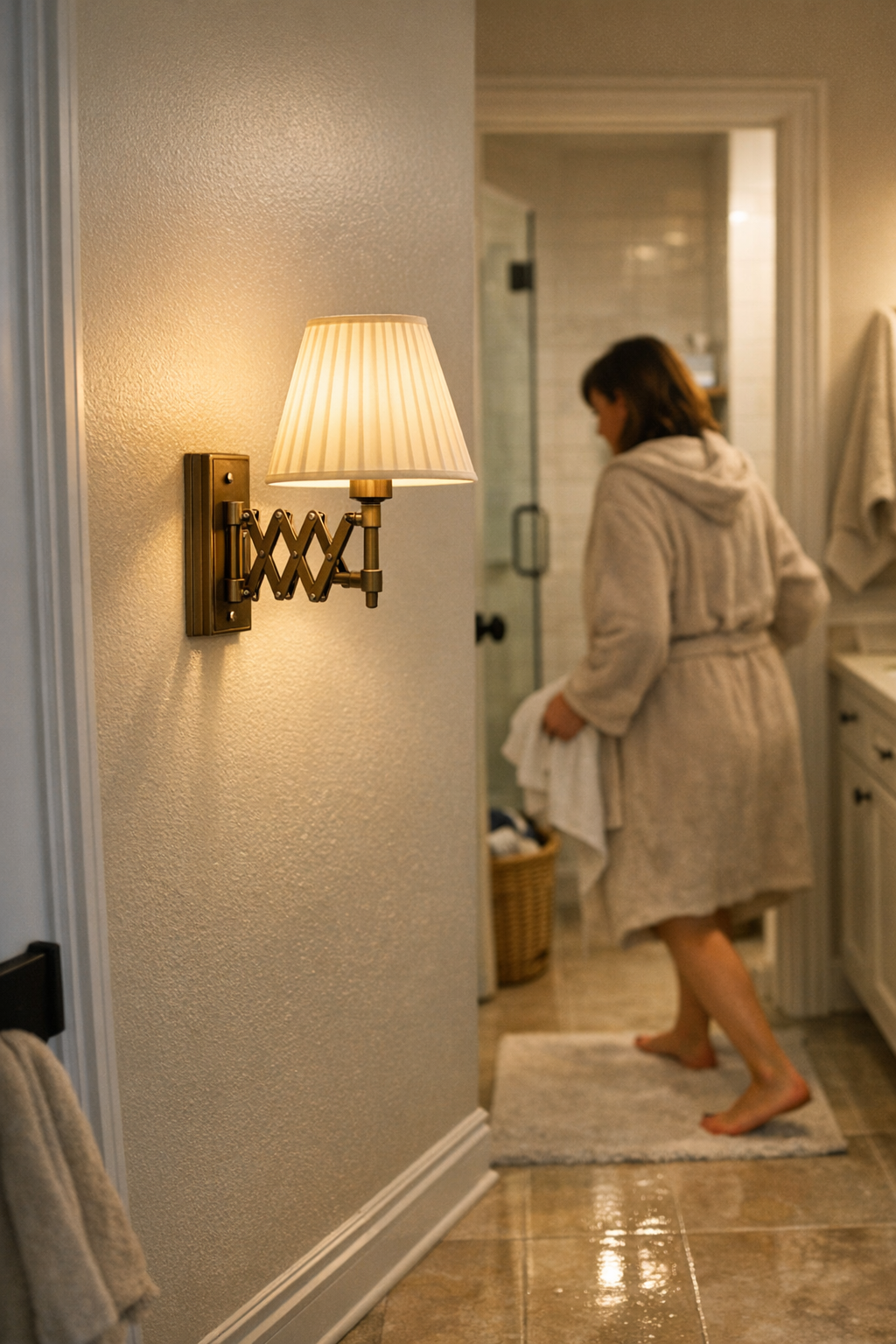
Slick floors expose lighting failures you don’t notice until you’re in motion—pausing at a stair turn because you can’t see the next step, squinting to spot a puddle on wet tile, or feeling one side of a glossy hallway vanish as shadows swallow the baseboards. Overhead lighting that looks bright on paper can fall apart the moment you cross polished tile or lean in at a fogged mirror. If you’re hesitating in spots that should feel direct—a bathroom exit, a laundry zone, a hallway corner—you’re living with the daily cost of light that misses real movement paths and leaves practical visibility to chance.
Where Light Fails Slick Surfaces: More Than Just a Brightness Issue
One ceiling fixture might seem to drench the bathroom or laundry in light, but actual routines keep finding the missed spots. Step from a steamy shower—every tile gleams with reflection, but you’re forced to track a safe place to land your feet. Glare pools under overhead bulbs, catching your eye when all you need is to check for wet patches. Hallway turns collect uncertainty: shadows thicken at trim lines, just where your stride demands clarity. Stairs, baseboards, and doorframes become pockets of unlit risk—encouraging shuffling, deliberate movement, and small course corrections that slow you down and force your attention away from your actual task.
Repeated use makes the flaws impossible to ignore: slowing at slick thresholds, bracing at a darkened stair, drifting away from the brightest reflections just to keep your footing. These are more than small bothers—they’re repeated micro-decisions that drain confidence from each step and quietly raise the risk of a slip on the days you least expect it.
Struggles in Hallways, Bathrooms, and Laundry Zones
High-traffic, hard-surfaced areas create frictions that pure brightness can’t solve. In bathrooms, the supposed brightness turns against you—glare bounces off chrome and tile, bands of harsh reflection scatter right across your footpath. Hallways with ceiling-only light flatten at the center yet push the shadows out, so you feel one edge dissolve beneath your peripheral vision as you cross. On stairs, a single ceiling flush mount might blast the upper treads, but the landing lurks in partial gloom, marked only by a murky stripe where the surface shifts. Each missed spot isn’t theoretical—it’s where balance, visibility, or even the edge for a safe step disappears just before you need it.
Regular routines amplify these failures. You carry piles of laundry but must slow at the wet doorway, half-seeing the tile seams. Shoes leave water by the entry and the far side of the hallway feels like it falls away into shadow, even if the fixture above looks powerful when the room is empty. Weak spread and glare become conditions you adapt to, but never solve, leaving the space visually incomplete in every real use.
Common Friction Points That Interrupt Movement
- Post-shower footing: A field of reflections breaks up the floor, forcing a visual hunt for solid ground.
- Sharp hallway corner: The shine of the floor meets thick, shifting shadows—your step hesitates where clarity is most needed.
- Stair descent: Well-lit upper treads surrender to shadowed landings, making the next surface an uncertain guess.
- Laundry work zone: Overhead bulbs bounce from chrome and lids, making the workspace harsh while the floor blurs out beneath you.
Why Traditional Ceiling Fixtures Leave You Second-Guessing
Flush mounts and linear ceiling lights give a false sense of control—they promise coverage but deliver uneven spread, especially in rooms where slick surfaces multiply shadows and glare. The geometry of tile, the angle of baseboards, and the curve of a stair landing all work against uniformity. Turning up the bulb only intensifies these imbalances: glare clusters near your line of sight or blinds the shiniest patches, while corners and floor transitions retreat into darkness, waiting to catch your foot as you move on instinct instead of clear sight.
The gaps show up in routine, not emptiness. An immaculate bathroom may gleam after cleaning, yet you can’t find the edge of standing water until it’s under your heel. Overhead lighting leaves blind triangles beneath vanities and unpredictable shadow falls under sink lines and stair turns. A space can look illuminated but still fail—if every step requires a check or a detour, the lighting is only delivering surface-level satisfaction, not real usability.
Solving for Movement: The Power of Lower, Wall-Mounted Lighting
The difference comes from moving light where it’s needed—not from brightness, but from placement. In slick-floor, high-use spaces, adding wall sconces or hardwired wall lights at elbow height changes how the room behaves. Suddenly, persistent shadow pockets dissolve and glare is tamed, because light skims across the target surface without reflecting straight into your eye. The last risky patch at a stair or hallway edge doesn’t vanish through sheer brightness, but through careful, targeted illumination of the path you actually use. The improvement isn’t theoretical: awkward pauses and cautious steps disappear, replaced by the ability to move naturally and see at a glance where to plant your feet—no more hunting for the safe spot or angling away from a blinding streak on the tile.
Practical Tip: Where to Place Fixtures for Best Results
- Mount wall sconces or hardwired wall lights at or just below eye level, focusing on main movement routes in bathrooms, hallways, stairways, and laundry entries.
- Prioritize fixtures with a diffused, wide spread designed specifically to reach down and across the floor zone—not just above counters or doorframes.
- Skip bare bulbs and narrow-beam spots; these create new glare, compounding the old problem instead of solving it.
- Walk the space after dark: if any corner or passage forces you to hesitate or look twice, lighting adjustment is still needed.
Frequently Asked Questions on Slick-Floor Lighting
How can I reduce glare on slick bathroom floors?
Choose diffused, wall-mounted fixtures with wide beams. Position them to send light directly across both walking surfaces and approach routes to tubs or sinks. This levels out shine and shadow, letting you see hazards without needing to squint or hunt for edges. Avoid direct, exposed bulbs—they often trade one hard reflection for another.
Where should task lighting go in laundry or bath zones that get slippery?
Target the zone at or just below eye level, especially near areas of repeated foot movement: entrances, laundry edges, tub approaches, and around any tight corridor. Good wall lighting fills gaps where tile meets wall and at turns, keeping steps clear and reducing surprise shadows before they interrupt your routine.
Will brighter bulbs fix poor visibility in these areas?
No—adding brightness usually magnifies problems by deepening contrast. The solution is not higher wattage but smarter spread: fixtures that bathe the movement zone in low-glare, even illumination and erase the shadow lines hiding at edges, corners, and under fixtures.
Lighting That Supports Real Life, Not Just Good Looks
A room that passes a brightness test can still trip up real routines—uncertain steps, hunched posture, split-second hesitation at the very spots you travel most. The best setups don’t just flood a room; they focus illumination wherever hesitation, shine, or shifting surfaces disrupt your habits. Balanced lighting removes those blind moments, turning each trip through a slick-floor zone from a string of micro-adjustments into a straightforward routine where you move naturally, without overthinking hazards or angles every time you cross the tile or circle the stair.
For lighting that actually keeps up with how you live—without leaving dangerous or annoying gaps—see what’s possible at LightHelper.