
Every indoor-cat home has one thing in common: toys don’t stay put, they invade your routine. You clear the living room, but hours later there’s a crinkly ball floating beside the food mat, a plush mouse wedged at the edge of the litter box, or a feathered wand you’ll only find after moving half the furniture. Even when you’re organized, cat toys seem to ignore boundaries—showing up in the path between shared rooms, rolling underfoot as you reach to fill a water bowl, or interrupting evening prep with yet another “where did this come from?” pause. What feels like a tidy setup at 9 a.m. quietly unravels under the weight of daily play, forcing you to repeat the same small, annoying resets—this is the main friction of indoor-cat life you can’t ignore.
How Toy Drift Turns “Tidy” Into a Frustration Loop
It’s easy to think sweeping stray toys into a bin ends the problem. But with nothing anchoring toys to one spot, every cleanup resets the clock, not the room. The real friction isn’t just visual mess—it’s the persistent, unnoticed labor. Every wandering toy creates a new moving target: a hallway blockage, stuttered footsteps in the dark, and lost minutes playing “find the wand” when all you wanted was a quick break before dinner. Instead of feeling organized, you’re left patching the same inconvenience, session after session.
One Day Looks Fine—A Week Tells the Real Story
A freshly picked-up room only tells half the truth. By midweek, the cracks appear—one toy you left on the couch now blocks the kitchen doorway, another has drifted into the walkway between the bed and bathroom, and you’re spending scattered minutes hunting through corners you just swept the day before. Each time you toss a toy back in the bin, two more have drifted out, making your reset routine stretch longer and wear thin after multiple rounds. Clean in the morning, cluttered by night—if you track where time gets lost, it’s here.
The Real Cost: Time, Hassle, and Interrupted Routines
The exhaustion isn’t the pile of toys, it’s reaching for the water dish and finding a jingle ball blocking the mat, or pausing mid-grocery-carry to scoop a forgotten plush before stepping on it. Every unwanted pick-up adds seconds—or minutes—to ordinary routines you expect to be quick. Over a week, this stealth “reset tax” piles up, slowing down every feeding reset, wipe-down, or shared-space crossing, making the entire room feel slightly less yours.
Small Setbacks Multiply: How Ordinary Routines Slip
In a single week, watch how disorganization creeps in: the play mat stays in place, but the wand migrates far from reach. Litter area gets a stray ball mixed in, tracking debris into new corners. Stepping around half-hidden toys with full hands risks a spill, and escalating frustration follows as quick resets stop feeling quick. It’s not chaos—it’s a low-level, ongoing grind that eats away at how easy your space is to use, clean, and enjoy without warning.
Why Most Cleanup Approaches Quietly Fail
The fallback move—periodically stuffing toys into baskets—always seems logical until it isn’t. The moment a toy vanishes under the sofa or your cleanup bin sits out of reach, the friction starts over. The cycle remains: toys “disappear” into the wrong room, show up out of place, and your setup only works if you’re willing to repeat the same hidden chore, every day, forever. Because the system isn’t built for how you and your cat actually use the room, tidy is never lasting—it’s a mirage that needs constant chasing.
The Reality of Shared Home Space
This friction multiplies with each extra person—partners, kids, or guests—using the same space. Toy scatter turns the hallway into an obstacle course, kitchen walkways into sidestep drills, and most tellingly, the human urge to “just move it later” turns into full-blown clutter by day three. Even if others don’t complain, you see the difference—there is always something to pick up, shift, or work around, and the mental drag isn’t imaginary.
The Structural Shift: One Consistent Play Cue, One Zone
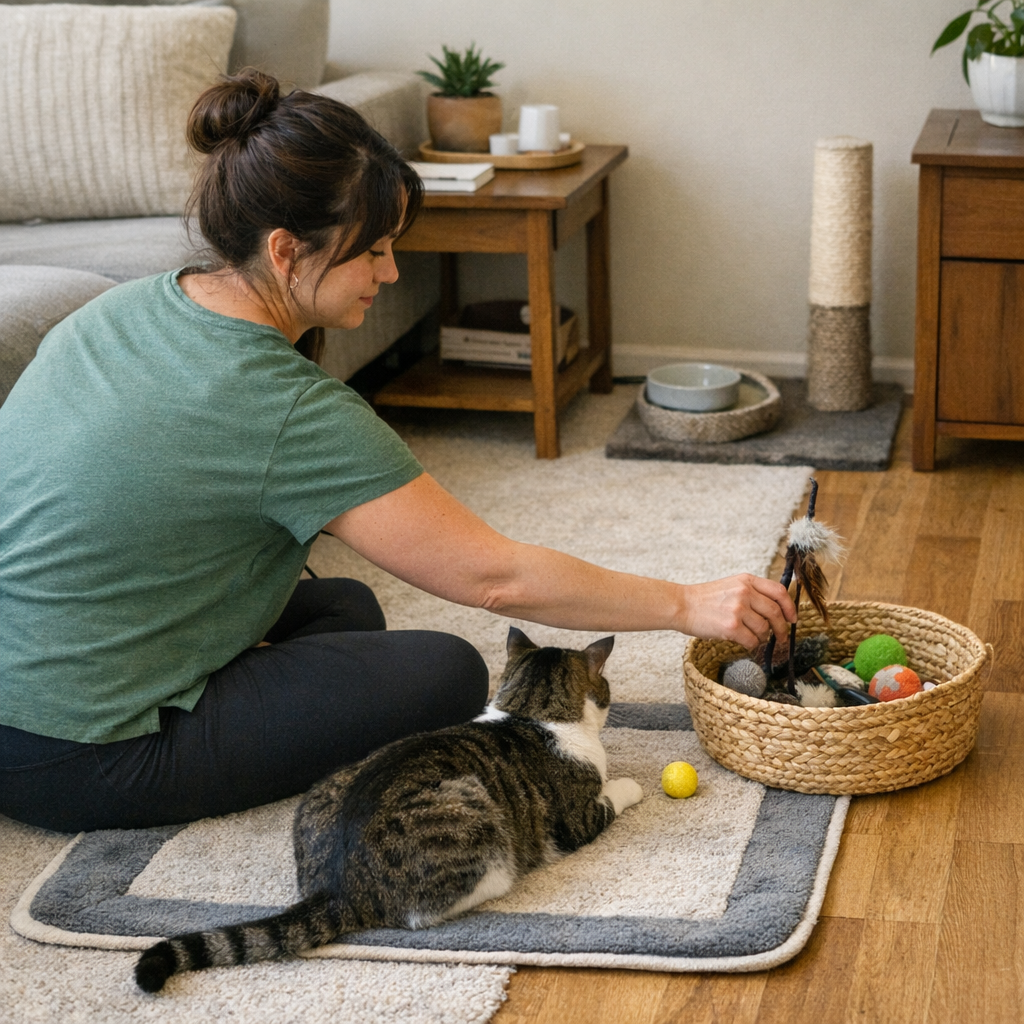
Adding bins or multiplying toy choices doesn’t fix the loop. The real change is structural: tie every play session to a single play cue—a sound, a spot, and a (preferably favorite) toy—anchored in one recognizable area, every time. Use a dedicated mat as the visible border. Bringing play back to this reset zone cues your cat and your own routine, and toys no longer orbit the house on their own schedule. You flip the pattern: toys stay anchored, resets shrink, and random clutter drops away.
The First Days: Visible Change, Easier Reset
Give this routine a genuine week. Ditch the multi-room scavenger hunt: leave toys by the mat, signal play from the same place, and finish each session by returning everything to arm’s reach storage. In days, most owners notice the difference—cleanup is a handful of seconds, not a full sweep. Even better, your walking paths and shared spaces stay clear, so routines feel less interrupted and more predictable, no matter when play happens.
When Toy Storage Helps—And When It Actually Gets in the Way
The right storage isn’t about more space—it’s about instant access and anchored habits. Open baskets or trays always kept next to your reset mat keep toys in view, grabbing them as easy as starting play. Tucking bins behind doors or in other rooms quietly kills the system: you forget, your cat loses interest, and toys freely wander. The only solutions that hold up make the return-to-zone habit automatic for you, not another step you have to remind yourself to do.
What About Rotating Toys or Spreading Play Around?
It’s tempting to scatter toys or rotate them for novelty, but this quickly turns “enrichment” into extra work. In lived practice, limiting toys and anchoring play to a single space actually makes the session more focused and anticipation higher; it’s the play ritual—not the raw toy count—that keeps your cat engaged, and your reset friction low.
The Visible Rewards: Less Reset, More Flow
Stick to a single play cue, a single zone, and clutter shrinks fast. The mat border becomes a visual anchor: toys stay where cleanup is easy, storage bins don’t overflow, and background mess doesn’t seep into every living area. You’ll notice the benefits most during transitions—no last-minute hunt before guests arrive, no bending down halfway to the door, no pause to clear stray toys before a litter or water reset. “Tidy” becomes repeatable, not another box to check off.
Resetting Becomes a Moment, Not a Project
What used to mean prowling from room to room, gathering wayward toys, now finishes in a ten-second pickup. Play ends, storage is right there, and nothing lingers to interrupt the rest of your routines. The method holds because it fits normal life—no alarms, no elaborate system, no dependency on perfect memory. Even when everything else is hectic, this corner stays under control.
Don’t Settle for “Tidy” That Still Interrupts Your Day
More containers or extra organizing won’t close the loop if toys still drift and daily resets stretch out. The reality is, only an anchored play zone and cue—integrated right into where you and your cat already use the space—eliminate the invisible reset tax that comes from weak structure. What looks clean in a snapshot may still cost you extra minutes and mental energy all week—fixing it at the root gives real, daily relief.
See practical indoor-cat setup ideas and solutions at StillWhisker.