
The room looks bright—until your hand hovers over the soap or your foot hesitates at the stair turn. Most homes are filled with fixtures that promise visibility but carve out shadows right where you need to see. The typical ceiling light makes a floor shine, yet lets the edge of the counter vanish, or throws a wash of glare across the bathroom mirror. You pause at the sink, feeling blindly for the faucet; you slow your step, guessing where the shadow breaks as you cross from hallway into a dimmer stairwell. If your lighting leaves you working by memory instead of by sight, the interruption isn’t occasional. It’s structural—and it repeats, every single day.
Why Glare and Shadows Become Repeated Problems
Friction creeps in not because the room is “dark,” but because task zones go half-lit at the worst moments. Every standard flush-mount or panel ceiling fixture pushes brightness downward and outward, but does little for sink lips, counter edges, cabinet undersides, or the detail lines of a mirror’s frame. Step into a new angle or open a cupboard, and the overlooked recess turns into a guessing zone. The cost isn’t just a one-time adjustment: you lean, squint, slow down—exposing how little confidence you actually have in your space’s layout. Over a week, those subtle hesitations fracture your routines and make surfaces you should trust feel unreliable beneath your hands.
Glare on mirrors is another trap. Ceiling fixtures bounce harsh white light into your eyes, obscuring face and hand detail when you need to see most clearly—shaving, fixing hair, touching up a spot at dawn or before bed. At the same time, overhead light behind you casts your own shadow onto every counter, turning each small task into a question of angle and adaptation. In laundry corners, one arm or a basket throws a shadow right across the stain you’re hunting for, and you find yourself hunched, nudging, or shifting the light source just to make sure.
Recognizing the Lighting Patterns that Trip You Up
It’s easy to be fooled by brightness at first glance—a “renovated” bulb doesn’t guarantee practical clarity. The mismatch only appears after repeated use. Common mistakes unfold in zones like:
- Mirror zones: Step close and your face halves in shadow; lean back and the glare hides all detail. Grooming turns into trial and error, not smooth routine.
- Under-cabinet counters: You see a spotless counter from the doorway. Stand to chop or clean and your hands suddenly disappear into uneven shadow along the working edge. You fumble more, grabbing at items by shape, not sight.
- Stairways and landings: Open staircase above and below, but every mid-turn the closest step softens into shadow—your stride instinctively slows as you test for the riser’s edge.
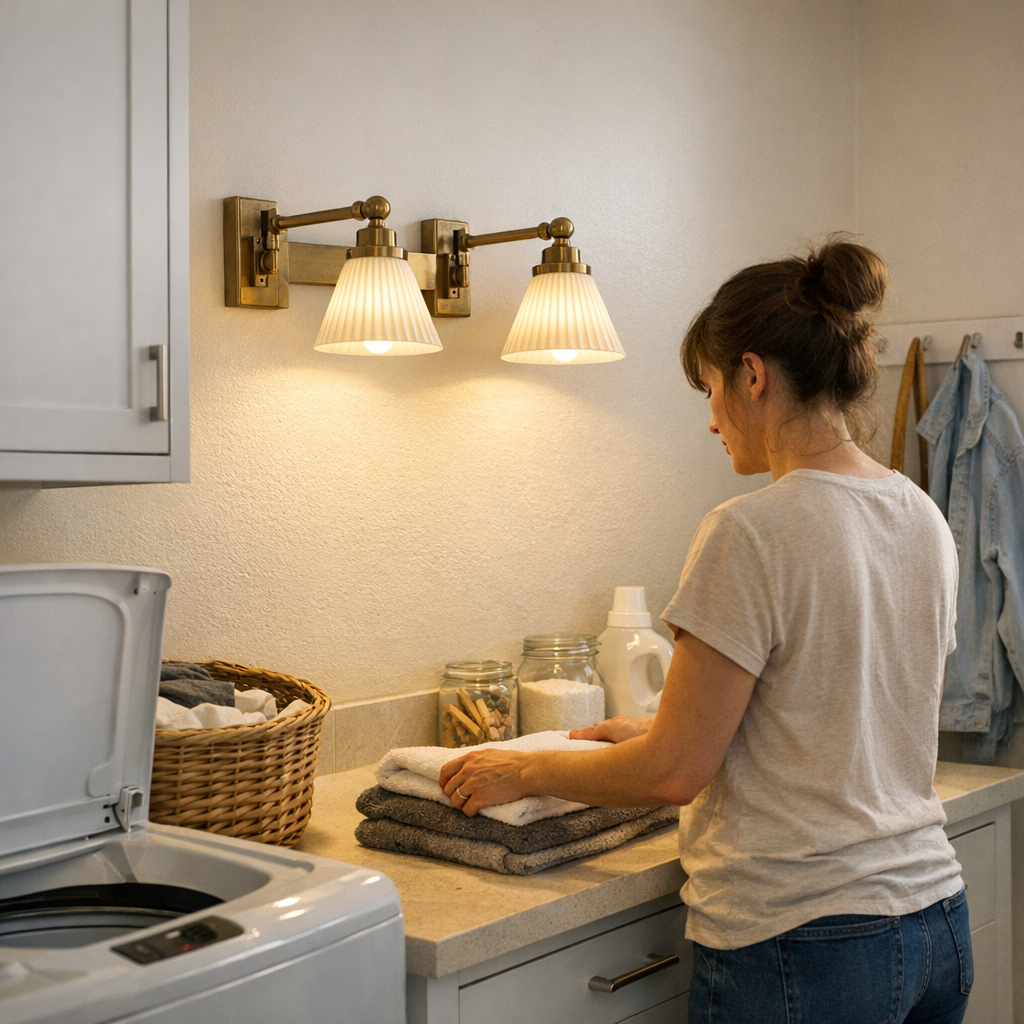
- Laundry and utility areas: Overhead lighting creates bright rectangles, but your own body blocks the spread as you move. Sorting or cleaning requires constant side-stepping to keep stains or spills visible.
The Confidence Gap: When Lighting Slows You Down
Confidence in movement is built—or undercut—by how reliably light covers the places you put hands and feet. When you have to lean close to check a spot, double-back on a dark stair, or squint for detail at the mirror, routines devolve into small compensations. Each act becomes slower, less precise, and less certain. The “bright” fixture overhead, for all its watts, lets these friction points persist—turning a workspace or passageway into something you have to adapt around, repeat after repeat.
Shadow at the Work Edge
Bathroom and laundry counters highlight this most clearly. Overhead fixtures appear to light the whole zone, but as soon as you reach forward—scrubbing cloth, sorting clothes, or looking for keys—your own arm throws darkness onto the work surface. This isn’t a one-off; the same pause happens every time. The result is a string of half-blind, tentative movements rather than seamless flow.
Glare at the Mirror
Direct overhead light on bathroom mirrors blinds rather than reveals. Instead of seeing blemishes, stray hairs, or makeup accuracy, your vision splits between squinting through reflection and searching for shadowed detail. The strain shows up especially in morning and evening routines: what should take a confident second becomes a drawn-out, error-prone pause.
Simple Placement Shifts Create Reliable Visibility
Improvement doesn’t mean raw brightness. It means dropping the light source to the level of eyes and hands, placing illumination right where interaction happens. A wall sconce or hardwired side light above laundry counters, for example, erases persistent murky strips so stains, lost buttons, or detergent spills can’t hide. Set flank lights on both sides of a mirror—not just above—and the facial shadow breaks, making grooming straightforward and balanced. Under-cabinet strips in kitchens put usable light directly onto chopping or cleaning zones; a hallway or stair run lit with panel fixtures near turns rather than in the center keeps every tread or pivot clearly marked by direct light, not guesswork.
- Install wall or sconce fixtures at the level hands and eyes engage—beside mirrors, anchored above work tables, along stair midpoints.
- Mount under-cabinet strips so work areas stay even and readable, not interrupted by a hand’s own shadow.
- For hallways and stairs, shift ceiling fixtures toward corners, pivots, or bends where movement tension actually collects in the dark.
Task-focused placement solves the hidden gap: you no longer twist, lean, or double-inspect what should be obvious. Daily paths smooth out; simple motions—reaching, stepping, glancing—regain their speed and ease. The room works as instinct promised, not as old lighting trapped you into expecting.
When to Upgrade: Recognizing It’s Not Enough
The tipping point is repetition. If you catch yourself constantly adjusting—checking the counter twice, shifting position at mirrors, slowing before a stair—your space is signaling that surface-based, targeted lighting is overdue. When “illuminated” never equals “usable,” or when shadows and glare become routine obstacles, it isn’t an aesthetic shortfall. It’s a fixable boundary in your everyday movement—an interruption you only stop noticing when you finally address it head-on.
Lighting That Quietly Improves Daily Movement
Effective indoor lighting barely calls attention to itself, but rewires every routine it touches. When the position, height, and focus of fixtures finally match the way you actually use your space—again and again throughout the day—the grinding hesitation fades. You stop making adjustments, stop second-guessing, and start trusting each step, reach, and task. Lighting does its quiet work. The difference is visible in the routines that no longer slow you down.
See how practical indoor lighting setups can simplify the routines that matter most at LightHelper.