
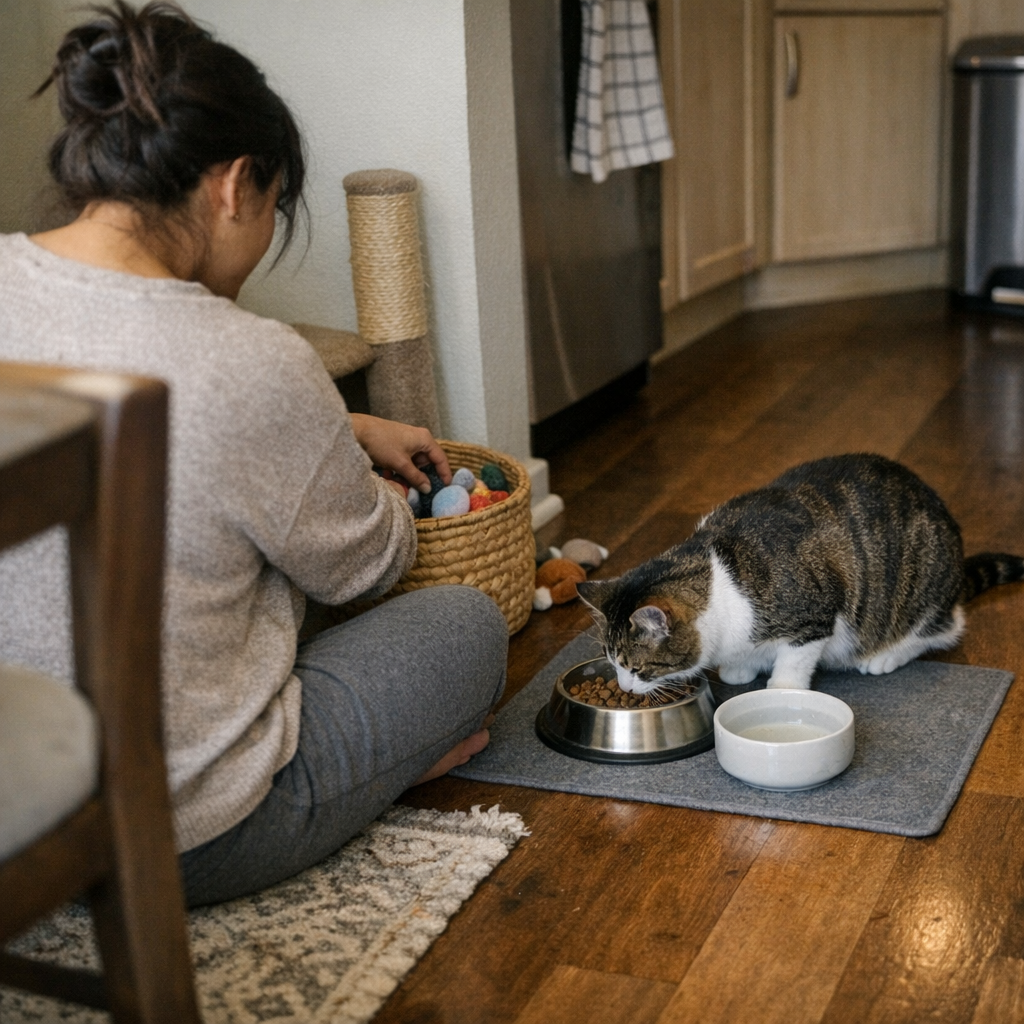
Set up, tidy up, then get blocked at the worst moment. In most indoor cat homes, a feeding mat can look settled in its corner, toys stashed tidily, and supplies lined up—yet the same everyday friction keeps coming back. Bowls end up blocked by stray toys, water edges spill just where you’ve wiped, and crumbs or fluff return between resets. It’s not simply mess; it’s repeated reset work: hunting for the scoop under a pile of toys, shifting a mat to mop up after every meal, dodging scattered chews or a misplaced rest cushion just to refill the bowl. For StillWhisker homes, the struggle isn’t lack of gear—it’s the momentum of daily routines exposing weak points you thought you’d fixed.
Why Feeding and Play Sequence Shapes the Daily Mess
Even a careful cat setup starts to break down when routines ignore the order of play and feeding. The shift from “play, then eat” to “eat, then play” rewires how often you need to clean, what objects stray into walk paths, and whether the feeding area stays usable between resets. Change the order, and it changes where the work shows up. Most owners notice the hidden cost only when toys migrate to feeding mats, crumbs travel out of the bowl zone, and cleanup quietly drags on. Every shift in energy leaves a visible trail—on the floor, around the mat, across the shared room.
When the Routine Backfires (Even in a Tidy Room)
Feed first, and you often pay twice: the cat barrels toward the bowl at full speed, spills kibble across the nearest walkway, then grabs the first toy in sight to launch back into the same cleared zone you just wiped down. The effect is cumulative—random fluff by the mat edge, streaks from water splashes, a path you cleaned this morning lined with tiny grit before noon. No new mess-maker needed; the routine itself keeps undoing your work, and reset cycles stretch out.
Play Before Food: The Hidden Reset Button
Play first—then feed—and the whole setup holds up longer. Cats that burn energy in play before meals settle for quieter, less messy feeding. Food tends to stay near the bowl instead of skating across the mat. Water splashes retreat, and toys go back to their zone instead of crowding feeding time. Even after several days, that difference is real: the same floor space holds up with lighter sweeps, fewer surprises, and less chasing after out-of-place objects. The change isn’t theoretical—you see it in how much less you need to move, lift, or return with each cycle.
The Cumulative Cost of Ignoring Sequence
Ignore routine order, and the consequences pile up everywhere: the spot you mop gets wet again, you wipe crumbs that weren’t there ten minutes ago, and toy migration restarts before you’ve finished cleanup. It’s not about “cat training”—it’s the work that repeats. If cleanup supplies aren’t grab-and-go, or if you spot yourself moving the mat, toys, and bowl just to clear a corner, the real friction isn’t the cat—it’s routine structure pushing the same flaw forward, day after day.
Spotting Repeat Problem Zones
Most setups fool you at first. Mats look generous, baskets start out full, and everything lines up—until a week in, when certain islands of trouble refuse to go away:
- Crumby corridors: Food dust migrates from bowl to walkway even when mats fit tight, giving that unmistakable crunch underfoot midweek.
- Toy spillover: Balls, small plushies, and chew sticks wedge under chairs or against the water dish, always returning to the same mess-prone strip.
- Water edge drama: The bowl itself may not leak, but one quick lap sends water inches past the mat boundary, demanding another wipe-down.
- Resets chained together: You reach for a single crumb, but end up shuffling three other objects—mat, toy, rest cushion—just for basic access.
The pattern amplifies fastest when feeding and play overlap or happen out of order—showing up as persistent mess exactly where you want clean, open access. If evening always means retrieving the same toy from the bowl path or seeing water spots reappear in that one spot, it’s the sequence, not the stuff, dragging your effort down.
Separate Zones, Smoother Mornings
The simplest fix isn’t more gear—it’s space. Put toys and feeding several feet apart and keep cleanup tools where your hand naturally reaches. Even shifting a bowl mat one hand’s width from the wall gives you a physical buffer. Toys become less likely to ricochet into bowl zones. Water, food, and play debris hit their own areas and stay there. Cleanup shrinks from a round of rearranging back to a ten-second sweep and a single pass with the cloth.
Why “Looking Tidy” Isn’t Enough
Judging a setup by last night’s reset is a classic trap. The corner can look perfect for hours and still break down the instant routines collide—like a ball knocking over a food dish or a cushion drift that always blocks the next refill. The real test? How long the order lasts, and whether you keep moving objects out of the way just to do ordinary tasks. If you’re still zigzagging around piles to reach the bowl or the toy basket always needs a mini-tidy, “tidy” isn’t translating to “easy.”
The right setup doesn’t just look cleared—it feels easier to pass, reset, and maintain. When familiar friction keeps coming back (toys crowding the refill zone, bowls surrounded by relocated fluff, or cleanup dragging into a shuffle of accessories), the structure—not the stuff—needs the change.
What a Functional Setup Looks Like in Real Use
Picture a kitchen area where the feeding mat doesn’t hug tight to the wall, but sits with built-in buffer; toy storage is past the walk path, and the feeding zone’s edge doesn’t overlap with play or rest corners. After breakfast, your reset is actually fast: one pass for crumbs, a check of the mat, done. No search under cabinets, no repeated water mop-up, no play detour clustering around the food. You don’t get perfect order—some days, toys stray or a water splash finds a new tile seam—but the routine isn’t constantly stacking new work into your path.
With one deliberate play-before-food cycle and clearly split zones, the mess becomes a one-off, not a rerun. That’s what makes maintenance lighter: you stop repeating the same clumsy shuffle and start noticing that your space holds up for real, not just for photos.
Small Adjustments, Big Payoff
Rethink order, tweak spacing, and the difference stays visible. The biggest home-life shifts don’t require new bowls or extra storage—they rely on breaking repeated patterns. For example:
- Bowl refills take seconds when no toys crowd the reach angle.
- Mat placement matters—a spot that keeps scatter from spilling past the wall saves another round of sweeps.
- Toy return drops to weekly, not daily because the play zone’s now well away from feeding reset points.
- Shared walk spaces clear—no weaving around resting pads or scratchers mid-chore.
- Litter drift slows when the post-play dash never crosses through every other zone right after meals.
These differences are what actually shrink the daily load: you end up restocking, cleaning, and straightening in seconds, not full sessions. The quiet friction goes away.
If You Keep Finding the Same Mess, Give Rhythm a Second Look
If the same toy, water streak, or crumb zone keeps showing up, the fault isn’t usually with the equipment. It’s the rhythm and structure handing you repeat work. If resets stretch out or you feel blocked every time you use the space, ask which routine happened first and which zone kept overlap alive.
Test a “play first, feed second” cycle and pull toys an extra few feet from the bowl for a week. Even after three days, you’ll spot whether the reset shortens, the mess travels less, and the same blocked point finally disappears.
The endgame isn’t spotless—it’s a setup that works with your routines, not against them. That’s when shared spaces actually become livable, not just organized for a moment.
Find practical, field-tested setups designed for real indoor-cat routines at StillWhisker.