
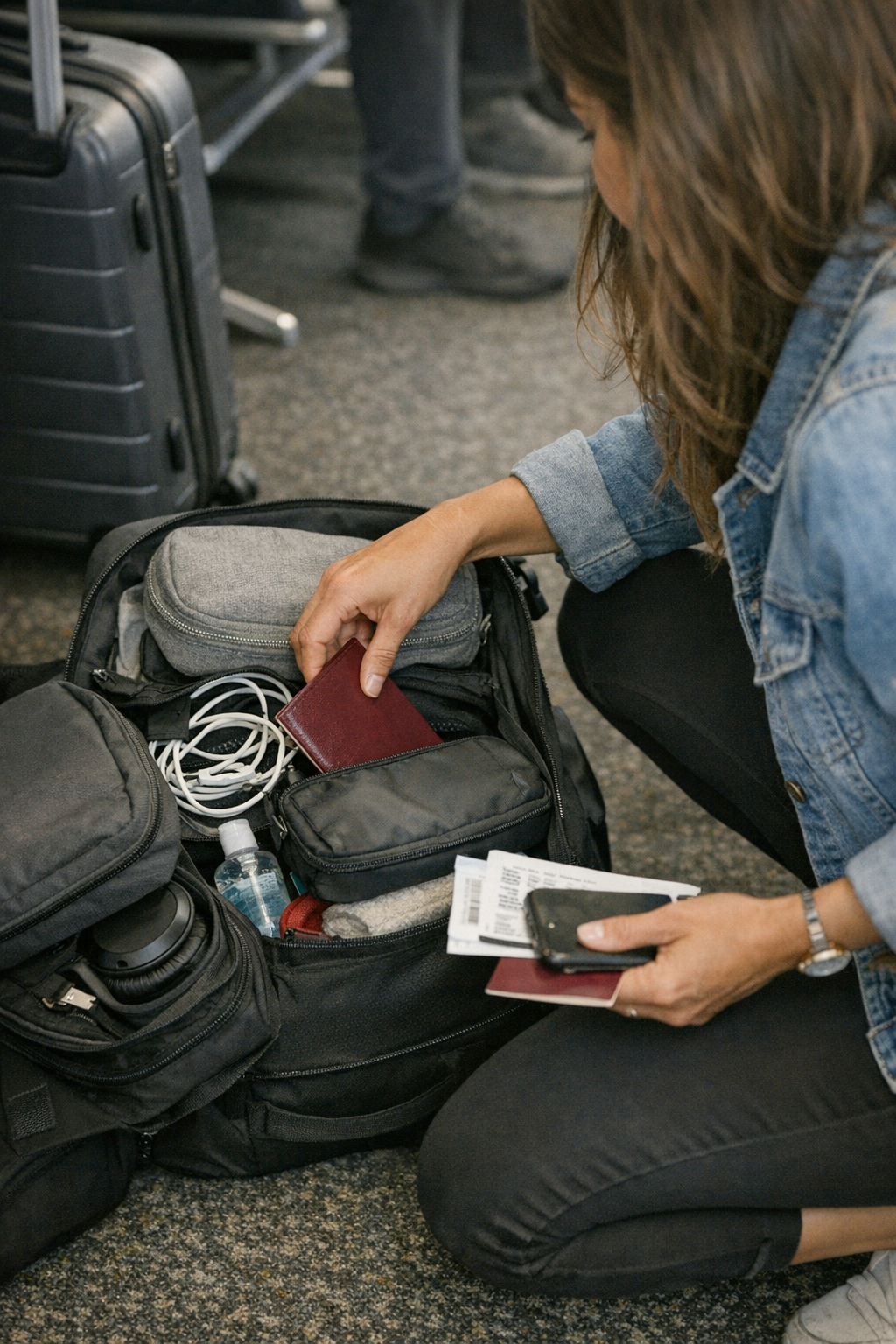
The carry-on that looks pristine on your living room floor can break down fast—right when real travel hits. The moment you hit the security line, tray in hand, and start reaching for your passport or charger, the “perfect” packing system starts to falter. Items shift, pouches block other pouches, and that reliable organization dissolves into a slow crawl at the worst possible time: security checks, boarding queues, and jammed airplane aisles. The more you try to keep order, the more each routine reach turns into a small setback—and the more you notice where your setup really fails under real airport pressure. This is where the rigid packing logic of home clashes with the snagged, in-motion reality recognized by anyone who travels more than once a year.
Why Neat Packing Fails Under Repeated Pressure
The illusion: everything in its place, a lineup of pouches and zippered pockets, cables wrapped and filed away. Reality: that careful setup cracks the moment pressure builds—at the first ID check, at the next repack, at the third time you reach for your boarding pass. Suddenly, the cable you tucked in is coiled around your passport, sanitizer is pinned under headphones, and the “just one more zip” routine drags longer with each round.
This isn’t a messy-bag problem—it’s a repeated-access problem. Each movement you make exposes a new snag: your flow is interrupted, tiny frictions stacking up until even ordinary retrieval feels like a hassle. The complexity isn’t visible at first—it only becomes obvious after the same annoyance repeats three, four, five times before you land.
Real Carry-On Scenarios: When Visual Order Slows You Down
The Security Checkpoint Stumble
Security lines aren’t just about patience; they spotlight every flaw in your packing structure. You reach for your document pouch, but another organizer blocks it. Or you dig for your boarding pass and end up dragging out an entire tech pouch you haven’t touched since last night. Your supposed “order” just forced an audience to wait while you fumbled with zippers—what worked at home just slowed the TSA line and spiked your irritation.
The Overhead Bin Access Dance
As you stand in the tight aisle, ready to stow your bag, the pressure doubles. You think you can grab headphones or sanitizer quickly—but both are buried under layered organizers. The bag you zipped to perfection is now a barricade of pouches and fabric. With a growing line behind you, you unstack, search, restack, all before even reaching your seat. The cost: extra seconds, side glances, and a feeling that your “system” is working against you in front of a live audience.
Seat-Side Repacking Hassles
Sitting down should be relief, not another round of fumbled unpacking. Need headphones? Another pouch layer. Need tissues? Unzip the next pocket. Every time you try to return items—after the snack cart, after plugging in a charger—a small shuffle breaks the order you built at home. Over a long flight, these repeated, miniature repacking drills pile up, leaving your carry-on less usable and your patience thinner with every cycle.
Hidden Friction: The Cost of “Double-Layered” Packing Tactics
There’s a reason these headaches repeat. Nesting organizers look satisfying in your luggage photo, but repeated use turns them into speed bumps. Stacking pouches in the name of neatness means every retrieval becomes a chore: unzip, search, stack, return. The more you try to impress with clean lines, the more you slow yourself at every high-pressure moment—especially between gate calls and snap security checks. By your third dig for the same item, it’s not just a visual problem; it’s lost time, lost flow, and mounting frustration where the friction only increases with real use.
When Routine Interrupts Reveal Weak Spots
It’s easy to spot the real failure points: that mental tally of moments when you thought, “This again?”—passport two pouches deep, sanitizer never where you need it, headphones stuck under yesterday’s power bank. Your carry-on isn’t chaos, but every everyday access is a step slower than it should be. Visual order returns after you repack, but the underlying drag stays put.
- Passports and ID buried two layers down—leading to slowdowns not just once, but at every checkpoint and gate.
- Chargers, headphones, and tech in a puzzle pile—good luck getting one without spilling three others.
- Quick-use items like sanitizer stuck for neatness, but unreachable when you spot a line forming behind you.
- Pretty pocket stacking killing fast returns—you end up re-zipping, re-ordering, just to put one thing back.
- Every “visual reset” trick restoring order without fixing slow repeated access.
Designing for Access: What Actually Moves With You
The real upgrade isn’t a prettier setup—it’s one that breaks the repeated-interruption cycle where it starts. The structure that works is the one you trust to deliver in three or four real pressure moments, not just to pass a pre-trip photo test. Diagnosis is simple:
- How many times do you need instant access to your phone, documents, or charger between home and gate—and does your bag make that one move, or several?
- Are you still shifting entire pouch stacks for sanitizer or headphones every time?
- Do “neat” placements force you to unpack for one item, just to recap and reorder again before you move on?
- If a real pressure point exposes a friction—boardings, security, crowded aisle—does your carry-on fix it or compound it?
The setups that survive repeated use aren’t as strict visually. Those who travel often quietly break the symmetry: moving must-grab items into outer pockets, keeping tech loose in a top flap, accepting a slightly “broken” look in return for true access when it counts. The price is a little less tidy, but each friction point gets shorter, and your trip feels lighter, not heavier, with every step and every repeated reach.
Small Shifts That Add Up: Real-World Improvements
Watch a frequent traveler who’s stopped losing time: their boarding pass sits in a front pocket, not trapped in a zip system. Sanitizer and phone live loose in outside sleeves, not buried under a toiletries cube. Headphones and charger share a thin quick-grab spot, so in-seat reorganizing shrinks to one zip and out. The look isn’t as staged, but there’s less fumbling, less reordering, and noticeably less stress by the time you reach your seat.
None of this sacrifices basic organization—it shifts priority from “one glance, all tidy” to “one move, item in hand.” The ordinary daily flow—grab, use, return—finally matches up with how travel really unfolds: unpredictable, repetitive, crowded, and always pushing your setup to deliver under pressure, not just at rest.
When to Rework Your Carry-On Routine
If you finish a trip and can list two or three repeated sticking points—document pauses, slow sanitizer access, repacking after every tray—your current setup isn’t working for transit. It might mean breaking your home logic: moving the most-used items to the least symmetric spot, choosing outer access over inner perfection. But the tradeoff? Fewer micro-stalls, fewer frustrated digs, and a setup you don’t second-guess every time a checkpoint, gate, or seat-side search interrupts your flow.
The better carry-on isn’t the one that stays perfect on the floor—it’s the one that keeps you moving every time reality interrupts your plan. When that happens, the trip gets smoother—not because you packed more, but because you finally packed for actual movement, not just for looks.
See real access-focused carry-on solutions at CarryOnSupply.