
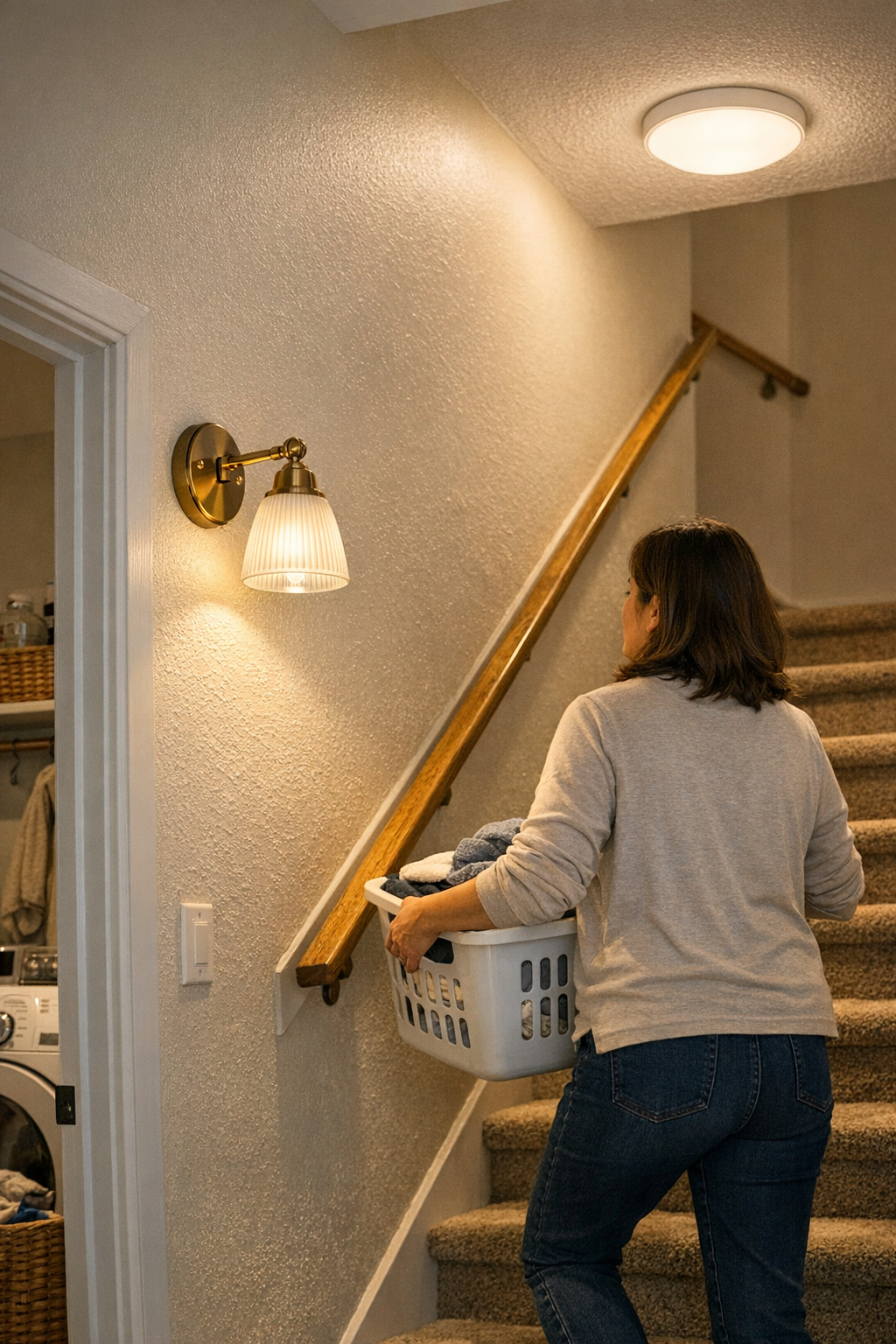
Stairways that look “well-lit” on paper can still trip you up—literally. It only takes one off-angle shadow or washed-out tread for a safe staircase to become a daily hazard. You think you’ve solved lighting by installing a bright ceiling fixture, but halfway up with a laundry basket, your own shadow erases the step edge right when you need it most. The difference between looking illuminated and actually moving confidently comes into focus fast, especially in spaces where safe footing isn’t optional.
Where Lighting Looks Fine—but Fails in Use
Lighting that seems balanced at rest falls apart during real movement. You notice it on stairs, landings, and corners: any time the layout, humidity, or what you’re carrying shifts, so do the shadows. Take the routine of hauling laundry upstairs. Arms lifted, basket in hand, your own load blocks what ceiling light was doing. Steps that looked clear vanish under your elbow, and steam from damp fabric scatters reflection into odd, harsh lines. It isn’t a crisis; it’s a slow, constant friction—hesitation, feeling for the rail, moving slower because visibility is suddenly unreliable.
The weakness isn’t just theoretical. A single ceiling light creates a false sense of completion, but leaves pockets of uncertainty where shadows pile up on the tread’s leading edge, or glare bounces from glossy paint. You have to aim your next step, not just take it. Every trip becomes a negotiation with the space, not a routine part of your day.
Layering Fixtures: The Practical Case
Flush-mount and semi-flush ceiling lights offer wide coverage but almost always miss problem zones—around stair turns, under low ceilings, or in oddly angled runs. On damp, busy days, their light scatters, but still doesn’t fill in the zones where movement happens. The problem becomes clearest when condensation or everyday chaos throws shadows into the exact places you rely on.
Wall sconces and directional wall-mounted lights bypass this limitation: Placing a sconce along the ascend or next to the landing cuts through shadowed “dead zones.” Side-light along the stair and rail restores contrast right where feet and hands move. Now, when you pass with a load, shadows can’t erase the step’s outline; visibility stays reliable from both above and beside. The intensity isn’t higher, but the usefulness is. Instead of a broad, overhead wash, you get targeted clarity that doesn’t collapse the second your routine changes.
Real-World Friction: The Laundry Room Stairs
Picture the stairway just off the laundry area. A flush-mount ceiling fixture casts plenty of light until you, a basket, and humid air enter the scene. Suddenly, every upward step is half in shadow, half faded by steam—perfect conditions for a misplaced foot. You slow down, feel for the rail, and check every tread. Week after week, it doesn’t get easier. This isn’t rare or dramatic; it’s how an “adequately lit” space sneaks risk into ordinary routines, turning what should be automatic into a mild obstacle course.
How a Small Change Makes a Big Difference
Add a wall sconce at stair-rail height—set about 70 centimeters above the run—and the game changes. Tread edges stay outlined, even when arms and loads get in the way. What used to turn foggy under damp air and awkward shadows now shows crisp, predictable step shapes every time. That constant second-guessing at the stair edge? Fades out. Movement becomes smooth again—three points of contact aren’t a feat of caution but a true habit, restored by light that fits the space’s real demands.
Blended Lighting: Addressing Everyday Movement
Layered lighting isn’t about overkill or ornament—it’s about control and confidence where you use it most. Combining wall sconces with carefully placed ceiling lights covers what wide ambient fixtures inevitably miss. Short stair runs, cramped ceilings, or odd geometry all amplify the flaws of single-source lighting. But place a directional wall fixture to highlight treads, or shift a ceiling panel toward a darkened sidewall, and the whole movement path changes. You stop compensating for the light’s limits, and the space starts supporting you instead.
This approach isn’t visible in style photos, but it’s obvious every time you carry groceries upstairs after a shower, or cross the hall with full arms. Small shifts in fixture type and placement decide whether “enough” light really means safe, fluid movement—or if confidence quietly drains away, trip by trip, until you’re always pausing or favoring one side.
When to Rethink Your Fixture Layout
Notice yourself pausing on a stair landing, leaning into corners, or checking the sweep of a handrail under your palm? Those aren’t quirks—they’re signs your lighting isn’t keeping up. Shadows that crawl over the edge of a step, rails that drift in and out of sight, or corners that stay murky after upgrades: all mean the fixture mix isn’t matching real movement. Swapping in a higher wattage ceiling bulb only blunts the problem. True improvement comes from added direction and coverage, not simply more brightness.
Look for these friction points:
- Dark bands and shadow traps at tread edges or along railings
- Lopsided light that only works from one direction (usually overhead)
- Pathways that get “dimmer” while hands are full or after a shower
- Harsh glare from reflective paint or awkward fixture angle
Addressing these means your movements become automatic again, not calculated. Often, just one or two added fixtures—a stair-side sconce or a shifted ceiling panel—quietly erase the obstacles, making every trip less tense and more predictable.
The Value of Lighting That Adapts to Real Life
Reliable indoor lighting is judged by daily routines, not just first impressions. It has to deliver during humidity from showers, arms full of laundry, crossings when your hands can’t probe for the next step. Decorative fixtures and bigger bulbs rarely solve the problem zones—they just hide them behind a gloss of general brightness. Lighting that layers sources, controls shadows, and matches the space’s real pattern of use keeps confidence high and routines brisk. It’s the change you only notice when trips up and down the stairs finally go back to being forgettable again—in the best way.
Find practical solutions for every critical indoor space at LightHelper.