
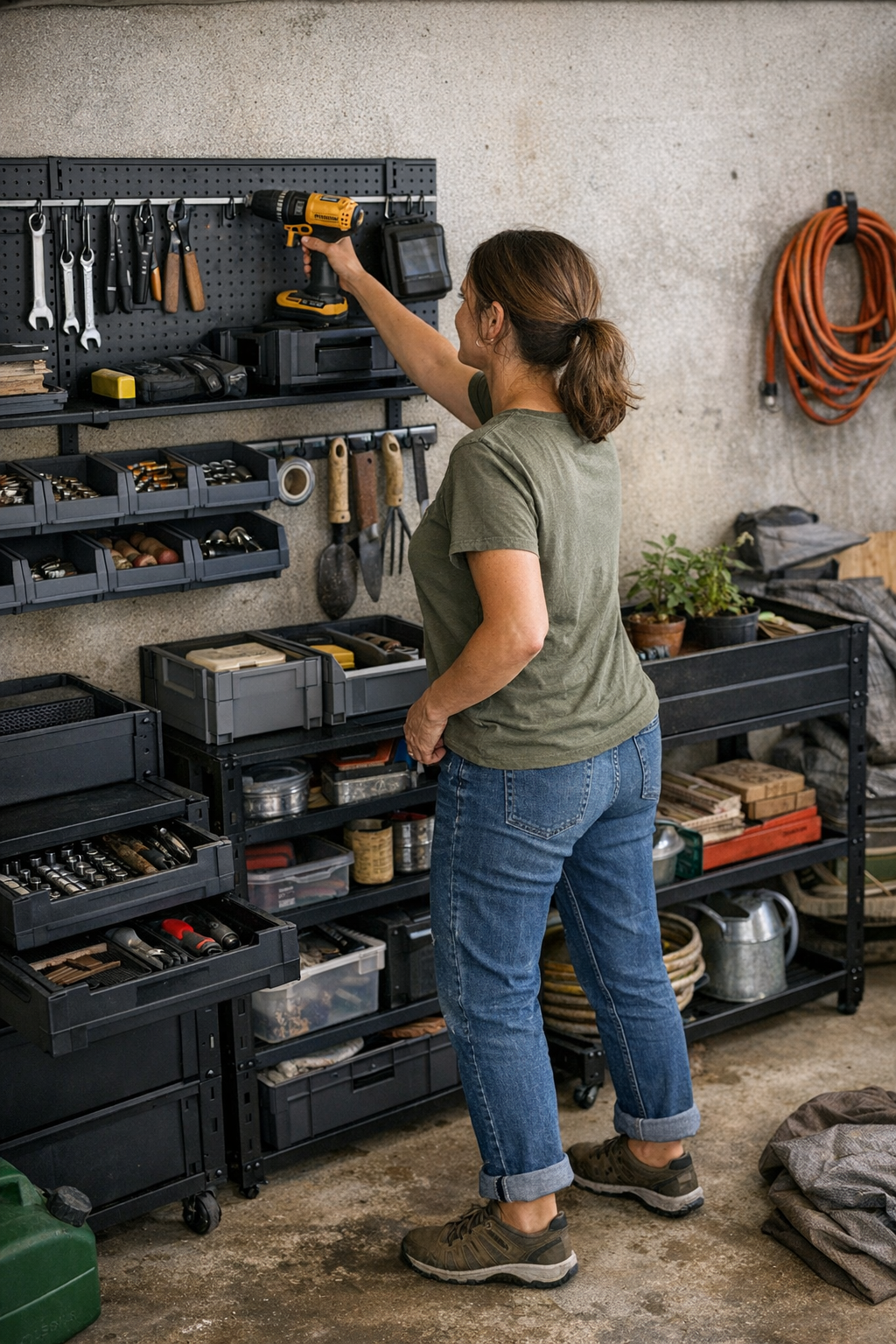
The first week after installing modular shelving and wall rails, it feels like you’ve finally cracked the garage. Everything has its row, the bins are still crisp with labels, all that old clutter cleared away. But anyone who actually uses their workspace—day after day—knows this honeymoon vanishes fast. By month’s end, the bins drift, the daily tools land on any available surface, overflow collects at the edges, and the generous aisle you planned for becomes a one-foot squeeze. Resetting the space is less clean-up, more rearranging the same obstacles. The hidden failing isn’t broken hardware—it’s missing “home spots” for the staples you handle every single day.
When “Looking Organized” Stops Being Enough
It’s easy to mistake shelf symmetry for a real solution. Freshly organized cubes and wall grids promise an end to hunting for gear. In practice, those tidy rows start slipping apart with each round of projects. Daily friction builds almost invisibly: a tape measure always left teetering on the edge, garden shears propped on the freezer, extension cords tangling with tools in the catch-all bin.
The real trouble creeps in: Without firm, intuitive landing spots tied to your actual routines, even premium modular setups quietly unravel. The things you grab most never get a dedicated home—so they pile up, circulate, or squat “temporarily” in the nearest open spot. Gradually, your shiny setup turns into an obstacle course of half-empty bins and crowded corners.
How the System Blinds You to the Actual Problem
Consider the real flow: every week, you find yourself shifting a rolling cart yet again, just to get at the saw you actually need. You reach behind a stack of bins—meant to be accessible, now blocking their own shelf. Hooks and cubbies look neat until their layout doesn’t match the way you move. Suddenly those wall rails start collecting “just for now” piles instead of organizing your tools.
Rigid sorting (all hand tools here, all garden gear there) barely survives real life. The cordless drill never sits quite right beside the long-handled rake. Heavy loppers bend the bin meant for light clippers. Overflow containers, meant as backup, wedge their way to the door—forcing you to loop around every time you carry supplies in or out. You start noticing “dead corners” that only exist to collect what doesn’t fit anywhere else.
Why Real “Home Spots” Change Everything
More bins won’t solve it. The fix is logic that fits your routine: give every high-rotation tool or supply a specific, visible landing place. Don’t over-complicate and label everything—zero in on the gear that travels between hand and shelf almost daily. The ratchet set, the utility knife, those gloves that never stay put—each needs a dedicated, clearly marked home instead of a vague shelf or generic bin.
One example: a garage owner quit chasing screwdrivers by blocking out a corner of the top shelf, labeling it with tape and color, and making it the only legal landing zone. Now screwdrivers actually return to their spot, not the paint shelf, not the counter, not lost to the clutter-jungle. Another win: mounting a small rail at eye level—just for two kinds of gardening shears—meant resets became automatic. They never vanished into the bin of spare cords. End-of-day cleanup got faster because you stopped hunting and stopped moving bins just to carve out space.
What Makes a “Home Spot” Stick
- Visibility: You see it without digging or guessing.
- Access: Nothing else blocks or hides it—not even the easy stuff.
- Precision: It’s sized for the item—enough space, not sprawling empty space.
- Personal marker: Tape, label, color—whatever jumps out so there’s no pause.
When high-touch items land in their exact place every time, your hands remember. Resetting becomes automatic. Search and shuffle disappear.
What Modular Shelving Nails—and What It Misses
Modular means flexibility—a rolling cart that actually moves to your work zone, rails that can go up or down when spring projects replace winter ones. That’s real-world advantage over fixed systems. But “flexible” isn’t enough without intention: you need to decide which tool lands where, and see those decisions reinforced in the layout. If you keep hesitating or double-checking where an item belongs, something’s off.
If one wall is bursting and the other is always empty, or if certain spots always collect “floaters”—stray drills, bags of screws, always-out battery packs—you’re seeing clues. The organized look fades the moment your daily flow (grab, move, return) doesn’t match your storage map. You start sidestepping carts, reaching around bins, stepping over backup crates that block your path out the door.
Why Clutter Sneaks Back
No matter how clean you make it, spaces without true home spots revert. A level perches on the garden bench for a week. Zip ties scatter into whatever bin is closest. Even right after a major reset, by Friday you find yourself moving two boxes to reach your drill—again. Blocked aisles, out-of-place tools, awkward piles: these aren’t rare accidents, they’re signals the system isn’t working with your actual behaviors.
Is Your Storage System Actually Working?
- Is your “mobile” cart mostly blocking your only walkway?
- Do you reach past bins constantly just to get what you need?
- Does one zone always fill up, while shelves elsewhere gather dust?
- Is there a corner that quietly becomes overflow central, week after week?
- Do resets take longer with each round—more shuffling, less true cleanup?
These are your cues. Not that you need more storage, but that you need clearer, smarter home spots for the tools and supplies you use every cycle.
Real Clarity Isn’t More Bins—It’s Better Flow
Here’s the test: At the end of a day, can you reset the core zone in under a minute, without stopping to think? Or are you still negotiating with your setup—babysitting bins, making awkward Tetris moves?
Spaces that work in reality make resets second nature. Every go-to tool or supply returns to a familiar, easy spot. Walkways don’t disappear behind backup boxes. Daily motion is clear and unblocked. The storage expands when the project changes, without turning every clean-up into a mini-move. You forget about your system—because it fits your habits.
The payoff isn’t a showroom. It’s that on a random weekday, you can step in, grab what you need, and put it back without breaking stride. Setup stops being a project of its own and just works—the way you actually work.
Find modular storage that adapts as your real habits shift at StackNest.