
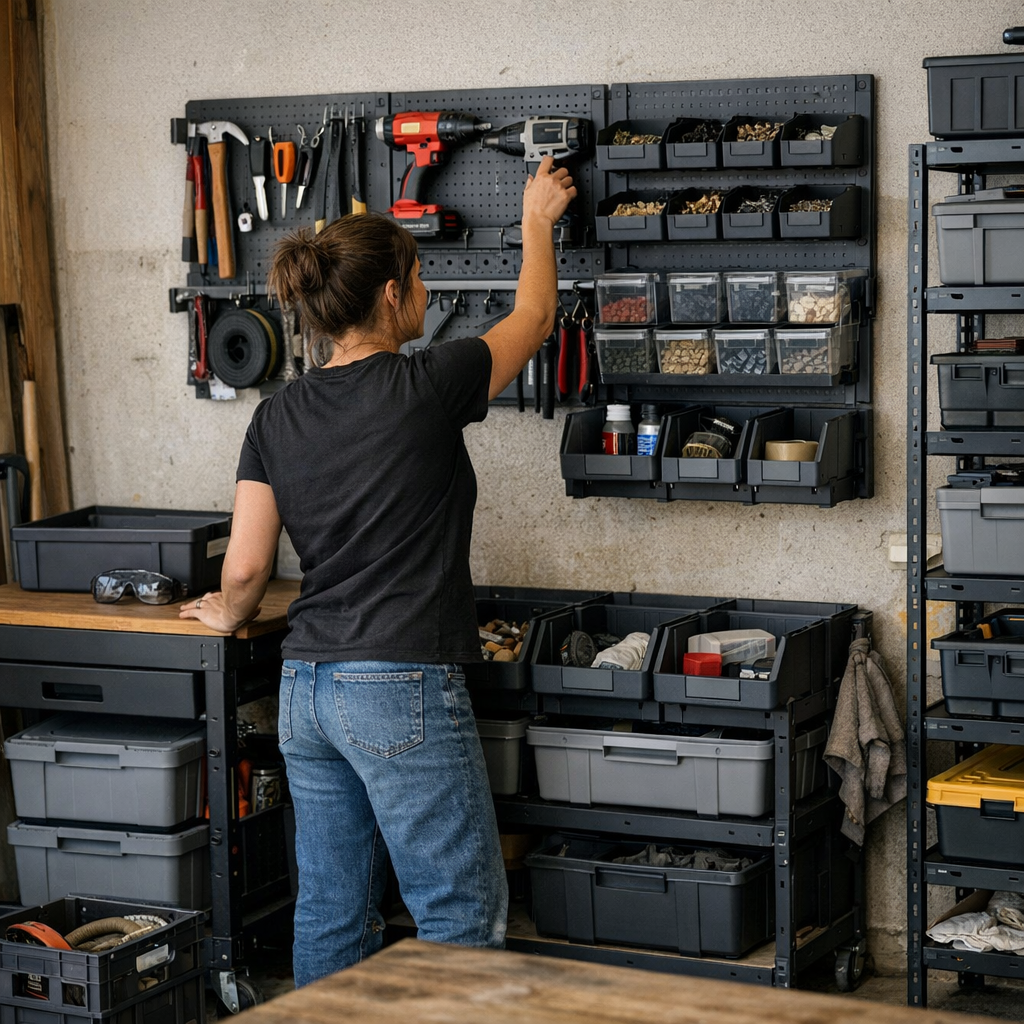
That rush of satisfaction when you first set up wall storage in your garage or workshop is real—and a bit deceptive. Shelves are lined up. Tools and parts stand at attention in labeled bins. The floor feels open for the first time in months. But then, as you dig into actual work—one project, maybe two—the system you just installed begins to press back. Your wall looks organized, but your hands and habits say otherwise.
When “Organized” Stops Fitting Your Routine
The typical wall storage layout—stacked bins, crisp pegboards, modular tracks—gives the illusion of readiness. But walk through a few real jobs and the compromise becomes obvious. Each grab for a tool changes the flow: reaching past awkward edges, skirting around a rolling cart parked in the only open gap, shifting one bin just to get to another. The setup that’s supposed to streamline your area quietly slows you down, project by project.
Maybe the fastener box you need is two rows up, just out of reach, and you stand on tiptoe—again. Or you’re always bumping the cabinet door because the handles crowd each other. For all the visible order, the routines beneath keep stutter-stepping, collecting little piles of “return later” on every available surface. The floor might stay clear, but your effort is getting rerouted by your own storage system.
The Misleading Calm of a Clean Wall
Don’t trust that tidy look at a glance. Sure, a flush row of bins looks neat, but if pulling out one means unstacking two, or if a pegboard jammed with tools means handles get hooked together, the surface calm is masking daily friction. The real cost is measured in small, repeated disruptions—each time you have to shuffle boxes to get a single drill bit, or circle around a rolling cart parked out of ‘temporary’ necessity.
Ask anyone with a loaded garage wall: Over time, your top-use tools wander. Bins double-stack, or land on the floor “just for now.” You start tracking which bins gather dust because it’s too annoying to return things properly. A handsome wall becomes a maze of micro-adjustments, minor blockages, and the slow creep of overflow into your freshly reclaimed floor space.
Everyday Clues That the Wall Isn’t Pulling Its Weight
Real life exposes what the neat install hides. Picture a Monday—your drill lives in prime territory, but by Thursday, pliers and screwdrivers have migrated to the workbench after repeated stretching or acrobatics just to hang them back. Three bottlenecks crop up again and again:
- Overlapping pegs: It takes a wrist twist to fit a screwdriver back without shifting a wrench or knocking off your measuring tape.
- Bland, packed bins: Rows of small hardware bins blur into one, so you resort to rummaging every time you need a washer, and “returning” items is just as tedious.
- The “default drop zone”: Bins lower on the wall gradually claim all the busy tools, because returning them up high is just awkward enough that you stop bothering. Suddenly, overflow hardware mixes with daily drivers—a habitat for clutter.
Now the smooth return after a project is replaced by improvisation: a favorite tool perched on the edge of a shelf, an extension cord coiled in an empty cart, the whole area slowly drifting off-script. Containment beats chaos but never quite delivers a frictionless flow—you’re maintaining appearances, not momentum.
Pushing Past Looks: The Impact of Real-World Tweaks
Improvement isn’t about adding another label or ordering more bins. It’s about shaping the system to meet your actual moves, not just mimic the showroom. Try this:
- Center your most-used tools at chest height, spaced apart so you can grab and replace each one with a single, blind reach—no dodging neighboring handles.
- Dedicate lower shelves to bulk hardware or overflow, where you expect to dig, not reset quickly.
- Divide the wall by function. Make one section for hand tools, another for fasteners, a third for safety gear—rather than mixing everything on one crowded board.
- Look at how you actually approach the wall. If you’re always reaching above eye-level or leaning sideways, lower the busiest zone by a foot. That 12-inch tweak can kill off a daily annoyance for good, shrinking the awkward footprint and making resets automatic again.
The effect? Those gaps where clutter collected disappear. You stop inventing workarounds and start trusting the wall to support, not interrupt, your projects. Suddenly, you’re not thinking about storage mid-job—it just keeps pace with you.
Can You Feel the Friction? Here’s How to Notice
The evidence is right in front of you: tools start living on carts, benchtops, or even the floor. If every cleanup uncovers a pile of “I’ll put that away later,” it’s not laziness—it’s the wall getting in your way. And the classic mistake? Trying to fix it by adding bins, which only spreads the mess unless the zones match real tasks.
Watch for dead corners—sections of wall you never use because the angle’s wrong or reaching around a cabinet edge is always awkward. These spots pull in random leftovers and quickly become clutter magnets. True efficiency comes from resisting the urge to fill every inch and instead making every zone a natural “home” for something you use—no shuffling needed.
Immediate Fixes That Actually Work
- If returning a tool requires moving (or risking) another, rework that area so each tool’s path is direct and single-step.
- If one wall is jammed while another stays empty, cut the guesswork: set obvious roles for each zone so you’re never “just putting it somewhere.”
- If cleanup time lags behind the work itself, change zone height, rethink traffic paths, or let go of the urge to over-stack for looks. The time you reclaim is the proof it’s working.
The Difference You Actually Feel: Movement, Not Just Order
A wall setup that truly helps doesn’t just look sharp—it erases the small stalls that slow you down. Resetting after a rush job stops being a chore. You reach, use, and return tools on autopilot, without second-guessing where things live. The floor stays open because the wall absorbs routine clutter—no clogged corners, no accidental drop zones.
The real mark of an effective setup isn’t the first-day reveal but how easy movement stays, week after week. When you’re not tracing the same awkward footprints or pausing to untangle a storage pileup, you know the system fits your flow. In the end, it’s about matching visible order to lived-in clarity—a shift from staging a space to actually owning it, day by day.
Find modular wall setups, rolling carts, and storage systems designed to flow with your real routines at StackNest.