
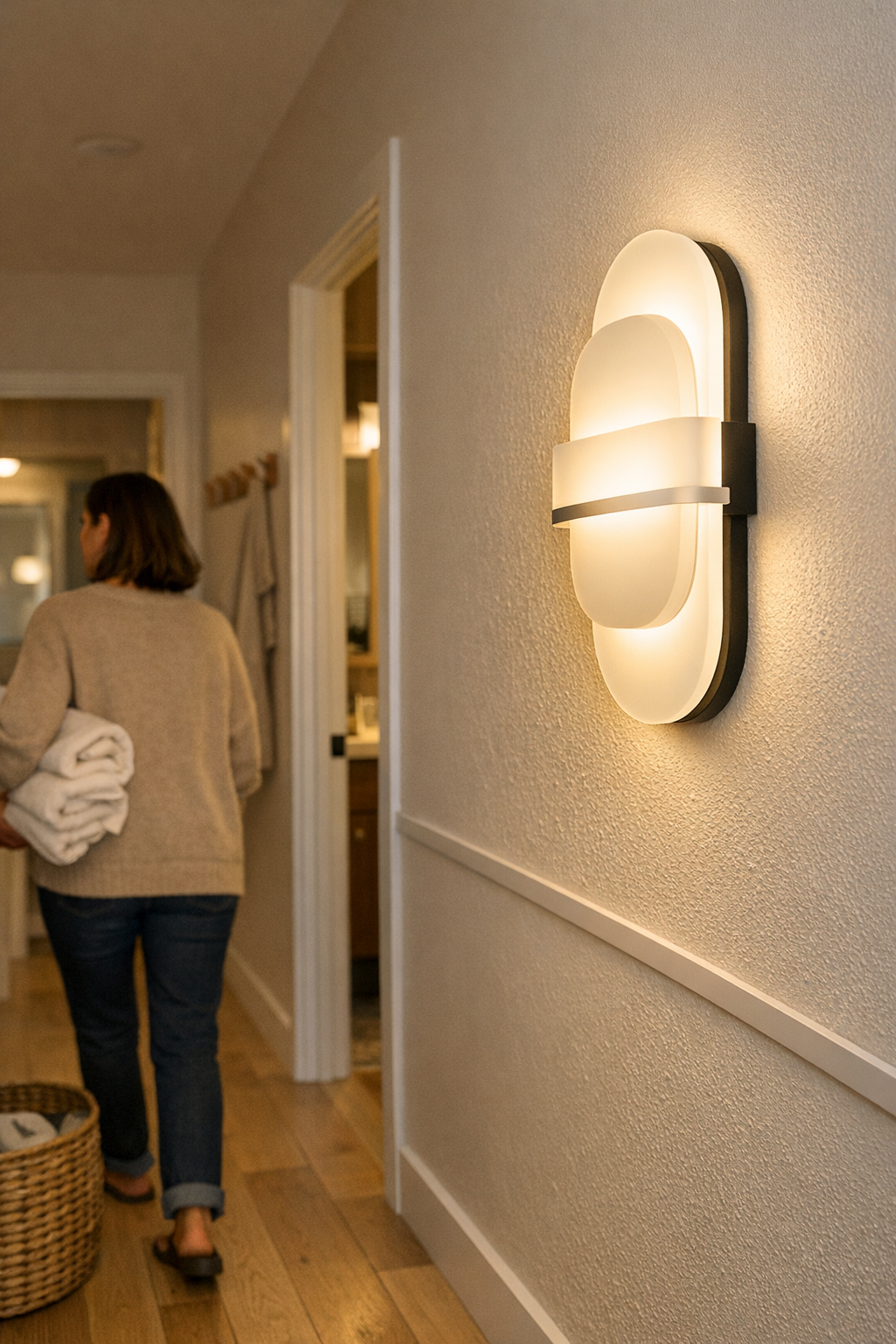
Hallway lighting failures don’t stay hidden for long. The sharp glare of a bare LED panel, the uneven pools left by a flush ceiling fixture, the exposed under-shelf strip that looked invisible in the package—all of them show their real limits once daily routines start to test them. Turn the corner with an armful of laundry and squint at the hotspot flaring at eye level. Notice a thin cable threading down to the outlet, slightly out of reach but still distracting in your side vision. Pass through before sunrise, hesitating at the shadow lines pooling in front of doorways. Every pass, each soft stumble, adds up: what began as “clean” now means pinched sightlines, unpredictable brightness, a trip over an awkward support when you’re not fully awake. Weak hallway lighting isn’t a small inconvenience; it’s a repeated interruption, dragging attention exactly where you want none—into the gaps, the glare, the hardware that never quite fades from view.
Where Minimal Lighting Setups Trip You Up
Minimal fixtures rarely stay invisible once you need the space to work. That flush LED tray promises a crisp ceiling line, until the exposed diodes catch your eye and force you to change your path. Plug-in lights on the shelf edge look “discreet,” but their hotspots carve sharp transitions as soon as a doorway breaks the beam. Even if you only register a quick glance away or a slight body shift, those micro-adjustments signal a setup that isn’t truly blending into your life. Day-to-day use turns these small misalignments into friction: hands reaching for backpacks in the morning, tired eyes darting from glare on a midnight snack run, one person shifting their stride to avoid the same hard-lit patch near the linen closet.
The real problems multiply with movement—especially with other people, bags, or just the collision of regular activities. A cable that looked hidden in photos snags on a shoe or hangs one inch too low. “Perfectly placed” once, a fixture now throws shadow bands down the wall or makes a narrow passage feel even tighter. Hardware that promises minimalism draws the eye every time you pass, refusing to disappear when routines demand the space just work. In real homes, the lived friction always outpaces the showroom promise.
Lighting That Works With — Not Against — Your Movement
Hallway lighting has to move with you, not stand in your way. It isn’t a question of pure brightness; it’s about consistency—light that fills without shouting, so every walk-through feels neutral, no hesitation. Controlled diffusion changes everything:
- Flush ceiling panels “disappear” on install day, but the hard downward beam bounces off floors and makes glare nearly impossible to escape in motion.
- Wall-mounted diffusers or under-shelf bars, slightly more visible at first, actually cast an even wash across your walk—softening corners, dissolving abrupt edge shadows, letting you ignore the fixture entirely after a few passes.
The shift isn’t just theoretical—it’s immediate and gets sharper the more the space is used. One week with a good setup: you stop bracing for eye shock by the bathroom door, no longer pause to dodge a bright spot, and baskets or bags stop catching in the same overlooked corner. When hallway lighting works, you “forget” it—not by hiding the fixture, but by removing the tension that makes you notice where it fails. Unremarkable is the goal: light that fits so well it becomes part of your muscle memory, not a navigation challenge every night.
Real-World Hallway Setbacks: Where the Setup Fails
Picture the hallway at its worst moments: arms overloaded, lights needed most, routine breaking down. That exposed ceiling bulb worked fine until you flinch and grope along the shadowed wall, eyes burning from a misplaced hotspot. A cable running along the ceiling skips the tidy look altogether—hooking coat hangers, snagging a child’s sleeve, or just interrupting calm every single time you see it out of the corner of your eye.
Compact hallways with shelving or multiple doors multiply the problem. Strong beams frame the space exactly wrong—turning “organized” storage into blind corners or giving every reach for a coat a lingering moment of awkwardness. The missed seconds and flickers of discomfort aren’t in the marketing photo, but they become the real cost of an unresolved setup, day after day.
What Changes Hallway Lighting From Distracting to Dependable?
Reliable hallway lighting is built with placement, not power. More lumens or a trendier fixture won’t undo practical mistakes. What usually makes the big difference: a low-profile, wall-mounted light run parallel to the hallway’s length, cable-managed in a channel that matches your trim, installed at roughly one meter above the floor. It’s not flashy—it’s a structural shift.
- Positioning below eye level wipes out direct-glare crossfire; you stop wincing on each pass.
- Wall wash softens the sharp baseboard shadow and brings dim corners into usable view—night or day.
- Neutral cable channels ride tight to the wall or baseboard; wires disappear, and nothing interrupts shoes, baskets, or shoulders cutting through.
- Doorway “blast zones” vanish: the surface stays visible, even, and free of sudden visual drama.
Give it one month: the nagging shuffle disappears, glances at the lighting drop off, and the old habit of squinting or bracing fades. The fixture no longer asks for attention—because it truly blends with how the space is used, outlasting showroom perfection by simply not getting in the way.
Practical Observations for Smoother Hallway Lighting
Don’t Try to Dim Your Way Out of Glare
Most hallway glare comes from exposed bulbs or direct-view LEDs, not raw output. Lower wattage only softens the problem; it doesn’t fix the underlying angle or intensity. Diffusing shields and smarter positioning almost always deliver clearer comfort than fiddling with how bright the room feels on paper.
Cable Management Should Quiet the Space
Unmanaged wires don’t just look off—they drag your eye every time you pass, breaking concentration and adding visual clutter. Closely fitted cable channels, matched to existing baseboards or run behind shelf lines, make wiring silent in daily life. After a few days, covered edges vanish and your focus returns to simple movement, not sidestepping the setup.
Mounting Height Matters—Aim for Steady, Even Light
Mount hallway lighting at about one meter above the floor when possible: this avoids harsh sightlines, broadens the spread, and keeps fixtures out of the danger zone for door swings. Especially in narrow passages and with low ceilings, the payoff is less in appearance and more in how routine movement stays relaxed—no dodging brackets, no glancing at the light mid-step.
The Real Test: How the Space Feels After a Hundred Passes
The difference between a hallway light that looks good on install day and one that works month after month is always revealed in routine. If the fixture “disappears,” not by hiding, but by never breaking your flow, you know the setup is finally right. Lasting comfort isn’t about technology or perfect cable runs in week one—it’s about designing away those little repeated stings that nobody notices until they’re finally, quietly gone. Only then does the hallway become what it was meant to be—just a part of daily movement, no longer a reminder that something didn’t fit.