
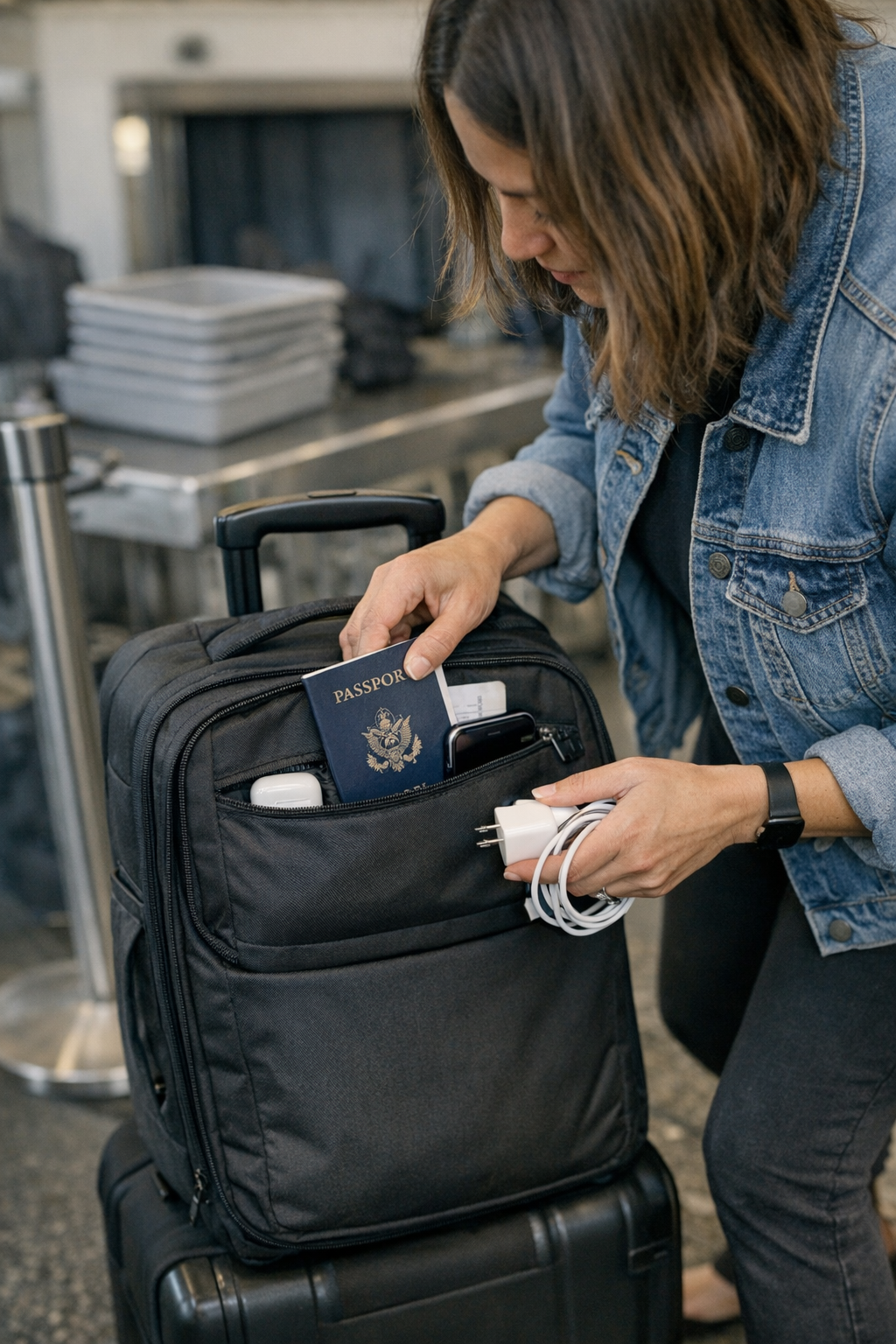
A carry-on isn’t really tested until it’s in motion. The instant you step into the airport, every careful home packing decision gets stress-tested—first by a passport check, then an outlet search, then that first scramble as your boarding group is called. That sense of order you achieved at home starts breaking down the first time you need to grab a document or charger on the move. The problem rarely shows up on the bedroom floor; it hits when you find yourself fumbling with too many zippers, digging past tangled chargers or a wallet wedged deep in the wrong pocket, while the line inches forward and subtle frustration starts to build. This is the friction CarryOnSupply was built to diagnose: what slows you down in repeated use, even if your bag looks “organized.”
When “Well-Packed” Fails Under Pressure
The true weak point of most “organized” carry-ons appears the moment you need fast access in a real sequence: security, the boarding call, overhead bin juggling, dropping into your seat. It’s rarely what you packed—it’s how quickly you can actually get the one thing you need, exactly when you need it. You remember which pocket should have your passport, but when it’s your turn, it’s buried behind a cable, masked by a pouch, or stuck inside a section that now requires full unzipping. That outer order becomes a slow-motion breakdown: a double-zip hesitation, an awkward pause, a pileup forming behind you. Instead of clearing the checkpoint with one smooth zip, you’re working around invisible structural drag, and your “system” suddenly isn’t helping.
The Overlap Problem: Where Organization Complicates Access
Trying to combine too much into one control zone—passport pressed against charger, earbuds sharing space with tickets, phone layered with receipts—creates a new problem: every retrieval turns into a decision tree. In the logic of real travel, this overlap is where “neatness” backfires. Suddenly, a compact carry-on that looked streamlined hides access traps, especially under airport pressure. The classic mistake: front pouch loaded with all your essentials, so grabbing one thing starts a shuffle—holding up the line at security, digging around for an ID, extracting cables in front of a watching crowd. You’ve reduced visible mess but haven’t reduced the repeated, high-pressure interruptions that cost the most time and patience.
Packing Choices That Backfire in the Terminal
Nested organizers, micro-compartments, and zip pouches stacked in the main compartment seem efficient right up until you need something mid-journey. In practice, this “system” collapses into:
- Peeling back several layers just to retrieve a boarding pass at the gate
- Unzipping half the bag, obstructed by other travelers, to rescue a charger
- Squeezing aside with your bag in a crowd because one needed item won’t surface easily
Each of these friction points adds micro-delays that pile up: a journey built for movement becomes one of constant minor resets, especially when space and time are tight and every other traveler is also reaching for their essentials.
Document Drama: The Airport Security Gauntlet
Security trays reveal what neatness hides: the passport that slid under a pouch, a cable snagging on a charger sleeve, a document that now means partial bag unzipping in an overcrowded tray area. Suddenly, what worked “at rest” forces a full unpack in a two-foot gap between bins—with the impatient shuffle of a growing line behind you. These small breakdowns aren’t occasional; multiply them by every check, seat entry, carry-on repack, and gate transition, and structural weakness becomes the real trip cost.
How a Dedicated Outer Pocket Changes the Trip Flow
One well-placed pocket, sized for just your actual “in-transit” essentials, can flip your whole rhythm. Move the repeat-use items—passport, phone, boarding pass, earbuds—into a single, slim, exterior pocket that stays unblocked and upright. At security, it’s one zip: out and back, no bag drop. At boarding, no rummaging through nested organizers—just instant retrieval and return. In the jetway, your ID is under your thumb, not at the bottom of a compartment. Even reaching up to the overhead bin or squeezing into your seat, your next-needed object is where your hand expects it, not deep-buried or cross-layered under less urgent things.
The difference comes after use: essentials settle back quickly, the routine resets itself, and you keep moving—no table, no reorganizing, no hunt for lost order. This isn’t about visible neatness; it’s about minimizing interruption and restoring real flow, every time you need to reach for something basic. The cleaner your access sequence, the less the system falls apart in repeated cycles.
The Repacking Burden: Small Choices, Big Frustration
Most travelers tolerate a carry-on that “looks right” but keeps costing time in every routine use. The moment you pull out a document and have to rebuild the pouch stack to keep things tidy, or when a charger extraction leads to a crumpled mass of cables and papers to rein in before walking on? That’s the real-world penalty for structure that only passes the bedroom trial. In crowded terminals or boarding queues, the price is bending awkwardly in a tight space or blocking the aisle as you unpack, hunt, and repack for the third time in an hour.
The only test that matters: does your setup let you move faster (not just look neater) after multiple real-world resets? Every time you’re forced to step out of line, break your stride, or pause for another reach-inside search, the answer becomes clearer. The silent tax is in time and focus lost—rarely recovered by just “reorganizing” for looks.
Small Improvements That Add Up Over a Trip
Real carry-on performance isn’t about chasing perfect order—it’s about removing the biggest sources of repeated drag. These changes add up where it counts:
- Keep only the most-used essentials in an exterior pocket you can reach fast, bag upright and in hand
- Put chargers and power banks in a dedicated, separated sleeve—not sharing space with travel documents
- Use internal organizers for secondary items only—anything you’ll grab once or not at all before arrival
- Avoid the “everything in one tidy pouch” temptation; if you’re unpacking to access, the setup is already slowing you down
This isn’t about more compartments. It’s about reducing steps—so airport flow, gate waits, and in-flight reach-ins all become one-motion easy, not multi-step hurdles.
Packing for Movement—Not Just Appearance
Nearly every traveler’s routine exposes the same flaw: a setup that can’t withstand two or three real cycles of use without starting to break down. What appears “in control” is often structurally weak; hand hesitations, cascading zippers, and uncertain pocket searches add up to repeated travel friction. What matters isn’t order in the static moment, but the speed and ease of use after the fifth repack, the fourth ID check, or the third overhead-bin grab in one day of travel. A genuinely reliable carry-on is built for these pressures—not just for the look of readiness, but for the flow that only holds up when order is quickly restored, again and again.
Find carry-on gear built for repeated, real movement at CarryOnSupply.