
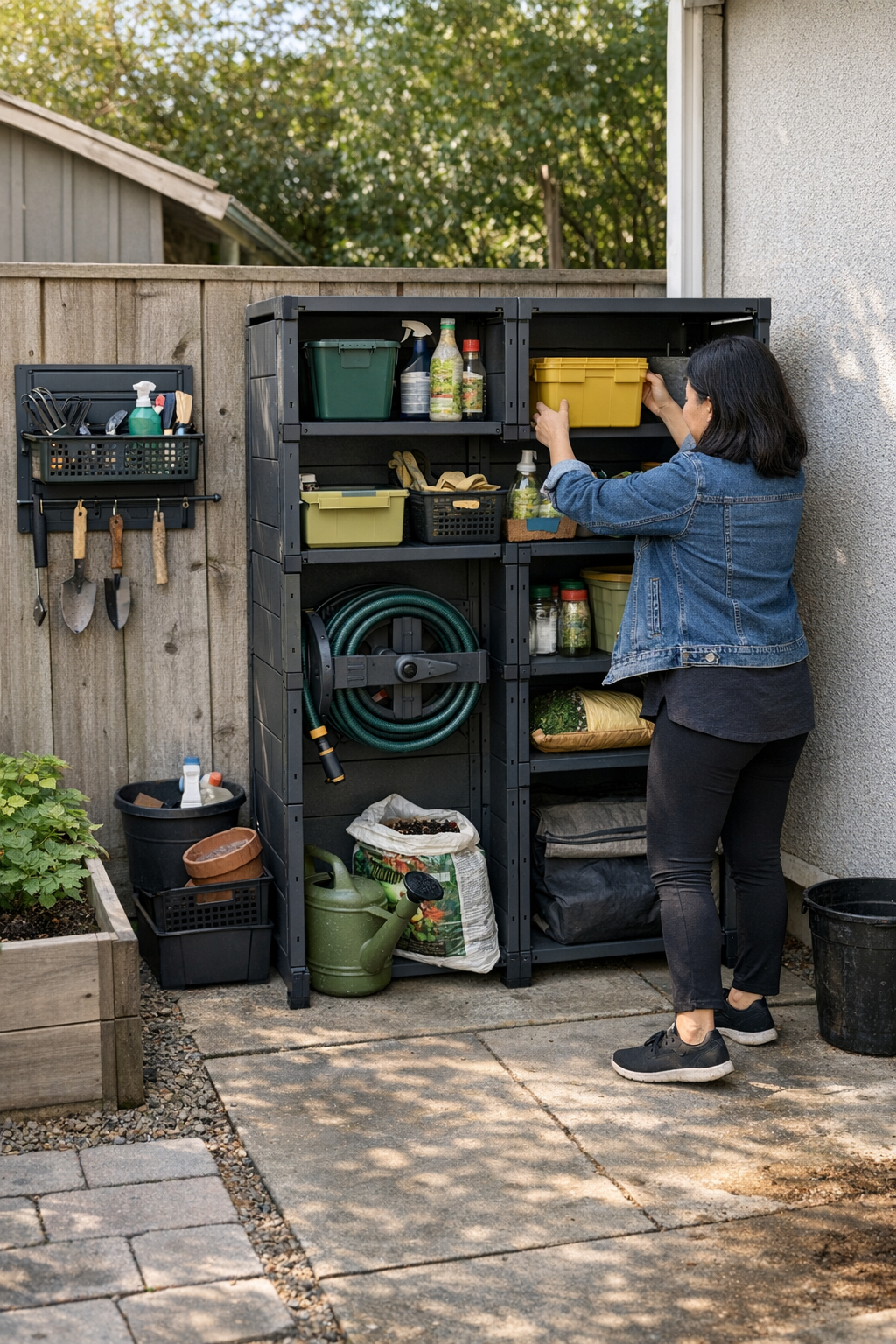
Out in the yard, every storage decision shows up in how you move—not just how the space looks. Most outdoor storage setups start with hope: you install a trim shed, a tidy wall rack, or modular bins along the side fence, and for a moment, the disorder recedes. But then real life floods back in—garden work, trash runs, a weekend of bikes and bins—and the walk zone collapses. The route that felt “clear” on day one now demands a shoulder twist, a shuffle, or a full stop just to dodge a rake, a rogue pair of boots, or a storage unit edging too far into your path. The layout still reads as organized, but every pass through the area pulls you deeper into a slow-motion obstacle course. Eventually, the friction isn’t dramatic—it’s a buildup of hesitation, one minor interruption at a time.
Why Footpath Space Is the First Thing to Guard
The real trap of outdoor storage is the invisible squeeze: the path that looks wide enough until real use crowds it. All it takes is a shed edge, a freestanding shelf, or a rolling tote pushing eight inches into the walkway. Nobody grumbles at first, but soon retrieving the garden fork means skirting a hose, nudging past an awkward stack, or negotiating space with someone hauling bags behind you. What should be a one-step handoff becomes a sequence: slide this over, shift that back, step aside. It’s the same in side-yard strips and patio edges—tiny encroachments that, over several busy days, turn free movement into a slow dance of sidestepping and apologizing.
The moment routines get even a little hectic, storage starts to leak into the path. You cut across the garage threshold during a project, drop gear in the first open spot, and by the end of the week, you’re unlocking a silent contest between what belongs in storage and what’s simply in the way. The “open” walkway dissolves into new clutter hotspots, faster than you’d expect.
How “Organized” Storage Becomes a Bottleneck
Even the cleanest-looking modular wall or perfectly matched bins can create trouble when they overreach the real boundaries of movement. Picture a fence lined with storage that looks streamlined—but pushes the circulation path just out of line. On a regular week, the cracks appear quickly: carry mulch sacks, steer the trash can, pass a second person with a shovel. That slim extra foot taken by storage means the main route kinks at a critical moment, so returns get messy. The rake you always reach for leans out to catch your sleeve. The wall holds your tools, but now the entry fills with scatter—seed packets, pruners, gloves—none of it in its place because the route is too tight to keep clear through daily use.
Movement gets blocked not by lack of storage, but by the footprint that isn’t quite honest about how much passage it needs. The space looks fine on paper, but in reality the flow chokes off, and with every interrupted trip, frustrations multiply. By midweek, your “system” demands too much from anyone just trying to return a single item without causing a pileup.
Stacking, Shifting, and the Sluggish Reset
The stubborn giveaway of a broken setup is the quiet decay into pointless reshuffling: pausing to slide a hose so you can park the mower, wedging a bin sideways just to close the gate, or stacking gear in a clear spot thinking you’ll shift it later—which, let’s be honest, drags on for days. Wall space gets filled, but not helpfully; one awkward corner keeps pulling in overflow, becoming a “temporary” holding spot that never empties out. Even when the yard starts organized, returning things becomes fraught with minor negotiations, until suddenly reset isn’t a quick end-of-day habit but a dreaded overhaul.
The Turning Point: Guarding Pathways Harder Than Storage Volume
Everything changes when you treat the footpath as untouchable. Not more “decor,” not a wider cabinet, but a hard line: storage ends here. The best setups cut storage units to fit the true movement zone—wall systems pulled flush, rolling racks that can clear the line when activity ramps up, nothing crossing the path, not even “just for now.” That single rule keeps corners from becoming magnets for overflow and lets movement snap back to instinct. In real terms, this means no sidesteps with arms full, no hunting for clear floor, no losing energy to awkward shuffle routines. The storage becomes background, not a recurring part of the job.
Even after a high-traffic weekend, the mood flips: you walk through hands-full, reset goes fast, and nobody ends up muttering about sorting out the side yard again. The difference isn’t pretty on a checklist—it’s a path that stays free without reminders, so the gear returns itself almost as quickly as it leaves.
Visible Signs a Setup Is Working Against You
- You have to move or tip something every time you want to step through the “clear” route.
- Stray tools, boots, bags, or garden supplies show up in the main walk zone after each use—even though storage is “not full.”
- Putting away one item forces you to reshuffle others or leave things half-stored just to clear space.
- Corners accumulate extra gear for days—never truly reset, always waiting for a “later” that rarely comes.
- Everything looks put away, but moving through the area feels slower with each passing week.
Small Tweaks That Clear the Path for Good
Protect the path first—even if it means scaling back storage units or narrowing a wall organizer by a few inches. In reality, a slightly smaller system that keeps every foot of walkway usable pays off daily, while spacious units that block movement will always create work. During planning, tape the path boundary and never let a unit cross it. Position rolling carts or bins so they can slip into dead space, not the main lane. After every busy stretch, walk the path: do your feet move straight through, or do you find little piles waiting for later? Adjust, clear, repeat—the goal is to make the uninterrupted walk automatic, not an exception you have to fight for.
The easiest benchmark: if you can walk the route in the middle of the busiest week, arms full and focus elsewhere, without thinking about what you’ll have to move next, the storage is pulling its weight. That’s the difference between looking organized and living organized, and it’s where real outdoor setups finally start to hold up.
For more practical ideas on making outdoor storage function better, visit TidyYard.