
Everyone with an indoor cat knows this sequence: you set out a few chase toys, aiming for a clear, contained play zone. By midweek, the promise of simple entertainment sours. Toys aren’t just everywhere—they wedge behind chair legs, disappear under the radiator, and interrupt even the smallest routine. Suddenly, reaching for the water bowl means kicking aside yesterday’s crinkle mouse; a quick sweep turns into crawling after a hard plastic bead under the sofa. What should be a low-friction setup becomes a cycle of annoyance, dragging both your flow and your cat’s mood off-balance. Any claim of “tidy play area” fades as the mess keeps sliding into your usable space—without warning, your living room turns into a field of minor rescue operations. StillWhisker owners know: it’s not the toys you see so much as the interruptions you feel.
How Hidden Messes Undermine Everyday Calm
Most indoor cat routines trick you with a sense of order at first. It seems like you’re set—a stash of fuzzy balls near the wall, the walkway mostly open. But inevitably, the loose setup leaks. Chase toys migrate and vanish into cracks, while you tiptoe around stray wands or lose precious seconds fishing for objects just to refill a bowl. The problem rarely announces itself; friction shows up in stacked minutes, repeated pauses, and a growing sense that every shared-area reset uncovers another tiny blockade.
A common spiral: Three successful play sessions in, and now one ball’s stuck under the couch, a feather wand is half-wrapped around a dining chair, and a bead disappears into a radiator gap. You’re promoted from play partner to low-level janitor, forced into “toy retriever” duty as part of every evening routine.
Cleanup That’s Never Really Over
The mess isn’t epic, but it’s relentless. Each out-of-place toy means one more slow-down: a water refill interrupted, a quick surface wipe delayed until after the latest scavenger hunt, one more thing to shift before even starting cleanup. These aren’t deep messes, just constant nicks against daily flow. Rooms that looked clear in the morning become minefields by evening, and the “simple” reset keeps expanding from minutes to lingering frustration.
The Real Impact on Cat Behavior—and Your Routine
This isn’t just an owner’s hassle. When chase toys scatter, your cat shifts from play to restless patrol. Instead of post-chase calm, you get pacing, vocalizing, and nosing under doors. The visible clutter cues repeat expectation—a rolling loop of “what now?” energy. There’s no clear routine to signal play is over, so your cat lingers, unsettled. At the same time, your own routines stutter: vacuuming derailed by plastic, attempts at rest broken by a cat circling for something lost.
Noisy Even When the Room Looks Tidy
Even after you sweep, the quiet isn’t real. Your cat returns to the corners, eyes darting for new targets, newfound obstacles, or another spark of action to fill the gap. What looks like a tidy space still triggers tension—yours and theirs. Each time your cat paws at a hidden toy or starts pacing after play, you feel the absence of a genuine reset. It’s not just about visible clutter, but about the repeated disruptions that drain time and energy long after cleanup is “done.”
Surface Neatness Versus Real Reset
It’s easy to mistake a neat corner for a functional play setup. But repetition exposes the difference: what feels organized at 8 a.m. has already split open by noon. Three toys out in the morning morph into a scatter through the house by night. Cleanup isn’t a single scoop—it’s crawling after vanished pieces and reshuffling furniture just to restore order. Each sweep is less about general tidiness, more about battling a pattern of tiny, repeating setbacks that never resolve on their own. The false sense of “ok for now” becomes tomorrow’s source of annoyance.
Interrupting the Restless Loop With Structure
The fix isn’t just more storage or fewer toys—it’s rewiring the post-chase experience. StillWhisker setups favor anchored play: after high-energy chase, a single semi-fixed toy absorbs the restlessness, concentrating that last burst in one predictable spot. Instead of chasing resolution through scattered objects, your cat gets closure; you get a clear reset. The ripple is immediate: your routines pick up pace, the room stays open, and your cat’s energy settles faster—especially when space is tight or cleanup windows are short.
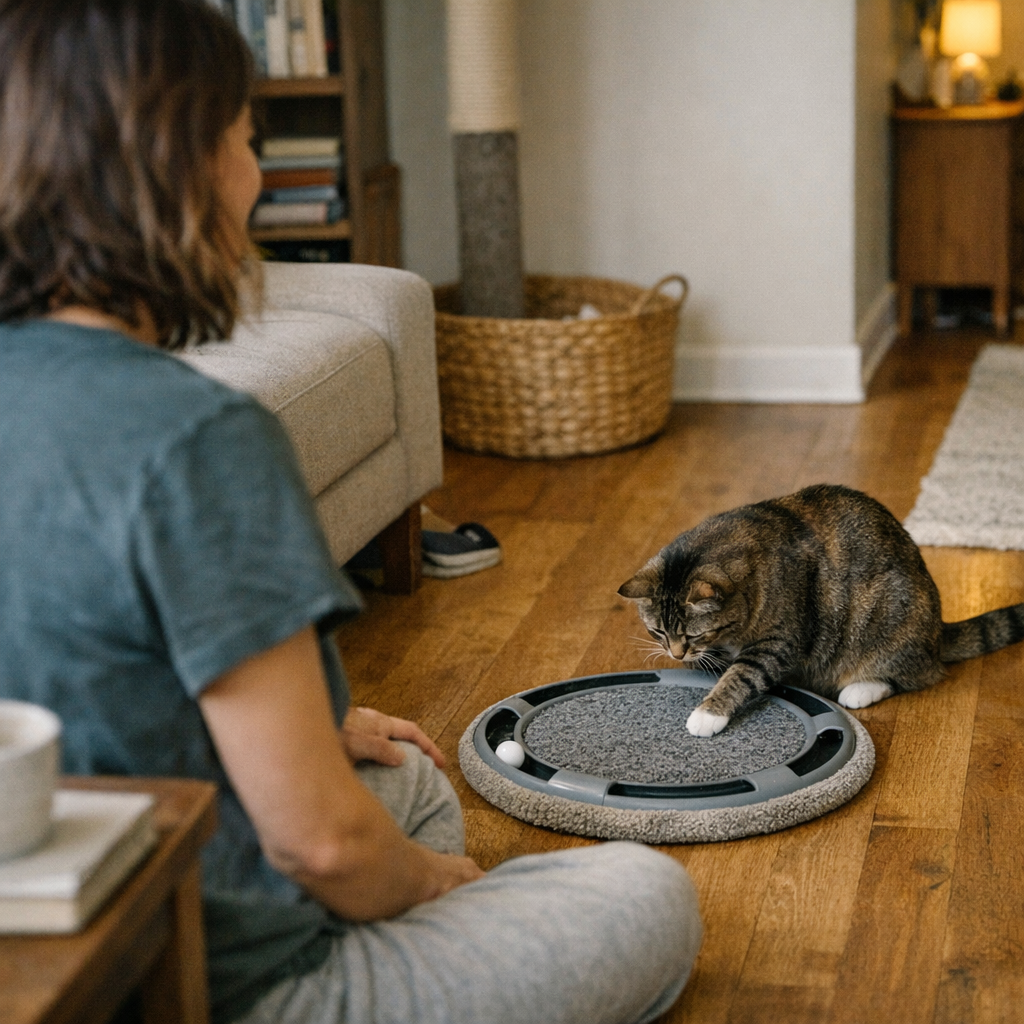
In practice: When you swap four loose toys for an anchored mat with a built-in rolling track, the end of play points to one specific location. Your cat finishes strong, and you reset in one step: slide mat, check for strays, move on. The lingering “unfinished” tension fades, and both of you stop circling the space for what comes next.
Containment Makes Reset Predictable
The biggest shift in real use is reset time. No nightly battles with the broom, no hunting for a missing bead before bed. One contained zone means you move toys back once—not in pieces, not at random hours. Your main floor route stays clear, shared spaces stop accumulating friction, and those stray meows signifying extra, unresolved energy drop off. The real gain is in what you stop repeating—reset shrinks to a routine instead of a lurking project.
Location Matters as Much as the Toy
Position is as potent as any new toy. Anchor the wind-down activity where both you and your cat naturally move—just off the main walkway, at the soft boundary of a living area, or tucked beside a sofa. The right spot keeps play visible and the rest of the space undisturbed; your movement recovers speed, and repeated detours evaporate. Over time, your cat’s post-play behavior becomes focused, your own motion gets easier, and sprawling interruptions give way to smoother transitions between play and everything else.
When Structure Slides: Signals to Watch For
Even strong setups weaken under fatigue or neglect. Watch for:
- Loose toys creeping back to corners or under hard-to-reach places.
- Renewed late-night pacing, door-staring, or low, repetitive meows from your cat.
- Reset times quietly ballooning—a supposed “quick pickup” becomes a five-minute search after dinner or before bed.
- Shared areas demanding mini cleanups before you can just walk through the doorway.
These are the flags: structure is slipping, and the cycle needs a reset. The rhythm—chase, wind-down, contained reset—brings the friction back down with minimal changes.
Getting Repeated Use Right: Small Adjustments, Big Differences
Perfect is rare. Indoor cat life is always moving, for you and them. The fix is almost never an overhaul—just targeted swaps and minor shifts. Anchoring a post-chase toy, cutting the number of open-ended objects, and placing the “final stop” where it fits both cat access and your cleanup route, transforms the home from a series of micro-aggravations to a pattern that fits real, repeatable routines. Sometimes that means swapping a rolling bead for a circular track; sometimes, trading a scatter of mice for a mat that won’t migrate. The missed toy under the chair may still resurface, but you won’t have to stop everything to deal with it daily.
Recognizing the Difference Between “Looks Better” and “Actually Works”
Tidy isn’t the measure. The real question is how quickly any setup returns to normal during repeated use, especially when no one has time or patience for heroics. The most reliable signal comes midweek, not after the deep clean: is the evening routine still being interrupted? Are you losing time to low-grade “toy rescue”? If not, structure is holding. Play that moves smoothly from high energy to organized wind-down—anchored to the right spot, reset in seconds—means the system isn’t just neater; it’s genuinely easier to live with, cycle after cycle.
Practical improvement looks like:
- A predictably managed chase-to-calm flow.
- Anchored play clearing the mental load of constant pickup.
- Containment placed in the natural movement path—no more circles around scattered objects.
- Cleanup that’s routine—not random, not effortful, not another slowing surprise.
This isn’t about designer home style. It’s the practical recovery of time and comfort, so both cat and human routines become easier—not messier—with each repeated reset.
Find more structure-focused setups for real repeated use at StillWhisker.