
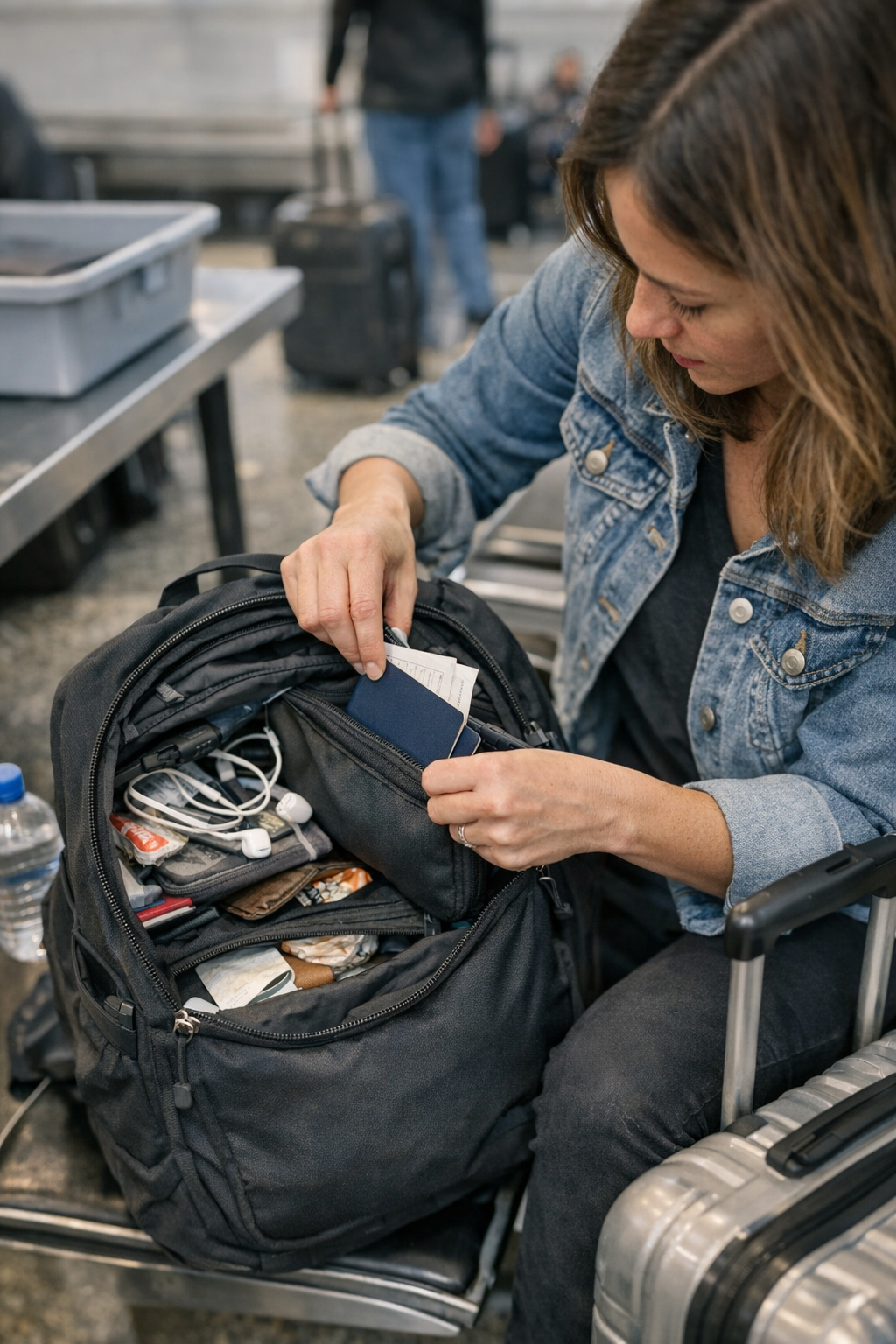
The quickest way to ruin a trip isn’t a delayed flight—it’s that supposedly “organized” carry-on that slows you down every time you move. The problem doesn’t wait until the end of your journey. Even before you’ve found your gate, a bag that looked squared away on your bedroom floor can turn every airport routine into a sequence of awkward pauses, mid-aisle shuffles, and frustrated zips. What promised flawless order at 6:00 a.m. becomes a slow leak of patience by the third time you need to pull out your passport or your headphones.
When “Organized” Isn’t Fast Enough
Plenty of travelers trust they’ve solved packing with a lineup of pouches, tidy tech sleeves, and document slots. But travel has a way of exposing what “organized” actually means under pressure. It’s never the first reach—instead, it’s the repeat. Picture this: headphones behind a double-zip, passport wedged deep in a sleeve, chargers at the bottom in a tech kit. As soon as the security line snakes forward, you’re hunting for a boarding pass that’s trapped under a pouch that just lost its shape, or you’re unzipping three layers just to confirm your ID. Each fix takes more time than you had in mind. The bag that looked ready for anything resets itself into disorder with every grab and rushed return, making each re-pack a little less clean than the last.
Friction in Every Routine Reach
Travel pressure amplifies small design flaws. Need your passport for an unexpected check? It’s pinned under that quick-access pouch that worked perfectly—until three routine checks turned it sideways. Earbuds disappear, buried under yesterday’s napkin and a stray receipt. Your laptop, intentionally low-profile, now means digging through a pile you just organized minutes ago. These friction points don’t just cost seconds—they sap attention and stack stress, especially as the hours and checkpoints add up. By the time you’re lining up for boarding, “organized” becomes negotiation: one hand holding a half-closed pouch, the other blocking what might tumble out next.
Gate Rushes, Security Lanes, and the True Test
The gaps in your bag’s setup rarely show when there’s time to breathe. They hit hardest when speed matters: a last-minute gate change, a tight group boarding moment, or a cramped aisle with others behind you. Quick access is the real dividing line. If your headphones take three steps to retrieve, or your sanitizer is somewhere beneath a shifting stack of pouches, that moment of indecision costs you rhythm. Placing your bag in the overhead? Every extra movement amplifies the risk: something slips, a pouch opens, or worse—the thing you actually need gets sealed away again, forcing a fresh round of opening, searching, and hurried repairs in a moving cabin or crowded walkway.
The Hidden Cost: Visual Order vs. Usable Flow
The illusion is strong: organizers and tech sleeves show off perfect grids and zipped compartments when everything’s unused. But movement exposes the tradeoffs. That good-looking document wallet? It becomes a roadblock if it means pulling out two unrelated items to reach your boarding pass under pressure. Nested pouches and deep storage feel clever until repeated retrievals toss their order—and your mood—into chaos. Looking organized is not the same as moving efficiently. By your third gate, every “quick check” adds clutter, splayed zippers, and a guessing game about where the next essential actually landed. The setup designed to impose order is now part of the bottleneck.
Reality Check: The Same Bag, Repeated Problems
Patterns show up fast. The same items migrate to the depths, even after a full reset. Your “grab and go” pouch is gradually overtaken by whatever didn’t have a true home—tickets, loose masks, gum that escaped its wrapper. The tech organizer, zipped for neatness, becomes a hesitation point because grabbing the charger risks unlacing the entire system. Security trays make things even clearer: you upend half the bag to satisfy the scanner, debating how much to unload and how to stack everything again with the line moving behind you. Five minutes later, you’re half-repacked and realize you forgot something at the bottom. One careless close and now your cable is on the tray, not in your bag.
Small Changes, Real Gains: Rethinking Access for Movement
Rebuilding from scratch isn’t needed—repositioning is. Transitioning travel essentials (passport, boarding pass, earphones) to a single, shallow zip pocket clears the first obstacle. Direct access isn’t just faster. It’s physically easier—instead of testing your memory with every checkpoint, muscle memory takes over. A dedicated quick-access slot or slim outer pouch can shrink retrieval time and reduce disruptions during boarding, seating, or sudden document checks. Even a single, logical zipper down the side can change a tense shuffle in a narrow aisle into a pass-through. It’s not about gadgets; it’s about a structure built to survive—not just appear—repeated use under travel strain.
The Long Game: Less Linger, Less Drag
The true standard isn’t the “Instagram moment” before the airport—it’s the fifteenth reach, the hundredth zipper motion, the reflex to open (or hesitate with) a particular pocket. Slowing at the same pinch points signals a faulty design: too much depth, illogical zipper paths, or essentials buried out of line with the rhythm of travel. Every small delay is the hidden penalty of prioritizing visuals over function. As you begin to separate “packed well” from “works in the wild,” you’ll notice what should stay visible and what can be buried. A lighter load sometimes comes from subtraction, sometimes from shifting what belongs where, but always from picking access over appearance when the pressure is on.
Pack for how you’ll actually move—not for how your bag sits unopened. For carry-on structures and tools that improve with use, visit CarryOnSupply.