
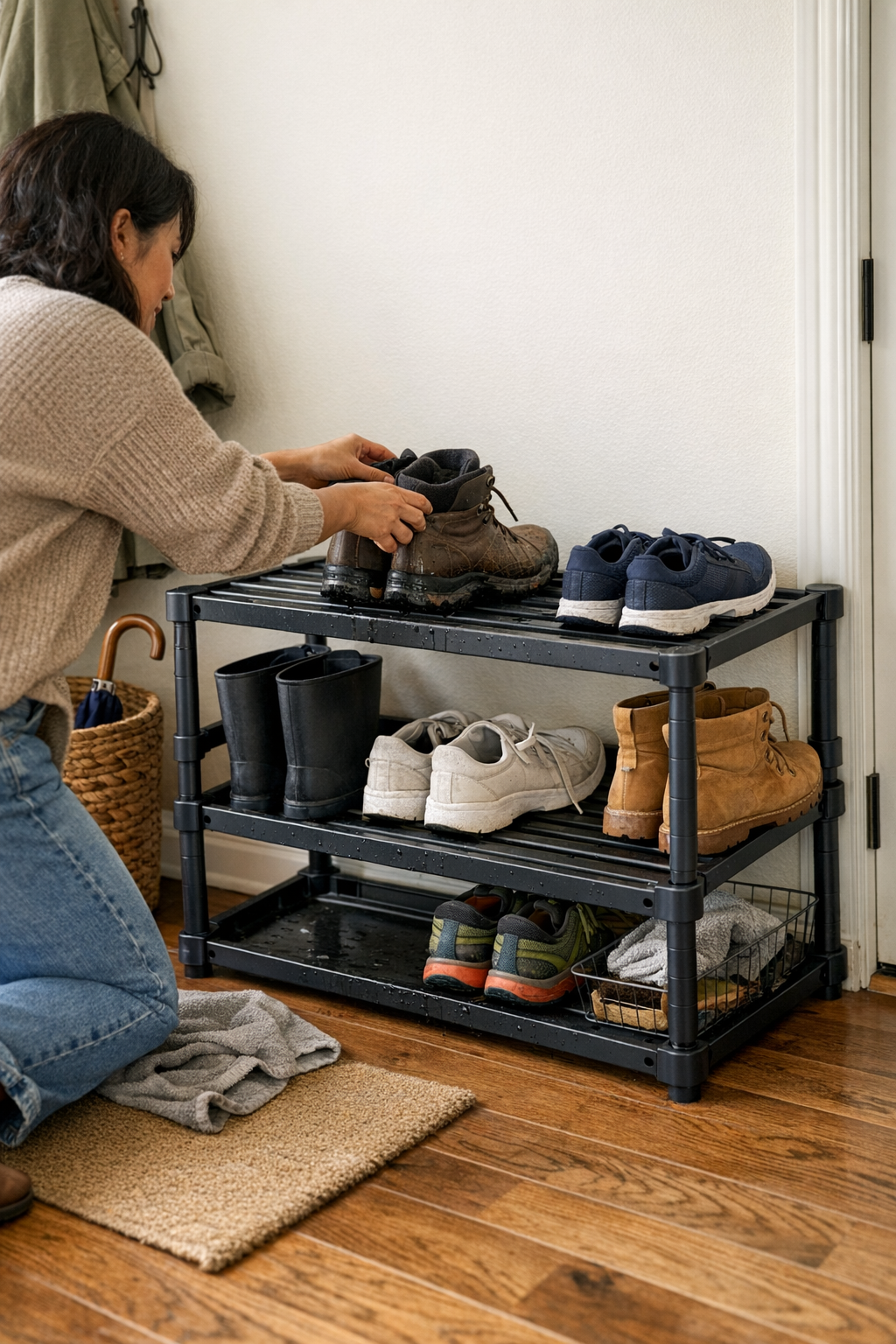
Flat shoe trays look like entryway order—right up until real weather hits and the illusion crumbles by day three. Step inside after rain or mud and you’ll usually spot shoes neatly lined up on a shallow tray, paired with a quiet hope: that this time, grit, puddles, and mess will actually stay put. For a day, maybe two, the routine holds. But as shoes repeat their cycle—wet, then wetter, then overlapping in a row that spreads wider—the shortcomings show fast. Tray setups that promise control undercut it with every soggy arrival: shoes stay damp, muck layers build, and the “clean” zone quickly becomes another source of work, not relief.
The Flat Tray Setup: Contained but Compounding
Shoe trays are meant to bring calm by boxing in mess and keeping drips off the floor. They work briefly—mud is corralled, water collects, order appears. But repetition reveals the flaw: each cycle leaves behind new wetness, never enough drying. Under the surface, water accumulates and grit turns to sludge. By midweek, there’s no hiding it—open the door and the stale smell hovers, the tray’s thin order replaced by a damp, slow-building blockade where shoes rarely dry and clutter creeps outward.
It’s not just that the damp lingers—it multiplies. If shoes aren’t cycled out fast, or if school runs and walks stack arrivals close together, the surface is always wet. Soaked sneakers and boots choke off evaporation, then extra pairs go on top, trapping everything in place. Odor barely fades before returning stronger. Instead of welcoming you home, the tray quietly signals, “Nobody’s taking care of this.”
Where the Flat Tray Fails in Real Entryway Life
Transition spaces run under constant pressure—boots drop, bags land, shoes migrate sideways, and within a day the organized tray turns into a bottleneck. The neat line bends outward, shoes start to overlap, and a “temporary” bag gets parked on top, soaking up the runoff. The system resets only with hands-on effort, which most avoid until things are clearly out of hand:
- Shoes grow heavier and soggier with every cycle.
- Sticky mud finds its way back inside, trailing past the tray.
- What seemed like an easy helper starts feeling like another cleaning job waiting for you at the door.
Lived movement also breaks down. If the tray blocks the natural path, each arrival slows—nobody wants to handle cold, wet footwear, and shoulders pinch as people avoid puddles. Shoes that should live on the tray spread to the edges: under the bench, clustered near the wall, or left at odd angles for quick escape. The tray contains less and less; the real zone for drop-offs and pick-ups compresses to wherever there’s still a dry spot, making even the act of entering feel awkwardly tight.
The Hidden Friction of “Contained” Clutter
The trap isn’t always visible. What looks like visual order is often just backed-up maintenance. The tray collects avoidance—nobody wants to reach into pooled water or touch other people’s half-dry shoes. Miss a cleaning cycle and the mud cements; the reset burden climbs. One skipped evening of cleanup and “contained” turns to “dodged.” Shoes start shifting to random corners, just to sidestep the puddles. Now the system isn’t just holding mess—it’s fueling it.
Raise the structure even slightly—move from a flat tray to a slotted, ventilated rack—and the entire pattern shifts. No, it won’t hide every speck of dirt. But now shoes dry, water drains, air moves, and the daily reset means less direct handling of old puddles. What used to be a major cleanup drops to a quick swipe of a mat. The friction to putting things back is lower—people actually use the storage rather than working their way around it.
Scene: Lost Shoezone, Blocked Flow
Picture midweek: tray crowded, shoes still damp, your bag lands “just for now” on what was the one clear spot. Boots migrate to the bench edge; hats end up draped on the wall. Someone shuffles through, nudges a shoe, and spills a cold puddle down onto the floor. Suddenly the passage narrows, the “clean” zone vanishes, and the entry’s reset takes longer than you can spare.
How Minor Elevation Shifts the Entire Experience
Just a few inches higher, with slots or vents, and every drop-off changes:
- Moisture drains away, so shoes are above yesterday’s puddle instead of in it.
- Airflow underneath makes real drying possible by the next return.
- Dirt falls below or clears off easily, turning kneeling “deep cleaning” into a simple sweep.
- People don’t hesitate to put shoes away: the system invites rather than repels repeat use.
Over time, these tweaks mean resetting the entryway is less of an event, and more of a step. The setup looks looser than a fully boxed-in tray, but operates far stronger—less funk, quicker recovery, and much less avoidance of the essential routine.
Real-World Tip: Bridge the Wet and Dry With Layers
In smaller entries where water always finds a way, layer your system: slot a vented rack above a removable mat. Shoes stay lifted, runoff drips below, and reset means pulling a mat rather than scrubbing a single deep basin. It’s the gap between perpetual wetness and a fast, one-move recovery—no more kneeling over half-dry trays just to keep up.
When Setups Look Neat, But Don’t Work
The risk isn’t messy shoes in plain sight—it’s setups that perform worse in daily rhythm than their design looks. Visual containment hides slow traffic, hidden odor, and the way you end up double-handling everything just to maintain the illusion. Each moment you hesitate or shuffle things again, the flaw in the system is exposed.
Good entry storage responds every time something gets dropped, grabbed, slid, or put away—not just the first time you set it up. The difference between a flat tray and a low rack isn’t “looking a little tidier”; it’s whether returning home means one quick step or yet another reset you hope to put off. What traps mess on day one creates routine resistance by day ten.
Small Adjustments, Noticeable Difference
The goal isn’t a space that pretends to stay perfect, but one that actually adapts: shoes cycle in and out, airflow keeps up, and movement through the threshold doesn’t stall every time the weather turns. Over a season of repeated use, setups that let water drain and shoes dry will not only stay easier to manage—they keep the entryway a place you can reclaim, not a job you have to dread.
Find transition storage options designed for repeated real use at Betweenry.