
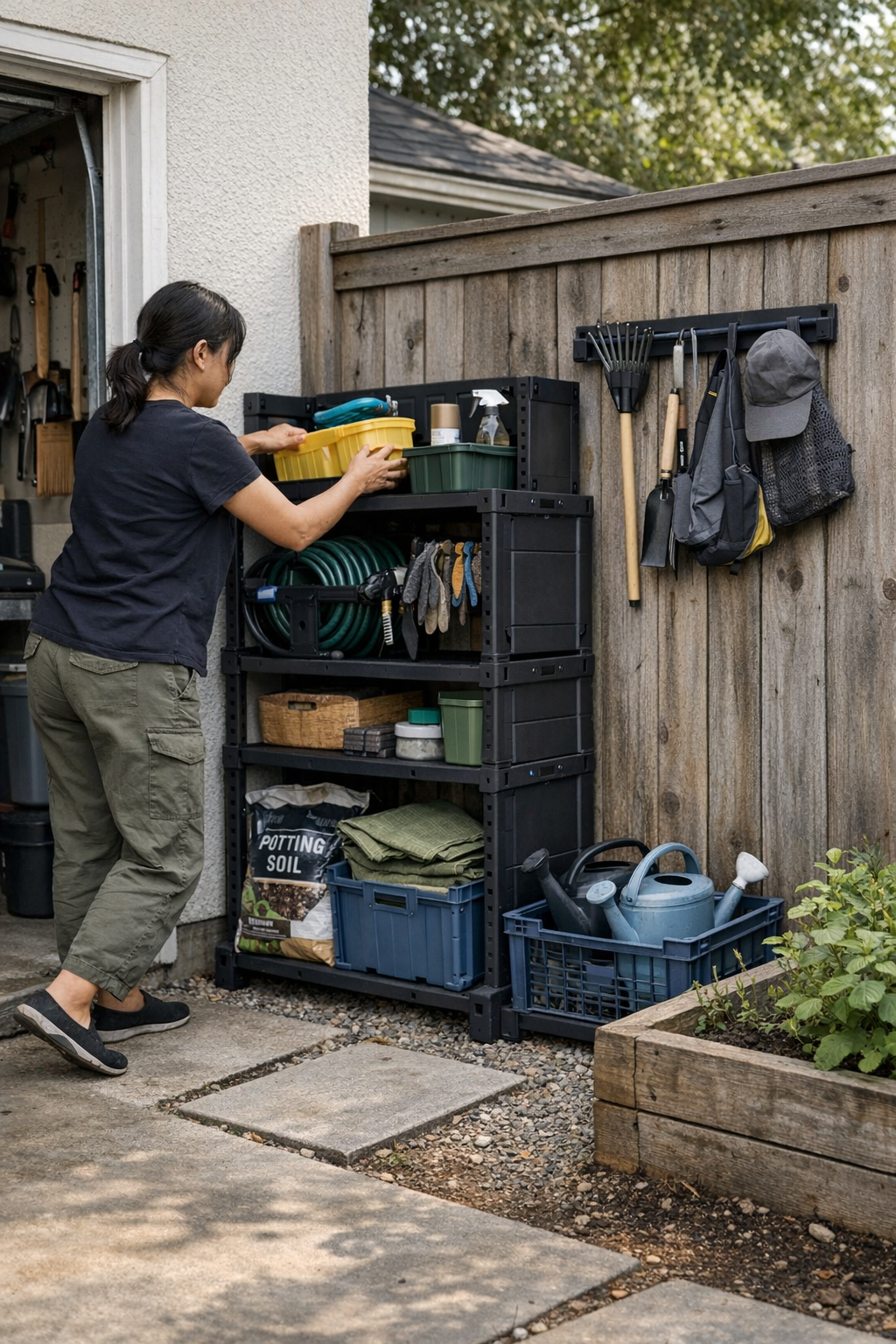
The problem isn’t getting organized—it’s staying organized through a real week in a tight outdoor zone. A new rack lands in a busy yard or along a narrow path, and for a moment, chaos seems conquered. But give it days of real use: foot traffic squeezing past, kids bringing out sports gear, quick gardening runs, someone forced to detour around boots or a heap of balls. The main route shrinks until every return trip means sidestepping another pile. This isn’t just clutter; it’s setup friction that never gets solved, just moved from spot to spot.
When ‘Organized’ Starts Getting in the Way
On the first day, bins in neat rows, a solid rack, or tall modular units give the backyard, garage edge, or side yard a brisk sense of order. But routines hit fast. One person grabs a trowel, another dumps muddy gloves, a soccer ball gets nudged under a shelf, boots wedge against the unit’s legs—soon every return involves shifting gear or asking, “Whose junk is blocking the walkway now?” The organization works for a week—sometimes less—until corners clog up and everyone starts calculating detours just to get through.
This isn’t messiness; it’s a mismatch between storage footprint and lived movement. Floor racks and standalone cabinets always sound practical—until they quietly claim the strip of space the whole household depends on to move through. Once movement paths are narrowed, even the smallest item out of place becomes a daily hassle. “Easy access” turns into routine reshuffling.
The Floor Storage Domino Effect
Picture a Saturday: the first person drops a ball as they squeeze by. Next, a couple of boots clog the rack’s edge. Someone tosses garden gloves onto the lowest rail, aiming for “close enough.” Loose cones and balls creep beneath the shelves. What started as an organized compact footprint has swollen into a physical bottleneck, shrinking footpaths down to shoulder width. If you need the mower or have to haul bags past, you’re kicking aside clutter just to reopen the lane. Each trip out means more objects in the way and another band of awkward shuffling around the setup that was supposed to fix this.
Wall-mounted hooks and rails flip the script. They don’t just free up floor—they patrol the margins of your movement zone. Lifted storage carves out a minimum air gap for feet, wheels, bags, and bins. It’s harder to “just drop” something in the way, and far easier to see and reclaim the path when spillover happens. Packed gear doesn’t creep silently into walkways: you notice, and you fix it, not because it looks messy, but because you actually need your route back.
Modular Systems: Useful or in the Way?
Modular storage seems clever—until it’s scattered in the wrong place. Snap-together units line up tidily on graphs and floor plans, but in reality, a single shelf jutting past the shortcut or edging into a garage threshold warps the whole outdoor flow. Space intended for storage chokes landing zones or turns a basic return trip into a slow-motion zigzag. Instead of sorting, everyone just piles—whatever doesn’t fit “right now” lands at the nearest open patch, and resets take longer each week. All it takes is one edge in the wrong spot, and the modular promise collapses into overflow and dead ends.
Some corners absorb modular bins well, but nothing lasts when routines shift—kids bring friends, mornings get busier, or the gardening season ramps up. If a setup blocks a route, the rest is noise: style, bins, and labels can’t overcome an awkward footprint clogging what people actually use.
How Raising Storage Breaks the Setup Stalemate
Take one cramped yard: a freestanding rack clogs the middle, trips are lost to nudging boots out of the way, shoving gear off the path. Swapping in a wall-mounted rail—eight inches off the ground—reset the whole pattern overnight. Suddenly, there’s a real walkway again. Now a cart glides through, hands are free, and kicks underfoot are rare. Even when afternoons get messy and gear comes flooding back all at once, the main path holds. Those missing eight inches don’t just mean cleaner lines—they mean the area doesn’t collapse back into flood-level clutter after a typical Saturday rush.
Some gear still lives by the back door, but now it makes visual sense: what doesn’t belong gets obvious sooner, tidying is quick and deliberate instead of a full reset ritual. The space doesn’t turn perfect, but resets become bearable and don’t kill momentum. The improvement isn’t spotless calm—it’s that putting gear away no longer needs an all-hands meeting or a warning sigh.
Know When Your Storage Is Fighting You
Gut check: if a normal trip to the shed or yard means sidestepping stray boots, rotating bins just to open the gate, or dragging a pile away from a choke point—your layout is fueling clutter, not containing it. Give it a month. Real use, multiple people, incomplete returns. If “reset” still means a full shuffle and you’re still blocked, your storage is just decoration for a problem that keeps coming back.
See a healthier setup when most items find the same home, paths clear quickly after use—even if nothing’s photo-worthy. It’s not about perfection; it’s about bounce-back, how little time it takes to reclaim the basics after a run of sloppy returns.
Wall Systems and Real Access (Not Wishful Thinking)
Mounting storage clears floors fast, but only if everyone can use it. Got little kids? Shorten a rail, add reachable hooks, or stuff a shallow bin at kid-eye level. If even one family member can’t return their gear easily, boot piles become inevitable. Label the right zones or anchor a slip-resistant basket so stray boots don’t migrate. Real access beats uniform “tidiness” every time—and a few deliberate adjustments can mean the difference between quick resets and gear endlessly orbiting the floor perimeter.
Don’t Plant Obstacles Where People Walk
Classic mistake: tucking a modular rack, box, or bin where all return trips squeeze past. Even an inch or two, and spillover multiplies. Floors become catch-alls, reset dread grows. Blocked movement is a mess accelerator in any compact outdoor strip or garage threshold. Want a real test? Load your arms with garden gear or a ball bag and walk your layout. If you have to wiggle, slide, or shift something—start over. The path’s the priority. The rest is just organization theory until the lane works in practice.
Quick Tweaks That Lower Setup Resistance
Forget perfect. Real yards drift toward disorder; the goal is to slow the drift and make resets almost frictionless. If one wall section keeps jamming up, bump infrequently used hooks higher or make a “rush drop” zone near the door for overflow. If a single spot always collects debris, move high-use storage there instead of fighting the flow. Fixes here are rarely dramatic—but shaving seconds off resets or making one awkward pile disappear adds up to hours of less frustration across a month.
Good Setup Feels Different—And Holds Up
A storage system proves itself not by looking sharp on day one, but by surviving a month of missed returns, sudden weather, and everyone dumping gear in a hurry. The payoff isn’t just seeing fewer piles—it’s walking through the space and not having to shift your stride or negotiate a detour every time. Raising storage, even half a foot, often marks the line between a routine that flows and a routine that stops cold. In the end, reclaiming walkable space isn’t just an aesthetic upgrade—it’s the quiet return of sanity to busy outdoor routines.