
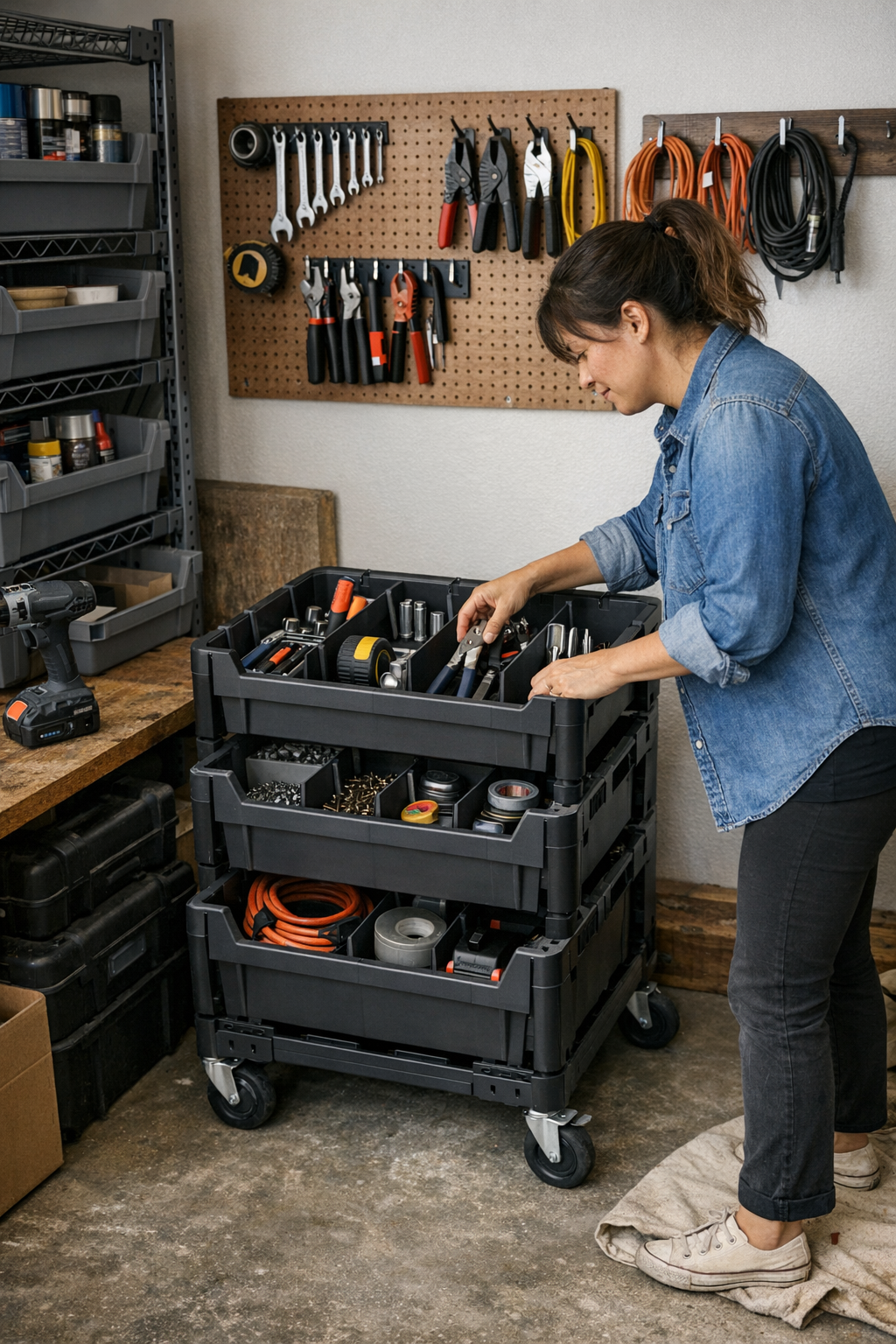
The garage always looks organized the day you finish the setup. Matching bins lined on shelves, wall hooks hanging in crisp rows—everything poised for easy access. But two weeks in, reality seeps through: bins don’t stay sorted, cords drift across shelves, and returning tools feels like threading a maze. The system that was supposed to tame the chaos starts to trip you up at the exact moments you need it to just work. Each rushed weeknight and cluttered Saturday turns the original order into something you have to fight to maintain.
When “Organized” Isn’t Enough: The Slow Decay of Categories
On the surface, every new garage shelf has that satisfying grid—each bin, tray, and compartment lined up with purpose. Fast forward a few busy evenings, and the system can’t keep pace with real use. You grab for a drill in a hurry, toss a wrench back as you rush to finish, and without firm boundaries, bits and hardware are on the move. Screws mix with clamps by midweek. Drill bits—once separated—slip into the pliers tray and vanish. Extension cords snake over lids meant for something else entirely. Even grabbing a broom means digging through accidental piles that formed where there were supposed to be gaps.
You can feel the friction every time you reset: minutes lost hunting for a lost hex key, handling the same tangle twice, resigning yourself to the small messes you intended to avoid. Over months, the cost is more than clutter—it’s routines slowed, distracted projects, and the constant nuisance of searching in a space built to be efficient. The setup that looked bulletproof starts to wear you down every time you use it.
Return Flow Friction: Why Putting Things Back Gets Messy
The real breakdown begins when you’re cleaning up in a rush. No obvious home for a tool? It lands wherever there’s an opening. Categories begin to dissolve around the edges: “Screwdrivers” merges with “random hand tools,” the bin for odds and ends balloons into “everything I’m not sure about,” and the spots you plotted for specific items turn into makeshift drop zones. The next time you go to put something away, there’s no clear landing—so you pile like the rest. Slowly, the walls between categories collapse, and you spend more time thinking about where to fit things than just working.
The illusion of “efficient” storage—maximized shelves, bins stacked tight—often trades away access for density. What fits neatly together today creates choke points tomorrow. One handle poking out jams a whole row. Floor carts, packed with potential, end up wedged in odd spots because a stray tool blocks the path. Instead of rolling smooth, you nudge the cart back and forth, making room just to reach a piece you need. Wall racks that promise easy access become a clump of overfilled hooks, so grabbing the garden shears means navigating around three hammers and a level. Awkward footprints force you into repeat detours, with dead corners that trap clutter for good.
Scenes from Real-World Garage Friction
- Cart shuffles: Want to pull out a ladder? First you slide the rolling cart—twice—only to find a screwdriver jammed in a wheel or a tangled cable clinging underneath.
- Blocked walls: That sleek wall-mounted rack made sense until two wrenches and a mallet shared a hook, turning a one-grab action into a three-step process every time.
- Overflow creep: The “spare cables” bin becomes a catch-all for chargers, paint brushes, bolts, and batteries. Within weeks, it morphs into a black hole—impossible to reset, always swallowing the pieces you can’t find elsewhere.
- Aisle squeeze: Storage that “fits the wall” still interrupts the walk from one end to another, with carts, bins, and baskets squeezing the pathway into a shuffle, not a stride.
Real Boundaries vs. Flexible Chaos: Why Zones Win
It’s tempting to trust labels and flexible shelving—until you see how quickly flexibility drifts into disorder. Bare bins and too-tight rows invite items to wander. Every gap you think saves space today becomes an invitation for tomorrow’s misplaced tool. Physical boundaries are what actually hold categories together.
Add a hard divider in a bin, and suddenly stray bolts don’t crash into the drill bits. Separate hooks with just a hand-width of breathing room and the hammer has nowhere to stray when you toss it back. The tiniest change—a sectioned tray, a spacer, an extra bracket—gives each tool a defined home. Now when you reset, you’re not negotiating; you just return things to their clear starting points. That’s the quiet difference between a zone that holds and one that collapses when you’re in a hurry.
How Clear Zones Transform the Routine
After overhauling my own garage cart—hard dividers, spaced hooks, bins marked and sectioned—the chaos slowed to a crawl. No more digging around a sander to fetch the trowel. The wheels stopped jamming, because nothing hung loose to catch them. Resetting stopped being a half-hour fix and started becoming a five-minute wrap-up. Even after three chaotic weeks of fast repairs and weekend projects, the order survived. It wasn’t flawless—but the routine shifted from endless reshuffling to nearly automatic return flow. That edge made the space useful day in, day out.
Small Upgrades with Real Impact: Building Zones that Last
- Add basic dividers: Even a scrap of wood or a plastic insert inside a bin turns a loose pile into clearly separated pools of hardware. One barrier keeps months of sorting from unraveling.
- Rethink hook spacing: Stagger your mounts with enough room for each tool’s grip, even if it means trimming your wall plan to just core items. The result: no more tool “slippage” and easier, one-handed returns.
- Reset as a user, not a designer: Walk the route you’ll use after each project. If you have to sidestep a cart or squeeze along a shelf, something needs shifting. Resets should flow, not stall at the same pinch points.
- Defend empty spaces: Leave intentional gaps—don’t fill every inch just because you can. Air between categories is what keeps them from merging in a hurry.
What Really Lasts: A Garage Setup That Holds Under Pressure
The difference between “visually organized” and “actually functional” is built at the edges—where things return and where they don’t spill over. A true setup isn’t about Sunday snapshots; it’s about how smoothly you find and return gear when midweek chaos sets in. If you can reset your space in minutes, check any shelf and know what lives there, and move carts without cursing—your system is starting to work for you, not the other way around.
Focus on boundaries that stick—a real home for each category, a little extra space where tools transition, a deliberate break between seemingly similar zones. It’s not about squeezing more in; it’s about making sure what’s already there actually works. Over the long run, you’ll reclaim more time, fewer headaches, and a garage that delivers on the promise of easy access, not just surface order.
Visit StackNest for storage systems that help your setup work the way you do.