
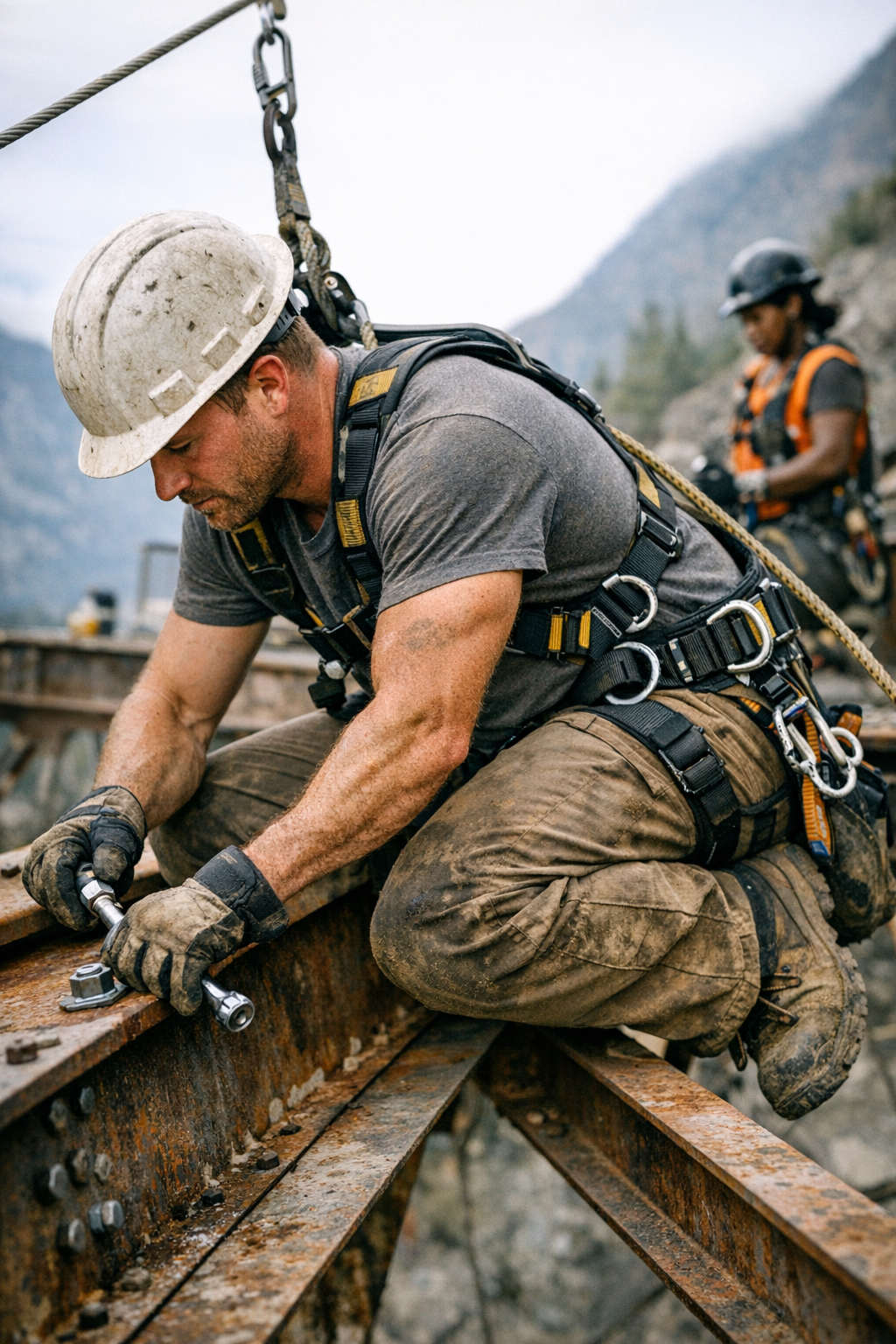
You don’t notice harness problems when you’re checking your gear. You notice them mid-task—right when it counts. You’re crawling under a stair stringer, drill humming in your hand, trying to drive a lag bolt above your head. That’s when the harness pinches, straps creep, and your body starts compensating for every awkward load. Minutes stack up. You shift to cut standoff posts, then sand edges, but the harness keeps pulling at the wrong spot or sliding into your ribs. Fatigue creeps in faster and the tool feels heavier, every adjustment pulling you out of the job and back into wrestling with your gear.
The Real Cost of Poor Load Distribution: Flow Breaks and Focus Drains
Harness discomfort isn’t just about sore spots—it’s about lost control and broken rhythm. In real routines, you’re drilling above your head, crawling through joists for fastener changes, swapping sanding pads, or reaching to cut and clamp without a break. If your harness loads unevenly—all the weight dragging down from one shoulder, leg straps gnawing behind your knees—simple jobs get clumsy. You move less confidently, fighting the harness with every reach. The seconds lost to fidgeting add up, and your precision fades: wobbling a drill bit, fumbling a screw, overshooting with a saw.
Similar at a Glance—Decidedly Different When the Work Starts
Most harnesses on a rack look identical: same webbing, shiny D-rings, stamped hardware. Their differences only matter when the day heats up—and you’re moving fast across scattered tasks.
The Back (Dorsal) D-ring Trap
For standing in place or moving in a straight line, a dorsal anchor is fine. But shift laterally on a beam, squat for a low bolt, or lean to sand a stair tread, and the weight yanks you sideways, twisting your hips, tiring your back. Every edge run, every tool swap becomes a reminder: the harness is slowing you down at every angle that’s not upright.
Why Lateral D-rings Matter for Tool Users
If your harness has well-placed side D-rings—anchored around your hips and pelvis—the load spreads out. Reach overhead to drill, kneel to attach a bracket, cut with one knee down: the harness stays put. No biting, no sliding. Your hands stay on the tools, not yanking at the webbing, and you move in and out of position without losing momentum or control.
How Imbalance Actually Wears on Your Day
Harness flaws are cumulative. Kneeling to drive screws under steel stairs with only a back clip, you feel the harness ride up with every lean. The fix is always the same: sit up, readjust, tighten—interrupt your rhythm. Little breaks become habits, and your work slows. Watch someone with a harness that distributes weight smoothly: no hesitation, fewer pauses, they stay locked on the job without fiddling or readjustment—tool always in hand, not a grip on the harness strap.
Look for the silent signs—shiny spots on harness webbing, imprints left on work pants, wear marks on the back of a shirt. These are pressure warnings, evidence of energy wasted not in the tool but in fighting gear friction with every repetition.
The Small Tuning That Changes Everything
Chest and side D-ring adjustments aren’t details—they’re difference makers. When the back anchor isn’t pulling you off balance, and chest tension sits just where you need it—say, a chest strap set slightly under your collarbone—the harness vanishes. Suddenly, you can twist smoothly to sand risers, drill anchor holes, or swap batteries overhead with no ride-up or shifting. Head in the job, hands on the tool. The drag disappears and the workflow sharpens up—less fidgeting, steadier lines, less tool fatigue by the final shift.
Whether you’re running a cutoff wheel above shoulder height or ratcheting a wrench in a tight space, a properly dialed setup converts every move into actual progress, not a wrestling match between you and your harness.
Signs It’s Time to Rework Your Harness Distribution
- Belt or shoulder pressure that flares up 45–60 minutes into a task
- Impulse to loosen, shift, or re-buckle mid-drilling or fastening
- Markings on work clothes tracing exactly where the harness bites
- Feeling wobbly on a ladder, or needing to change footing just to regain balance
Don’t ignore these signals. Over time, poor fit quietly erodes tool control, escalates fatigue, and even chews through your gear—right when every minute and motion needs to count.
Test Harness Moves, Not Just Fit—With Actual Tools in Hand
Don’t fit-test your harness in front of a mirror. Strap in and run your daily moves: climb a frame, kneel under a joist, reach wide to drill or sand, swap blades or batteries on the fly. If constant tugging and tweaking follows you from stance to stance, your setup isn’t right. A few minutes of this trial is enough to make the need for better distribution obvious. The right choices on anchor points or harness style will show up in fewer interruptions, faster tool switches, less frustration over a week of real work—not just a better feel during the morning equipment check.
Accumulated Delay: Cost You Never See Coming
Poor harness distribution rarely leads to a single disaster. It just drags: every task a little slower, every drill job heavier, every saw pass less precise. Five minutes lost at each repetitive action—anchor shift, battery change, cleaning buildup after a harness slip—stacks into hours by week’s end. When deadlines loom or you’re juggling late-day punch-lists, that’s the drag that stings.
Make the Harness Disappear—Dial the Workflow In
The best harness does its job by getting out of the way. With anchor points adjusted early, movement stays sharp. You can grab plywood, drill out plates, climb to fasten a bracket, or sand risers overhead—without fighting your own equipment. Tool control, confidence, and simple forward progress return. In a setup that matches your real routines, discomfort and lost effort shrink. Every anchor, cut, and adjustment starts working for you, adding up to more actual work done with fewer stalls and far less friction by the end of the shift.
Visit Gumboll for practical harnesses, tools, and accessories built for real jobsite routines.