
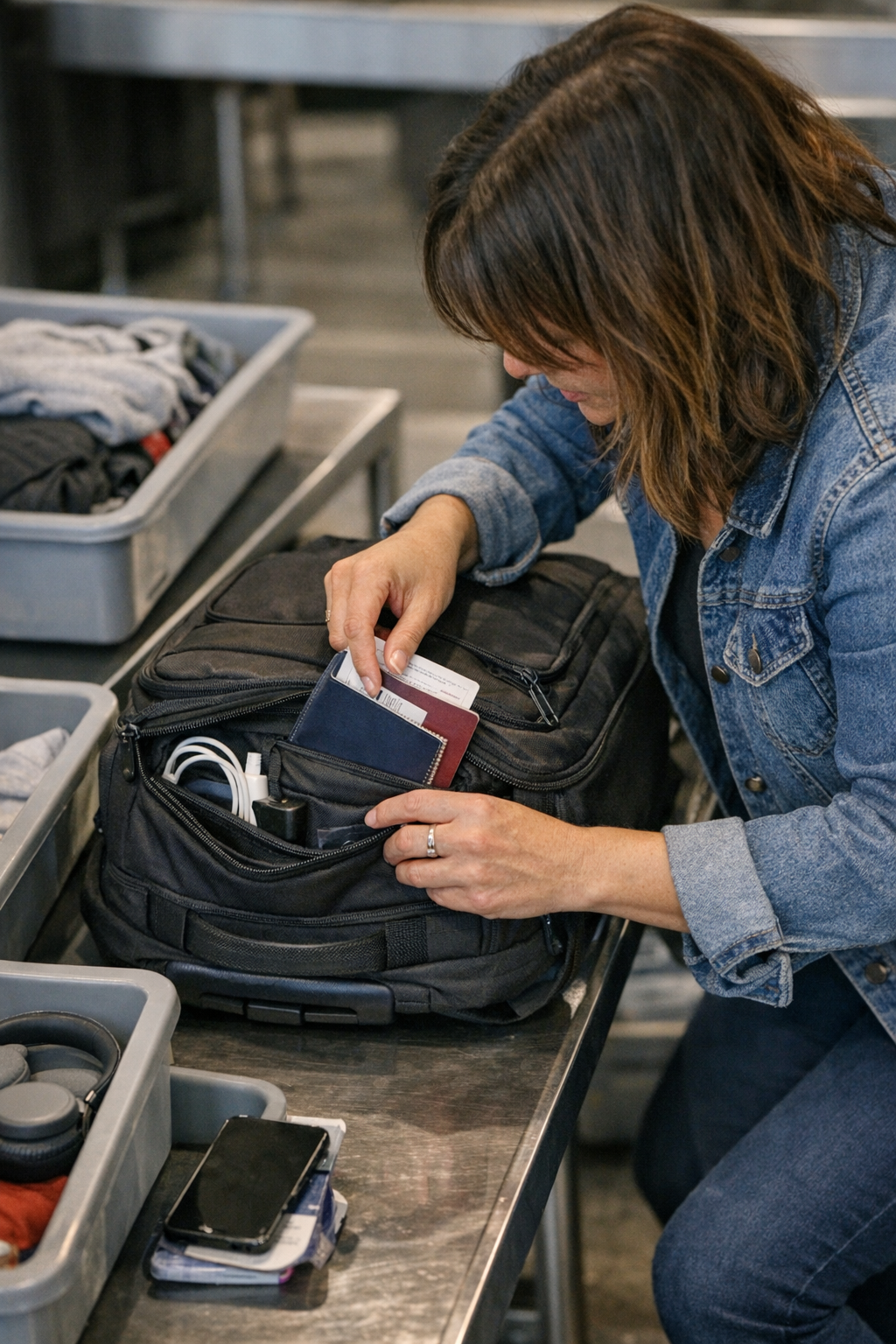
The difference between a carry-on that “looks organized” and one you actually want to dig into at the gate isn’t obvious until the airport tests every choice. Zip your bag closed at home and you’re proud of the neat rolls and lined-up pouches. Fast-forward to the first security line: the charger you thought was smartly packed is now buried, your passport is wedged under a stack, and retrieving anything triggers a quiet scramble—forcing half the bag open under time pressure while trays push up and travelers shuffle around you. You realize it’s not messy, just slow. What worked in your hotel room is working against you—one pocket at a time.
The Hidden Cost of Storage-Focused Packing
Social media is full of “satisfying” carry-on photos—every shirt crisp, pockets shut, order everywhere you look. But compression isn’t the same as usability. The tighter you stack and pack, the more every future reach becomes its own event: friction on top of friction, especially when you actually need quick access.
Think about the first checkpoint: bins rattling forward, shoes off, the person behind you pressing closer. If your main essentials—laptop, passport, ID—are trapped beneath layers of rolled shirts, charger bricks, and a shoe pressed against a pouch, every retrieval turns into a mini unpack. A layout that looked sleek and tidy now works against you, blocking quick reach, requiring awkward reshuffles, and breaking your momentum every time you move from line to line.
Where Travel Momentum Hiccups: Checkpoints and Chokepoints
Breakdowns in flow don’t arrive with fanfare; you notice them as a series of tiny, repeated stalls. Reaching for your passport becomes a two-step detour as you unstack layers or nudge aside zippered pouches. Down an aisle, retrieving headphones means shoving a sweater and zipping around cables. Security trays, boarding lines, overhead bin grabs—the illusion of packed order keeps getting peeled back.
Here’s reality: Just because a bag “looks” tidy on a bench does not mean it works under real pressure. Each slow unzip or pouch shuffle doesn’t just cost seconds—it piles up over a trip, taxing your focus and flow. Small retrieval delays, repeated across checkpoints and boarding routines, add up to a persistent drag on every segment of airport life.
Repeated-use Scenarios: Where Organization Breaks Down
Security Trays: Clothing Layers Become Access Hurdles
Picture yourself rolling into the security checkpoint. You need your electronics out, fast. Both are blocked by shirts crammed for space and a dense charger pouch—a setup that made sense at 6 a.m., but now demands a cramped, rushed search. Cables snag, pens tumble, clothing shifts. Suddenly you’re blocking the conveyor, forced into awkward hurry or letting your order collapse as you repack in a rush.
Boarding and Seat Entry: When Bags Don’t Flex
Boarding: it sounds routine until you juggle ticket, snack, device, and ID. Outer pockets bulge from over-compression, or the item you want is under a layer of barely-contained order. Every “just one thing” grab mutates into a partial unpack, with repacking slowed by corners that were tight by design. The result isn’t just inconvenience; it’s a public moment where smart storage becomes a private liability.
In-flight Retrieval: Quick Essentials Turn into a Project
Settled into your seat—then remember gum, earplugs, or the e-reader. They’re not where you want; they’re midpoint in a vertical stack. Instead of a quick zip, you’re half-standing in the aisle, pulling out layers, bumping elbows, or swinging your bag down—turning a one-handed grab into an in-flight project while your neighbor waits and space runs out.
What Looks Packed Isn’t Always Easy to Use
The most common mistake? Packing to hide mess often hides ongoing hassle. A bag that looks calm pre-trip can dissolve into chaos when every “grab” means disturbing half your kit. This isn’t a packing laziness problem—it’s a structural flaw that’s invisible until you face the same stuck zippers, reset pouches, or stacked-over essentials again and again. The first trip you might just feel slow; by the third, you’re strategizing how to repack for access you can trust mid-movement.
You put your charger in a spot that made sense—logical in theory, but always an extra step deep when you need it on the fly. The same with a passport or boarding pass: guaranteed to wedge between snacks, headphones, or an oddly-shaped pouch as soon as you stand in line. The more order you create visually, the more you risk building friction into every future access point.
The Access-First Adjustment: Practical Tweaks That Change Movement
How do you actually cut down these micro-stalls? Build your packing order around actual use, not visual calm. That means isolating your high-frequency items—passport, phone, charger, headphones—into outward-facing, uncluttered pockets you can reach with one hand even when the overhead bin’s full or the aisle is blocked.
Use structure, not just space: Give each frequent-access item a home that’s never shared with bulky storage: passport and phone nested vertically by themselves; charger and cable separated into a shallow top pocket. This keeps retrieval friction away from your core setup, so every access feels like a direct reach, not a mini repack. You’re not packing less—you’re packing for movement, and the difference reveals itself at every gate, bin, or seat.
Recognizing and Avoiding the Most Common Packing Pitfalls
- Compression overkill: When every millimeter is packed tight, the smallest retrieval means triggering an accidental unpack cascade.
- Pouch overflow: Mixing tech, documents, and comfort items in one slot looks controlled, but leaves you unprepared when you must grab just one of them—fast.
- Edge illusions: Outer-pocket items can still be blocked if those pockets become dumping grounds for overflow bulk—proximity isn’t the same as access.
- Order without function: If you’re forced to unzip, reshuffle, or pause every time you need something, the organization is cosmetic. Flow matters most when the pressure’s on.
Living with the Setup: How the Right Pocket Placement Changes Everything
The shift is visible under stress—where travel design is meant to function, not pose for photos. At security, your ID, wallet, and device come out in one motion, not a layered excavation. Board the plane: your ticket lives in the same slim slot every time. Mid-flight, you grab headphones or a snack with a targeted reach—no neighbor disturbance, no half-opened bags, no wardrobe cascade.
Airport travel finally feels like moving forward, not sideways—moving with your bag, not fighting its layout. What changed? You didn’t drop essentials; you just separated the high-frequency retrievals from the static bulk, ending the cycle of forced resets and fumbled repacks. Organized doesn’t mean untouched: it means packed for how you actually move, not just how you like your stuff to look at the start.
Building a Carry-On for Real Airport Rhythm
What sets a carry-on apart isn’t “max packing”—it’s the ability to match supply with demand in real time. The best setups prioritize movement: each key item assigned a frictionless pocket, each access designed around travel’s routine stress points. Your bulk gear still belongs in main space, but everything you need on the go stands apart, immune to pouch blockages and panic zips.
This is where a carry-on stops being just a container and starts behaving as an in-transit tool. Micro-disruptions fade; retrieval, boarding, and repacking become background—not bottleneck. Every checkpoint, line, and aisle exposes the difference. The payoff isn’t a perfect Instagram shot; it’s the flow that can only come from structure made for the way you actually move.
Find travel tools and layout inspiration for your next carry-on at CarryOnSupply.