
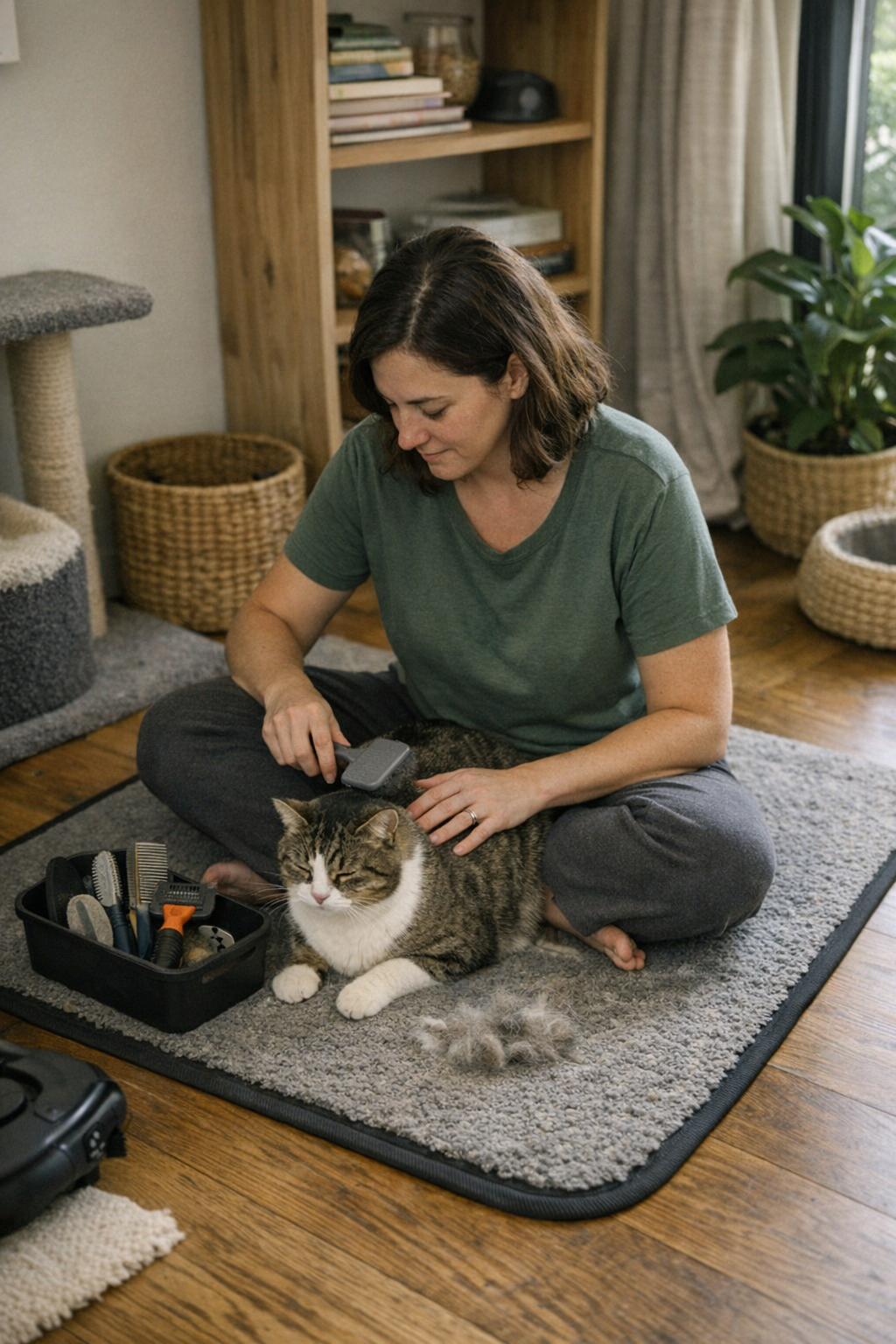
Indoor cat grooming routines rarely fall apart all at once—they unravel with every loose brush left in the wrong room, every stretch of fur drifting from the hallway to the sofa, every reach for a comb that’s somehow not where you need it. Grooming “wherever” sounds flexible until you’re finding lint rollers under the coffee table and brushing hair off your own bedspread for the third time that week. What begins as convenience turns into a daily circuit of tracking, hunting, and chasing collapsed routines across your living space. This is where the setup itself starts to matter—especially in a home built around StillWhisker’s world of practical, repeat-use, and layout-aware solutions.
When a Floating Grooming Routine Falls Apart
Most indoor-cat owners improvise: grooming tools get parked wherever there’s free space—maybe the kitchen, maybe next to the laundry, possibly wherever the cat rolled over last. The allure is obvious: no fixed station, instant access, brush when and where you can. But the cost is counted later. You spot the first patch of fur on the sofa after a hurried weekday brush. A comb disappears for two days, only to resurface behind a stack of magazines. Bristles inch their way into play corners, rest mats, even feeding zones—no part of the room is off-limits because the routine never anchors. You’re forced to clean wider, remember more, and reset across the entire house instead of one controllable area.
The disadvantage creeps in slowly. Cleaning no longer means one sweep and done; instead, fur starts surfacing in places you never meant to use. That sense of order dissolves fast—irritating messes resurface beneath furniture, on recently cleaned carpets, or on toss pillows that only moved once. The “anywhere works” plan quietly multiplies your work, demanding more searching, more bending, and more repeat passes the longer it runs unchecked.
How Rotating Setups Sabotage Shared Spaces
It only takes a few days for grooming leftovers to invade every room. Compact homes suffer most: a single stray brush near the window today means fur waiting on the curtain tomorrow. Shifting “the grooming spot” wherever is free means you trail mess from sunlit corner to door mat, leaving behind hair, bristles, and the memory of a job half-finished. Instead of one controlled zone, you inherit constant layers of clutter: today’s vacuum round catches what was dropped yesterday, and even small apartments start to feel interrupted by the chase.
This isn’t just stray hair stuck to a throw—every moveable setup creates more zones to patrol. Grooming becomes a scavenger hunt and every surface feels up for grabs. It drags out your daily reset, delays your actual cleaning, and asks for more patience than you thought necessary. You lose pace, lose time, and lose the sense that you’re ever caught up.
Why a Permanent Grooming Spot Changes Everything
The smallest decision—anchoring grooming to a single, easy-care spot—stops fur drift before it starts. Instead of splitting your focus and effort, you claim control in one defined zone. Brushes, combs, and wipes park there; a mat rated for actual shake-out takes the hits from loose fur. Nothing slides around when the cat moves. Cleanup collapses to one swift step with no side trails into other rooms. Tools have a landing pad, and so does every shed hair.
Dog owners have long understood the reason for a designated “wipe paws” station. StillWhisker’s world translates that logic indoors: a fixed grooming corner where everything begins and ends. Now, brushing becomes a four-minute sequence: grab a tool, work over the cat, scoop up fur, shake out the mat, set everything back. Nothing escapes to the carpet. Nothing doubles back to show up two rooms away days later.
What This Means in Daily Life
There’s no mystery hair creeping under the bed or landing on a guest’s coat. A simple mat under your cat’s favorite window or by the hallway—chosen for shake-out speed—catches virtually everything in one go. Grooming tools never stray, because they live within reach. Cleanup shrinks to a single step: shake, brush, or toss the mat in the wash. The next session, everything’s ready. You don’t lose time digging through junk drawers—or end up finding the right tool only once the fur has already spread somewhere new.
Over weeks, the difference gets clearer: fur and tools stay contained, and you’re running a short, closed loop—not an endless cycle. The rest of your living space holds together longer. You’re not cleaning harder; you’re just cutting off the spread before it starts.
Spotting (and Avoiding) the Usual Pitfalls
The “easy spot” is often a trap. Cozy corners, thick rugs, sun-warmed sofas—they invite grooming in the moment but snare fur for days. Deep carpets grab every strand. Beds and throws soak up leftovers between vacuum runs. Even if a spot looks ideal once, it can falter fast: hard to sweep, slow to vacuum, impossible to fully clear after a cat barrels off mid-session and takes clumps to a new spot.
The right permanent setup is:
- Within easy reach for both owner and cat—no dragging tools or wrangling the animal into awkward spots
- Not in beds, lounging nooks, or main rest areas (fur doesn’t belong where sleep happens)
- Placed on a washable, shake-out-safe mat—never thick carpet or heavy throws that hold fur hostage
- Backed by a non-slip layer so you’re not chasing both a shifting mat and a moving cat
- Right beside a storage tray or caddy, so nothing gets stranded or lost between sessions
Shift a grooming station a few steps outside your cat’s play or feeding zone and watch cleanup tension drop. Fur stops contaminating food bowls. Loose bristles don’t sneak into stacks of toys. Resetting becomes predictable—the session ends with its own built-in cleanup rather than a mess that leaks quietly into the rest of the house.
Repeated Scenes Where Setup Makes Life Easier (or Not)
Small pain points multiply when flexibility is your only routine:
- Reaching for a brush and it’s not there—it’s still lost in yesterday’s room. Grooming gets postponed, and so does cleanup. Later always demands more effort.
- Wrapping up a session just to discover hairs on the hallway rug and sofa. Even after cleaning, you’re left tracing the spread to spaces you didn’t mean to use.
- Stepping in leftover fur during a reset, then doubling back with a vacuum. The section you finished now means another round—extra steps, more delay.
- Noticing your cat asleep on the mat hours after grooming ended—still shedding there. The “permanent” area helps, but only if it lives where cleanup stays easy and maintenance doesn’t fall behind.
Each frustrating scene grows from the same root: temporary or unfixed grooming structures leave you with scattered work, lost tools, and friction that drags into the next routine. The problem doesn’t announce itself—it builds up behind the visible calm.
The Difference Between “Looks Clean” and “Works Clean”
Plenty of setups look fine right after a reset—but breakdown shows when routines overlap and rooms serve double roles. Fast resets slide; the “floating” grooming zone promises order but turns cleaning into a relay race just to keep up. Setting a fixed zone doesn’t just clean the surface; it puts a ceiling on future effort. Instead of forever restarting, you slot grooming and cleaning into one tight loop, with no sprawl into daily routines or unexpected corners. Less repeat work. Fewer frantic searches for a lost comb. And more time before your whole living space starts to feel off.
Practical Steps to Centralize the Cat Grooming Zone
Find the Natural Fit
Use the places you already share: a window ledge, a hallway edge, anywhere with hard flooring that isn’t the direct line of traffic. Avoid grooming on sofas or dining chairs—fur lingers where you want comfort. If your only option is carpet, layer a washable, non-slip mat. It’s about making cleanup automatic, not about reinventing the space.
Bundle the Tools
Group everything together—brushes, combs, spray, wipes—in one tray or hanging caddy within arm’s reach of the grooming spot. The key isn’t spending on fancy storage, but on keeping the process so tight that setup and cleanup can’t grow into chores themselves. If it stalls for ten seconds or more, it breaks under weekday pressure.
Contain Loose Fur (and Clean Up Fast)
Choose mats that actually respond to the problem: shake out, toss in the washer, wipe down—no draping with towels that double laundry loads or fail to dry. Silicone or waterproof mats work for some, tough textile mats for others. Avoid heavy, layered fabrics and anything that requires a full reset to avoid odors or stains. Cleanup should be a side