
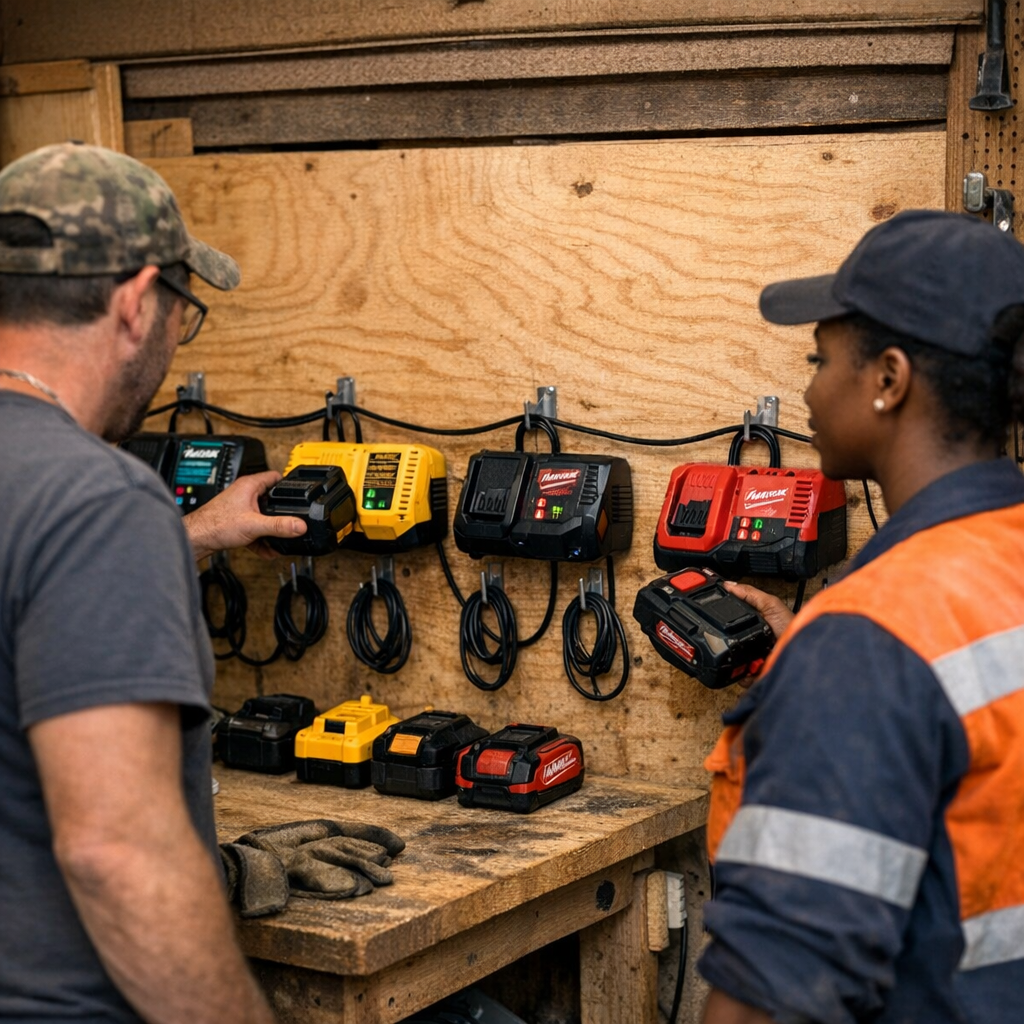
Power tools don’t let you down—until the charger station does. The day starts organized: drills, drivers, and saws lined up and charged. But a couple of hours into real work, the hidden weak point appears. Suddenly, you’re staring at dead packs, tangled cords, and blinking red lights right when you’re lining up for a critical cut or driving that final screw. Productivity nosedives, and minor chaos takes over the bench.
Where Charging Chaos Creeps In
Spend an hour on any busy job site—drilling walls, rapid-fire fastening, ripping boards—and you’ll see it unfold. Chargers lined edge-to-edge, cables coiled tight around each other “to save space,” all looks tidy in the quiet stretch before the day heats up. But as soon as the tool cycle speeds up, the setup cracks:
- Blocked charger vents crowd in, choking off airflow.
- Cords spaghetti together—no one’s sure which battery belongs where.
- Quick grabs pull on cords, half-unplugging chargers or yanking plugs just enough to interrupt the charge cycle.
The downside hits at the worst time: halfway through a plunge cut, a drill bogs down. You reach for another pack—still blinking, still empty. Now, the scramble begins: swapping chargers, guessing which cord goes where, accidentally unplugging the sander for the finisher’s orbital. “Organized” doesn’t mean much once the real-world pace picks up.
What Happens When the Job Gets Fast
Crammed charging isn’t just annoying—it grinds workflow to a halt. Imagine a carpentry crew rotating three saws and a brace of drivers, everyone expecting fresh power on every cycle. When chargers cluster or cables loop over each other, it’s not just about looks. It’s about:
Vent blockage silently overheating chargers—sometimes you don’t notice until the casing is too warm or you smell faint plastic. Over time, batteries lose capacity, tools lose torque, and your blade starts binding halfway through a long sheet of ply. Cables crossed and twisted, flexing behind benches, develop weak spots. Days or weeks later, that hidden kink leaves a battery half-charged right when you need full performance to keep the cut smooth and jam-free.
It snowballs in the background. Missed charges, intermittent contact, time wasted tracing which cord actually powers the jig saw charger, and more tool changes than necessary only add fatigue for everyone involved.
The Mark of a Shop That Runs Smooth
Visit a crew that never stalls for power and you’ll see the quiet difference: chargers set at least 15 cm apart, every cord cleanly routed and visible, cables hooked—not coiled—out of the way. During the rush before lunch or the last push before close, nobody’s guessing which light means “done.” Packs swap in and out without delays, cords untouched except at the plug. The bench stays open for tools, not tangled wiring.
Contrast that with corners where chargers are mashed together, cables twisted into piles. The consequences show up by mid-afternoon: a driver suddenly weak mid-fastening, a saw dropping RPMs midway through a board, frustration rising as the crew plays musical chairs with whatever packs look green.
When Small Tweaks Make the Big Difference
Giving each charger breathing room—just 15 cm—and separating every cord brings order out of chaos. When demand spikes—cutting hardwood, sanding entire runs, drilling frame after frame—chargers stay cool, charging lights stay easy to read, and batteries come off the bench ready for a full shift.
This isn’t about spotless organization for its own sake. It’s about reducing the hiccups nobody budgets for: thirty seconds wasted here, three minutes lost there, searching for a charged battery or untangling cords. Over a week, that’s hours reclaimed—time your team can put into cleaner cuts, more precise fastening, and finishing strong rather than fighting fatigue brought on by constant tool swaps and surprise dead packs.
Catch Trouble Early: The Warning Signs
Small details at the charging station quickly snowball into downtime. A charger that feels a little warm. A cable with a soft spot from being pinched. Ignore these, and you start to see:
- Flat batteries halfway through routine jobs—forcing unplanned stops.
- Chargers that slow down, stretching out fill times just when you need speed.
- An impossible tangle when troubleshooting: was it this plug or that cable? Why’s the finish sander flat again?
These are early warnings: if you fix them now—before the next push—you avoid the dead air and scrambling for substitutes when the work won’t wait.
Simple Fixes That Actually Hold Up
This isn’t about a perfect system. It’s about daily routines that take pressure off everyone using the bench. Spacing out chargers lets heat escape and keeps batteries cycling safely, with no silent capacity drop-off. Assigning every cord a single hook or run keeps problems visible—a nicked cable stands out, ready to be fixed before it turns into a bigger hazard. You spot loose sockets, worn insulation, or odd charger sounds right away. That keeps the team working—not hunting for fixes.
Whether you’re pushing through a Saturday in the garage or running a tight punch-list on a big site, a few seconds of care at the charging station echo through every cycle, every swap, every smooth finish with fewer pauses and more control.
Work-Proven Habits for Fewer Headaches
1. Inspect cables weekly—even if the system looks tidy. Bends, frayed sheaths, or dark marks show damage before it wrecks a charging cycle. Swap out tired cords so you’re not caught with a sudden short in the middle of an important run.
2. Tag chargers and batteries—especially for rotating crews or busy shops. Colored tape, initials, anything that links packs to a charger and a tool. The benefit shows up when pressure’s on and the right battery is ready at a glance—no guessing, no mis-swaps, no lost time when the job’s moving fast.
Bottom Line: Charging Station, Stronger Workflow
A solid tool workflow relies on one thing more than any touchscreen or upgrade: batteries ready when and where you need them. Small layout habits—those 15 cm gaps, dedicated routes for every cable—mean drills finish the run, saws cut clean, and crews aren’t fighting surprise downtime. Your tools deliver every bit of control and power you expect—no stalls, no strings of half-charged swaps—simply because the weakest link isn’t holding everything back.