
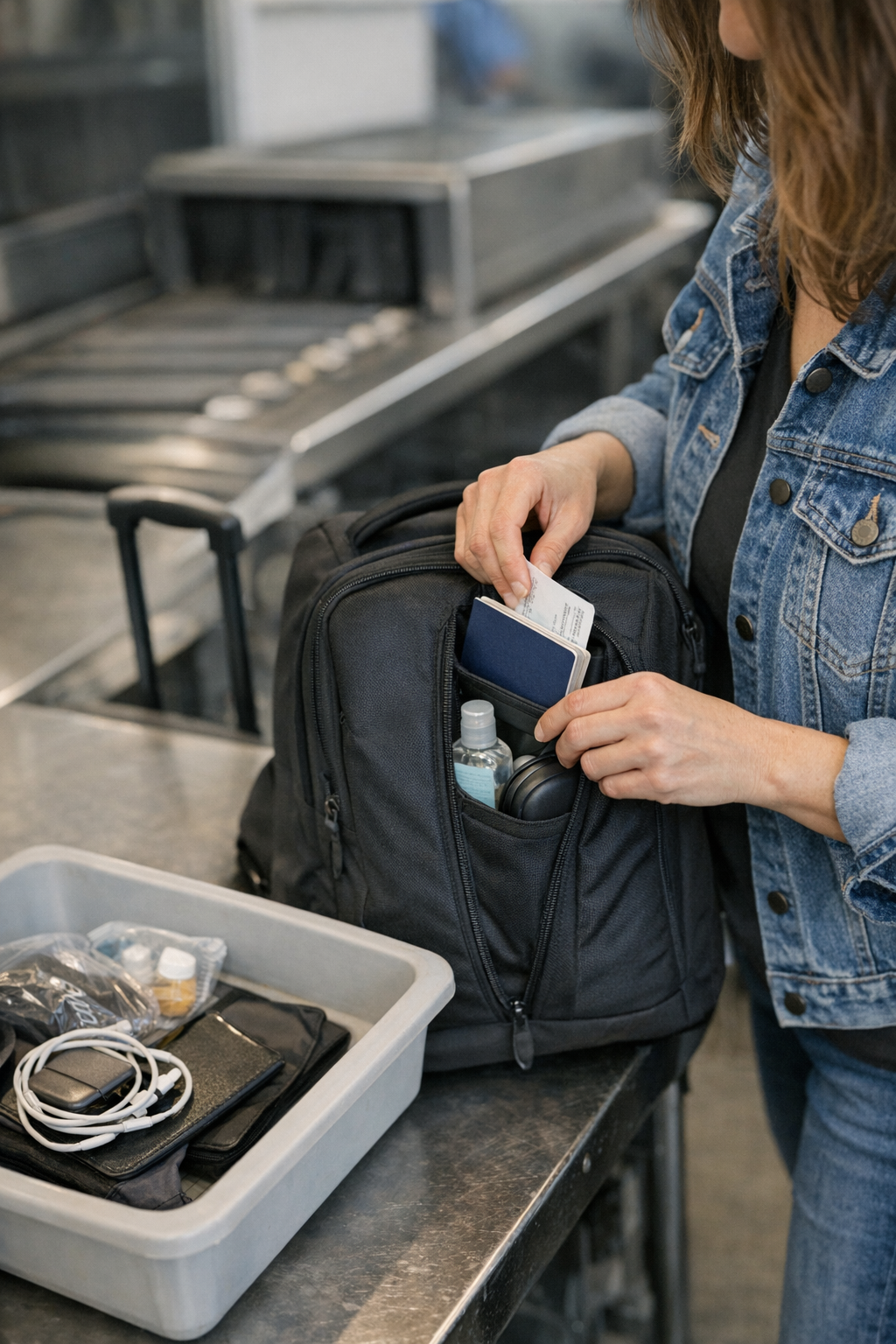
Every carry-on looks neat until you actually start moving through the airport. You pack your bag so everything has a place—passport zipped in, charger packed, headphones stowed. It appears under control while you’re standing still. But the real sorting test hits at the security checkpoint, in a boarding crowd, or squeezed into an airplane row. That’s when once-tidy pouches get in your way, quick access turns into a hidden search, and your smooth start collapses into delays. The difference between “organized” and “operational” isn’t visible on your hotel bed; it’s felt the third time you reach for the same essential and find it buried again. The layout that survives isn’t the prettiest—it’s the one that moves at airport speed.
When “Organized” Isn’t Enough: Carry-On Friction in Real Use
Most travel friction isn’t obvious clutter—it’s a bag designed to look sorted, yet bogging you down as you actually move. A sanitizing wipe slides over your boarding pass. A charger pouch swallows your passport. Headphones tangle, cables twist, and suddenly you’re two steps behind at the checkpoint, fumbling fast while the line advances. Friction isn’t about fitting more; it’s about stalling out when pressure hits. If your setup makes you unzip the same pocket twice or re-stack pouches to grab a document, you’re already losing time—and building up quiet frustration.
Movement Changes Everything: The True Test of Carry-On Setup
Carry-on layouts that look impressive “at rest” often fall apart in motion. The flattest packing and most layered organizer become liabilities the moment you need to grab a laptop at security, or reach for earphones in a cramped seat. What began as a 10-second retrieval becomes a tray-top mini-chaos: wrong pouch first, charger detour, cable drop, unplanned repack while elbows are tight and the line waits. Even a neatly zipped pouch system turns into a repeated repack ritual if every item’s stacked behind something else. Perfection fades when routines repeat.
Real-Life Moment: The Layered Organizer Letdown
You set up a mesh organizer with labeled sleeves, tight closures, and elastic bands. It looks dialed in. But on the plane, reaching for a simple e-reader drags out spare cables, lens cloth, and “just-in-case” meds—now scattered on your tray table. Before coffee service, you’re hurrying to restore order. This choreography was never visible in the packing photo, but in flight, it costs you time and adds one more task to a cramped routine.
Speed and Separation: What Frequent Flyers Do Differently
Seasoned travelers aren’t obsessed with “max packing.” They pay attention to vertical external pockets and real item separation for essentials—passport, sanitizer, boarding pass—each with its own upright home. No more burying travel docs under pouches or wedging headphones at the bottom. The upside becomes clear during real choke points: lined up for boarding, standing at security, or moving fast as overhead bins fill. A single-motion reach replaces the old slow stack-and-search, especially where travel flow punishes hesitation.
Not Just for Show: How Pocket Placement Plays Out
Directly moving documents and cables into a vertical front pocket shaves time every time. You reach forward, not down and behind. Boarding passes stop slipping into pouch gaps. Each movement returns the same way: up front, one reach, one return, no detour behind zipped tech pouches or hidden sanitizer. The pattern turns a potential traffic jam into a barely-noticed step, even in a rush. The structure edits the chaos out of your route.
Hidden Slowdowns: When “Tidy” Masks Travel Trouble
The trap is real: “Tidy” rarely equals “ready.” Your carry-on looks calm before you leave, but friction shows up at every forced pause. Overstuffed mesh sleeves make every grab harder. Deep, catch-all pouches force you to dig past tangled extras. When travel picks up, each retrieval means shifting or dropping something that shouldn’t have been touched in the first place. There’s no time buffer when a crowd surges at the gate or your seatmate blocks quick access. Each wasted second feels heavier the more often you repeat the cycle—and by your return leg, minor delays have multiplied into low-level travel fatigue.
A packed-tight organizer, praised in theory for “order,” now means extra layers to unpack and reassemble. Even if you don’t lose items, you keep repeating the same delayed motion until the return trip feels like a chore. True travel readiness means friction drops and essentials move with you, not against you, at the pace of the journey, not just the packing plan.
Real Carry-On Problems: Scene by Scene
Document Roulette in Security Lines
The first pause is small—passport wedged behind a sanitizer. By the third pause, tension is up: sorting through repeat layers mid-queue, unlocking a pocket with one hand while the line compresses behind. With documents always up front—separated, vertical—you flow right through. Miss that, and each retrieval becomes a replay of the last trip’s error, burning seconds when movement matters most.
Tray Transfer and the “Wrong Pouch First” Routine
That critical “tray transfer” moment—pulling out a laptop or tech—shows how wrong pocket order costs time. You reach for one pouch, get the wrong item, land in a half-unpacked shuffle, repack, and then repeat with something left on the plastic tray. Crowded security? That’s when you realize your sorting system relies on stillness, not speed. Every missed grab means running behind as trays stack up and staff nudge you forward.
Seat Entry and Overhead Bin Hurdles
Inside a packed aisle, tight layouts break. You need headphones or meds from the lower pocket, but layers are compressed. Now you’re balancing your bag in cramped space, opening wide just to pull one thing, and struggling to repack cleanly before a row fills or the overhead closes. Functional setups keep essentials accessible even during narrow entries or awkward repacking—reducing the repeated hassle that a “perfect” packing job introduces in motion.
The Repeated-Use Difference: Small Choices, Big Impact
What actually makes a carry-on functional? Not elaborate mesh or tightest fit, but structure that stands up to motion and pressure. A high-utility setup comes from:
- External vertical pockets—for one-move handoffs, especially at trays and gates
- Sharp separation of comfort and document items—so you never trigger accidental repacking
- Consistent pocket logic—same move each time builds real travel rhythm
With every trip, the contrast sharpens: a well-designed carry-on shrinks your reset time whenever bags open and close under stress. “Looks organized” is useless if it extends the same interruptions from check-in to boarding, over and over. The setups that survive are the ones that don’t force repeated “fixes”—just one movement, every cycle, every line, every seat change.
Does Tighter Packing Always Help?
Real use proves it: compression is often the enemy. The more tightly you squeeze things, the worse your access—layers slide, items stick, and chargers hide behind repacked pouches. By the last leg of your trip, the cost of digging out one cable or finding snacks has added up. Static neatness hides weaknesses that only travel exposes.
Travel That Moves with You
Every carry-on setup looks good when undisturbed. The real dividing line is how it handles repeated access, movement, and crowd pressure. Upright pockets, clear separation, and predictable retrieval flow aren’t about aesthetic—they cut down distraction, reset, and hand friction across every checkpoint, aisle swing, and repack. You don’t need magical order. You need travel that interrupts you less. The next time you pack, ask: where does wasted motion actually appear, and which setup will survive five real retrievals—not just the first one?
Ready to reset your carry-on for real-world ease? Visit CarryOnSupply for practical travel tools designed for movement, not just order.