
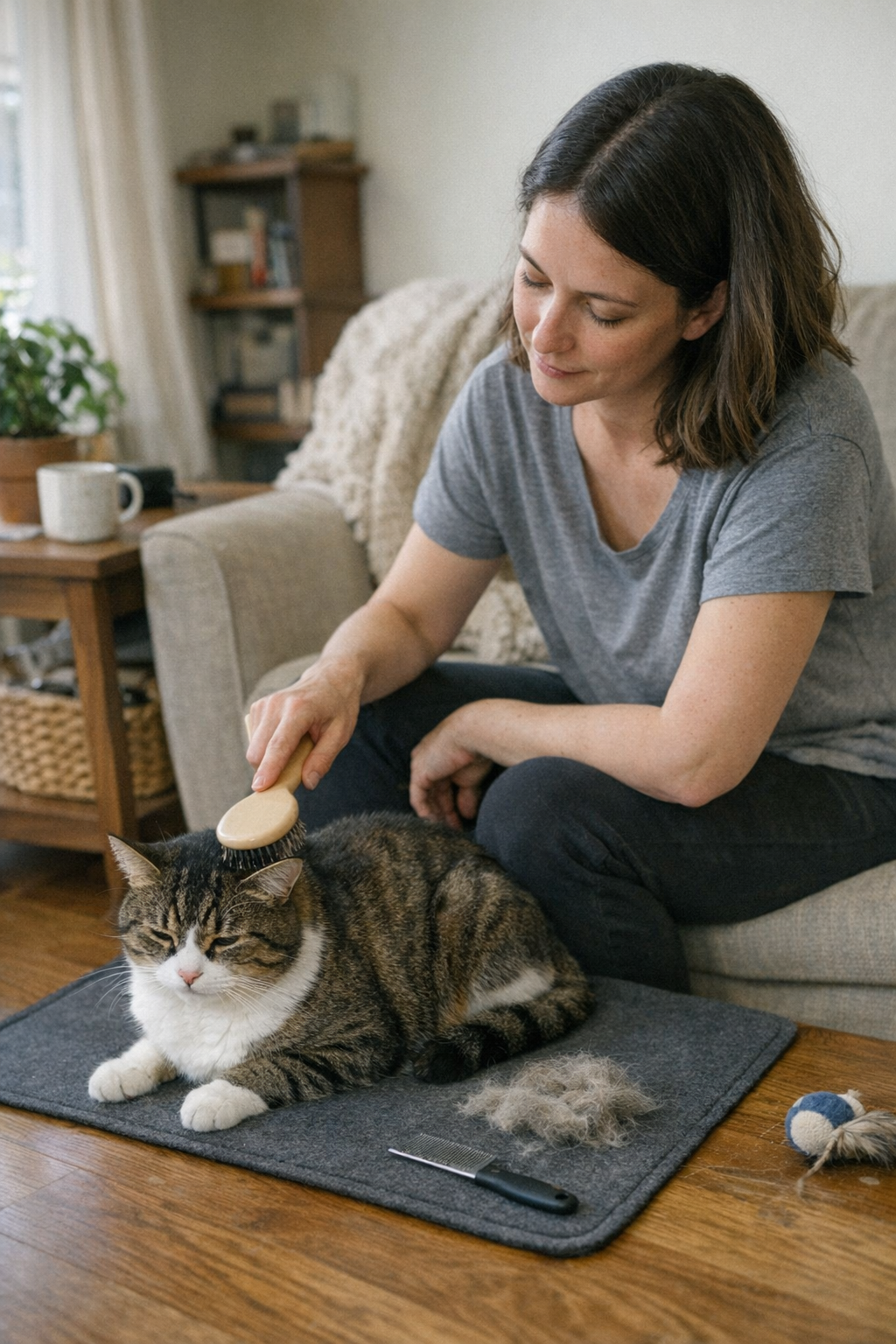
Every indoor cat owner sooner or later runs into the same snag: grooming setups that look organized, but break down during real, repeated use. The friction shows up faster than expected—a calm session on the mat turns tense when you need to swap brushes, and suddenly your cat ducks out, leaving half their coat unfinished and loose fur drifting across the floor. What seemed like a controlled routine quickly becomes a round of chasing down missed fur, searching for the right tool, or trying to lure your cat back after a fumbled reset. If this keeps happening in your space, the weak point probably isn’t cleaning skill or laziness—it’s that the setup doesn’t stand up to the everyday shifts, mess, and interruptions that indoor life brings. StillWhisker exists for exactly this: the difference between setups that just look sorted, and setups that actually hold up after the third, tenth, or thirtieth real run-through.
The Trap of Tidy Grooming Spaces That Don’t Hold Up
A neat stack of brushes, a spotless mat, a matching grooming basket—these seem like signs of a fixed routine. For the first session or two, the illusion holds. But very quickly, friction leaks back in. The visual order breaks down the moment you need to change tools—especially for indoor cats who notice the smallest changes in scent, texture, or position.
The moment you grab for a different brush, the system slips. Your cat, now alert, pauses or slips off. You’re left mid-session negotiating with a cat that remembers disruptions, and fur has already slipped off the mat and under a chair. “Organized” doesn’t mean “less hassle” if every real run-through reveals small resets, tool searches, or moves your cat reads as stress signals. Even tightly packed grooming corners crumble if the routine itself makes cat and owner start over every time.
Why Tool-Switching Creates Grooming Friction—And More Mess
Rotating brushes or swapping in “just washed” tools seems like variety, but for your cat, every switch is a disruption. Each new brush brings a strange texture, grip, or scent. Suddenly, what feels like “choice” for you adds “uncertainty” for them. Small shifts—an unexpected bristle, a missed scent—become reasons for your cat to hesitate, scoot back, or leave altogether.
That’s when the trouble accumulates. Sessions get cut short. The mat’s clean edge no longer contains the fur, which turns up at the rug, under tables, or even scattered well outside the grooming corner. Instead of grooming being a single, contained flow, it splinters into searching: hunting for tools, coaxing your cat back, then trying to catch up on cleaning fur trails across the rest of your floor. These are the real costs hiding behind a tidy starter setup.
One Familiar Tool: More Predictable Sessions, Less Post-Grooming Cleanup
The move that actually makes routines hold up? Stick to a single, familiar grooming brush—same touch, same scent, always in reach. When there’s no switch mid-session, your cat settles faster and stays longer. The routine feels familiar; you get fewer darting exits, fewer episodes of scattered fur, and more sessions that end with an actually brushed cat, not just the easy half finished.
The result is easier to see around the mat. Stick with the same tool, and stray hair barely leaves the boundary. Post-grooming, there’s no running under the couch with lint rollers or hunting for missed clumps at the far edge of the room. Cleanup resets to a single step—fold the mat, quick-wash the brush, move on—instead of ballooning into another thirty-minute side project. The right tool, kept reachable, keeps the mess trapped, and keeps the process background, rather than a recurring main event.
Real-World Example: The Brush Goes Missing, the Routine Stalls
It’s evening—you set out the usual mat, ready to brush, but the familiar tool’s gone. There’s two backups in the drawer, neither quite right. You grab the “close-enough” brush, but on the first stroke your cat stiffens and bails. Fur’s now loose on the mat, trailing into corners. You finally find the original brush, but your cat’s on guard, and you know you’ll have to coax them back later—if they even let you. The alternate tool slowed you down, scattered the mess, and made what looked like a simple reset into a drawn-out task you’ll feel again under bare feet tomorrow.
“Organized” Stations Can Hide Repeated Reset Trouble
Many cat owners take pride in a well-sorted grooming nook—brushes stacked by type, everything tidy in a basket, mat by the chair. But here’s where the friction creeps in: if you reach for an alternate tool just because it’s there, or the preferred brush winds up behind a pile of towels, the entire space becomes a stage for workarounds. Sessions drag when you spend more time searching for gear than brushing or keeping a wary cat from slipping away. The grooming area looks pristine at a glance, but fails when you try to move fast or keep the flow going for two sessions in a row.
The lesson? Shelf order isn’t function. An area that “looks” fixed still leaves you chasing hair trails or scrambling for the proper brush. Less mess on the shelf can mean more trouble across the rest of your house.
The Mat Boundary: Why Grooming Flow Has to Contain the Mess
Even a perfectly-placed mat is nearly useless if fur routinely escapes the first few minutes in. A routine that constantly pauses or derails—whether from a tool swap or a shifting cat—guarantees stray hair will scatter where it’s hardest to clean up. Fur under the edge of the rug, around table legs, or in the spot you’re about to use next is usually a sign that consistency broke down, not just that your cat sheds more. Losing track of the tool or having to dig out a replacement mid-brush throws the predictable flow out the window—leaving you with unfinished fur, a cat that comes back slower, and a recurring cycle of “catch-up” cleaning to make up for small interruptions.
Commit to one brush and one spot, and you’ll see more sessions where all the fur stays put, your cat actually returns willingly next time, and yesterday’s cleaning job isn’t undone by a fresh trail. The difference isn’t theory—you’ll spot it in how much less fur drifts out, and how much less you resent the reset after each session.
Practical Observation: Cleanup Supplies Matter, But Routine Wins
Stashing wipes or lint rollers nearby does help, but you’ll still find the main mess isn’t from missed cat spots—it’s from routine breakdowns that spill fur into the next room. If the flow stays tight, cleanup is a minor step. If it breaks even once—a missing tool, a switched brush, a lost rhythm—suddenly you’re chasing fur you never meant to let loose. The wipes feel too far away not because the supplies moved, but because the routine itself got interrupted.
How Cats Read Scent, Texture, and Routine Faster Than You Do
Indoor cats pick up on changes much faster than we do. Even a slightly different brush grip, a new washing scent, or a shifted grooming mat is enough for them to pause or pull back. The first sweep of a swapped-in tool brings hesitation—and that means more exit attempts, more partial grooming, and more fur carried off into shared living space. Noticing this pattern means less time wondering why it keeps happening, more time stopping the cycle at its actual source.
Shifting the grooming area only adds to the uncertainty. What feels like a convenient move to you can reset your cat’s comfort level to zero. The breakdown spreads—first to the session, then to your living space as fur turns up in new places every time.
Keeping the Structure Predictable: One Brush, One Spot, Quick Reset
The grooming setups that last are almost always the most boring: single brush, same place, same reset routine. It isn’t fashionable, but it’s the one pattern that cats and owners both settle into. The reliable tool stays visible, freshly cleaned, and always within arm’s reach—ready to use before your cat rethinks their plan. When you put effort into consistency instead of variety, you get fewer interruptions, more finished coats, and dramatically less post-session mess.
After each use, a quick wash clears the brush, and you’re immediately set for the next time. The background work shrinks back to a footnote instead of a full reset. Instead of chasing yesterday’s fur, you move straight to actual care.
When Setup Looks Fixed But Still Interrupts Your Day
It’s easy to end up with a setup that appears resolved—a brush always laid out, a mat aligned near a corner—but still drags at the margins. Maybe the brush is “accessible” but half-tucked under a chair leg, so you hesitate to grab it before work. Maybe the mat needs to be shaken out in the hallway, adding steps you didn’t count on. The obstacle isn’t always obvious; it’s the two-second delay, the hidden tool, or the reset that spirals when one piece isn’t predictable—or immediately reachable—at the moment you need it.
The real fix comes from spotting and solving that specific weak point