
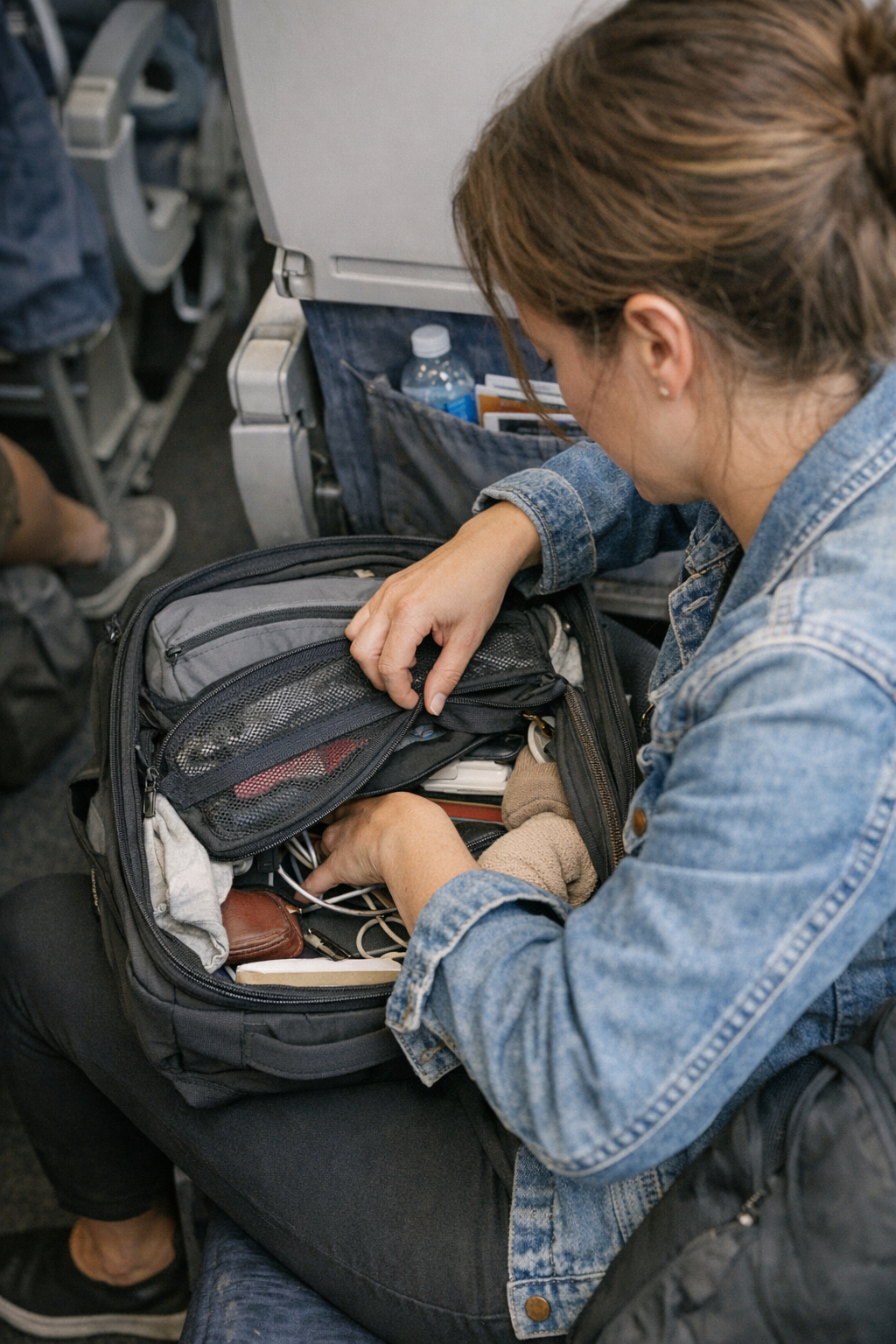
An organized carry-on isn’t truly “ready” until it can keep up with you in real airports, boarding lines, and cramped seats—when quick access matters most. That neat, compartmentalized layout you perfected on the hotel bed can backfire the instant you’re shoulder-to-shoulder at the gate or reaching for your passport while pushed along by the boarding queue. What looks orderly at rest can become a source of slow-down and missed moments in motion—especially the second or third time you need to dig for headphones, documents, or a charger before your row shuffles past.
The Hidden Friction Behind a “Tidy” Carry-On
Perfectly aligned pouches and maxed-out pockets sell a feeling of control. But that “hotel neat” reveals its cost at security and on the plane. Each extra layer, nested pouch, or tightly-packed cube inserts a small pause: unzip, sift, half-unpack—just to retrieve a high-use item. No amount of careful folding changes the reality that if your passport slides under organizers, or your charger blends into a web of cubes, you slow down each time access is needed.
This is not a theoretical complaint. If you’ve stood at a scanning tray awkwardly hunting for ID or felt boarding pressure as you shuffle half your bag to find a travel document, the tradeoff becomes obvious fast. Those small holdups do not “even out” later; they add up with every checkpoint and seat change, turning neatness into repeat interruption.
Cramped Space and Repeated Reach: Where Things Fall Apart
The real test of a carry-on layout is how it behaves after hours in the system: five security checks, three different gate lines, or two unpredictable flights. Weakness shows when you twist in a crowded aisle to find your cable, only for it to surface tangled beneath the headphones that looked fine together during packing—but now block the only open zipper.
Fast-forward to a boarding group lineup—one hand dragging your wheelie, the other scrabbling for your boarding pass. If that single high-frequency item lives under a stack, or requires undoing two layers of pouches, every stop piles on a sense of friction. Try it across several flight legs and watch as small inconveniences compound: wrong pouch on the first try, repeated shuffling, and the nagging sense your system is working against you.
Typical Scenario: The Mid-Flight Retrieval Trap
Cruise altitude, seatbelt sign off—you want your glasses, but they’re in a zipped organizer buried under two others. Cabin lights are dim, both neighbors deep in Netflix, and your carefully planned compartments suddenly force a lap-load shuffle. Each attempt means elbows near strangers and cold glances as you disturb the row. What starts as “organized” quickly becomes disruptive, proving the real cost isn’t mess—it’s the repeated, comfort-draining pause every time you reach for what should be instantly available.
Why Full Use of Every Cubic Inch Isn’t Always Your Friend
The urge to leverage every internal pocket is strong. Organizer loyalists fill every slip and sleeve, believing more structure equals more efficiency. But the tighter the fit, the slower the access. If your top-use essentials—passport, sanitizer, charger, earbuds—don’t live in a quick-grab spot, the friction shows up on every reach.
Travel routines rarely stick to plan. After takeoff, you realize your phone charger is locked up in a main compartment under toiletry kits and cables. At descent, you need your ID but it’s in the bottom layer, and the clock’s ticking. Now you have a choice: uncork the entire bag in a tight seat, or do without. That “all packed away” look does nothing for in-transit flow, and the more flights you string together, the more these little failures make you question the system.
A Practical Shift: Dedicated Pockets for Repeat-Use Essentials
Too many sluggish retrievals make the case for a dedicated, obstruction-free pocket impossible to ignore. The outer or top section—reserved only for your highest-frequency use—changes the rhythm: one zipper, nothing stacked in front, no re-arranging required. No matter the routine shift—boarding, landing, tray tables up or down—your essentials ride in a single-use pocket. Reach, retrieve, repack: each action mirrors the last, cutting repacking drag to a minimum.
Over several flights, this single change becomes visible: no more spreading pouches across the tray, no second-guessing where things landed after a rush, no frustration-tinted laps as you try to repack between service carts. Access and return merge into one motion—no “hack,” just less interruption and less stress looped through every segment of the trip.
Real Use: Recognizing—and Fixing—Repeated Weak Points
Each airport trek and seat shuffle diagnoses your setup. If you spot yourself repacking after every minor access, or hunting through two wrong pockets before hitting the right one, your layout is hiding avoidable obstacles. Rework it: separate the must-grab items, keep them at the very top or in their own dedicated side. Let real use—not static organization—dictate what stays within reach. Every routine flight becomes a field test: what slows you down signals where friction still hides.
Movement Happens—Comfort Follows Smart Access
Visual neatness guarantees nothing once you enter the airport’s push-pull flow. If you lose sight of your documents mid-security, or still dig for earplugs on every trip, there’s a structural flaw—not just a bad packing day. Your comfort relies on removing overlap and access-fighting layers, so your bag flexes with actual movement, not idealized order. Travel smoothness comes not from focusing on the “perfect pack,” but from cutting out those tiny, constant stops that slow you between gates.
To find tools and organizers designed for repeat-access and real travel movement, visit CarryOnSupply.